Best Dutch Oven Brands
Last updated: February 23, 2026
Key Takeaways
- Le Creuset and Staub remain the top premium Best Dutch Oven Brands in 2026, with Le Creuset celebrating its 100th anniversary and Staub offering superior moisture retention through its self-basting lid.
- Lodge provides the best value for most home bakers, though its USA Enamel line is being discontinued — grab one while stock lasts.
- Made In fills the gap between budget and premium at roughly half the price of Le Creuset, with professional-grade performance.
- Enameled cast iron is the best choice for bread baking because it doesn’t require seasoning and delivers consistent, even heat.
- A quality Dutch oven is a multi-generational kitchen investment that handles bread baking, slow cooking, braising, frying, and one-pot meals.
Quick Answer
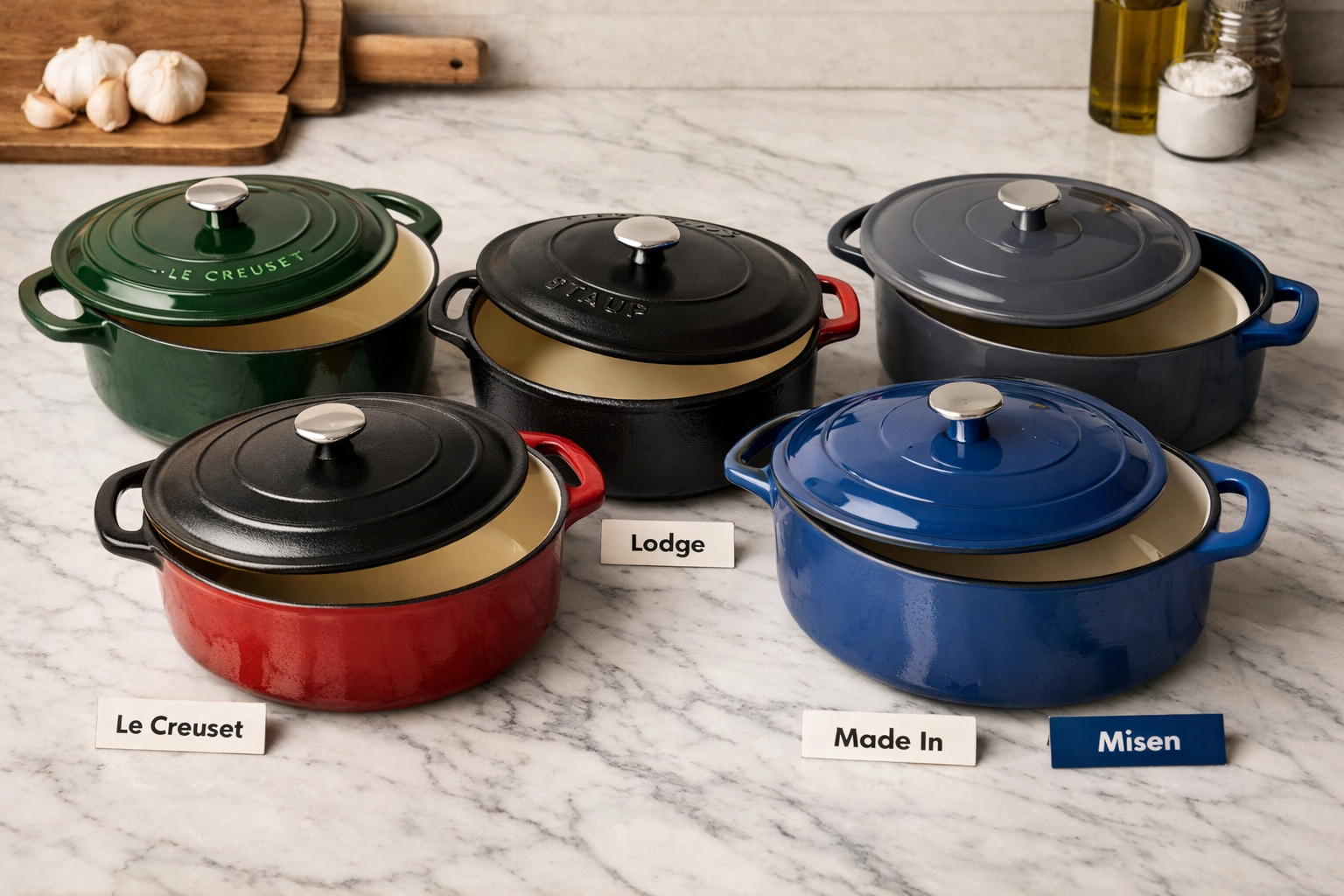
The Best Dutch Oven Brands in 2026 are Le Creuset (best overall), Staub (best for advanced bakers and braising), Lodge (best budget pick), Made In (best mid-range), and Misen (best for small kitchens).
For baking lovers specifically, an enameled cast iron Dutch oven between 5 and 7 quarts offers the most flexibility — it goes from stovetop to oven, produces bakery-quality bread crusts, and lasts decades with basic care.
Click for Latest Prices and Availability
What Is a Dutch Oven and Why Do Bakers Need One?
A Dutch oven is a heavy, thick-walled cooking pot with a tight-fitting lid, traditionally made from cast iron or enameled cast iron. It functions as a miniature bread oven inside your home oven, trapping steam to create the crispy, crackling crusts that baking lovers chase.
Why it matters for bakers: When you bake bread in a Dutch oven, the sealed lid traps moisture released from the dough during the first 15-20 minutes of baking. This steam keeps the crust pliable long enough for the bread to fully expand (called “oven spring”) before it sets into a golden, shattering crust. Without a Dutch oven, achieving this effect at home requires complicated steam injection setups.
Beyond bread baking, a Dutch oven is a genuinely versatile cooking pot. It handles:
- Braising and slow cooking — beef stew, short ribs, coq au vin
- Deep frying — the heavy walls maintain stable oil temperatures
- Soups and chili — even cooking prevents hot spots and scorching
- Roasting — whole chickens, vegetables, one-pot meals
- Desserts — cobblers, crisps, and even cakes
A single Dutch oven can replace several pieces of kitchen cookware. If you’re building a collection of durable cookware for your kitchen, a Dutch oven should be one of the first purchases.
Which Are the Best Dutch Oven Brands in 2026?
Le Creuset, Staub, Lodge, Made In, and Misen are the top-performing Dutch oven brands based on expert testing, durability, heat retention, and value. Here’s how they compare:
| Brand | Country | Price Range (5.5-6 qt) | Oven Safe To | Interior Enamel | Best For |
|---|---|---|---|---|---|
| Le Creuset | France | $420–$500 | 500°F | Light (sand) | Overall quality, beginners, bread baking |
| Staub | France | $350–$450 | 500°F | Black matte | Braising, moisture retention, advanced cooks |
| Lodge | USA | $80–$150 | 500°F | Light cream | Budget-conscious bakers, everyday cooking |
| Made In | USA-designed | $269 | 580°F | Light | Mid-range value, high-heat baking |
| Misen | USA-designed | $259 | 500°F | Light | Small kitchens (2-in-1 grill lid) |
Le Creuset — Best Overall Dutch Oven Brand
Le Creuset has manufactured enameled cast iron in Fresnoy-le-Grand, France, since 1925. In 2026, the brand is celebrating its 100th anniversary with a 20-piece color collection, including a new deep green shade called “Forêt” available across its signature Dutch oven line.
Why bakers choose it: The light-colored interior enamel makes it easy to monitor browning, critical when you’re checking the bottom of a sourdough loaf. The enamel is smooth and non-reactive, so acidic ingredients (tomato sauces, fruit fillings) won’t interact with the iron. Expert testing consistently rates Le Creuset’s enamel durability as best-in-class, with minimal chipping even after years of use.
The tradeoff: Price. A 5.5-quart Signature Round Dutch Oven runs $420-$500 at retail. That said, Le Creuset offers a limited lifetime warranty, and many families pass these pots down through generations — the cost-per-use drops dramatically over 20+ years.
Staub — Best for Serious Bakers and Braising
Staub, also French-made, competes directly with Le Creuset but takes a different design approach. Its self-basting lid features small spikes on the underside that continuously drip condensation back onto food, creating exceptional moisture retention.
Why bakers choose it: The black matte interior enamel develops a natural patina over time that improves non-stick performance. Staub’s thick 4mm walls provide outstanding heat retention and even cooking, producing consistent results for bread baking and slow cooking. Professional chefs often prefer Staub for its superior browning capabilities.
The tradeoff: The dark interior makes it harder to see fond (browned bits) developing, and the pot is slightly heavier than Le Creuset at comparable sizes.
Lodge Cast Iron — Best Budget Dutch Oven Brand
Lodge has been manufacturing cast iron cookware in South Pittsburg, Tennessee, since 1896. The brand offers both traditional seasoned cast iron Dutch ovens and enameled versions.
Important 2026 update: Lodge is discontinuing its USA Enamel Dutch Oven line. Once current inventory sells out, these American-made enameled models may not be produced again. The Lodge Enameled Cast Iron Essential Dutch Oven (6-quart, approximately $100) remains available and offers exceptional value.
Why bakers choose it: Lodge delivers roughly 80% of the performance of premium brands at 20-25% of the price. Heat retention is excellent. For bakers who want to try Dutch oven bread baking without a $400+ commitment, Lodge is the obvious starting point.
The tradeoff: Enamel durability isn’t as strong as Le Creuset or Staub. Some users report chipping with heavy long-term use. The fit and finish is less refined, you may notice minor imperfections in the enamel coating.
For a deeper look at Lodge’s seasoning process and bare cast iron care, check out this cast iron seasoning guide.
Made In — Best Mid-Range Dutch Oven
Made In’s 5.5-quart Dutch oven at $269 bridges the gap between Lodge’s budget offerings and Le Creuset’s premium pricing. The brand has gained traction by offering professional-grade features, oven-safe to 580°F, a self-basting lid, and third-party testing confirming the cookware is free of PFAS, PFOA, lead, and cadmium.
Why bakers choose it: The higher temperature rating (580°F vs. 500°F for most competitors) gives bakers more flexibility for high-heat bread baking techniques. Build quality is genuinely close to the French brands.
Misen — Best for Small Kitchens
Misen’s 2-in-1 Dutch oven ($259 for 5.5 quarts) solves a real problem: kitchen storage. The lid doubles as a grill pan, effectively giving you two pieces of cookware in one. A 4-layer enamel coating resists chipping better than traditional single-dip enamel application.
The tradeoff: The grill lid adds over 6 pounds of weight, making this one of the heavier options. If you’re looking for cookware ideas that work in small kitchens, the dual-function design is worth considering despite the heft.
Emerging Alternative: Xtrema Ceramic Dutch Ovens
Xtrema all-ceramic Dutch ovens are gaining attention as a non-toxic alternative to cast iron. They’re lighter, microwave-safe, and dishwasher-safe — none of which apply to cast iron.
However, ceramic doesn’t retain heat as aggressively as cast iron, so bread baking results may differ. Learn more about ceramic cookware pros and cons before deciding.
How Do Enameled and Traditional Cast Iron Dutch Ovens Differ?
Click for Latest Prices and Availability
Enameled cast iron Dutch ovens have a glass-like coating fused to the iron, eliminating the need for seasoning. Traditional (bare) cast iron requires regular seasoning but develops a natural non-stick surface over time.
| Feature | Enameled Cast Iron | Traditional Cast Iron |
|---|---|---|
| Seasoning required | No | Yes, regularly |
| Reacts with acidic foods | No | Yes (tomatoes, wine, citrus) |
| Non-stick properties | Moderate | Improves with use |
| Maintenance | Wash with soap and water | Hand wash, dry immediately, re-oil |
| Color options | Many | Black/natural iron |
| Price | Higher | Lower |
| Best for bread baking | Yes — no flavor transfer | Yes — but may impart slight iron taste |
| Durability | Enamel can chip | Nearly indestructible |
Choose enameled if: You bake frequently with acidic ingredients, want low-maintenance cookware, or prefer a specific color aesthetic.
Choose traditional if: You want the lowest price, don’t mind the seasoning routine, and appreciate cookware that genuinely improves with decades of use. For seasoning guidance, see this complete cast iron seasoning guide.
What Are the Best Cooking Techniques for Dutch Ovens?
Dutch ovens excel at techniques that require steady, even heat and moisture control. Here are the most important methods for baking lovers:
No-Knead Artisan Bread Baking (Beginner)
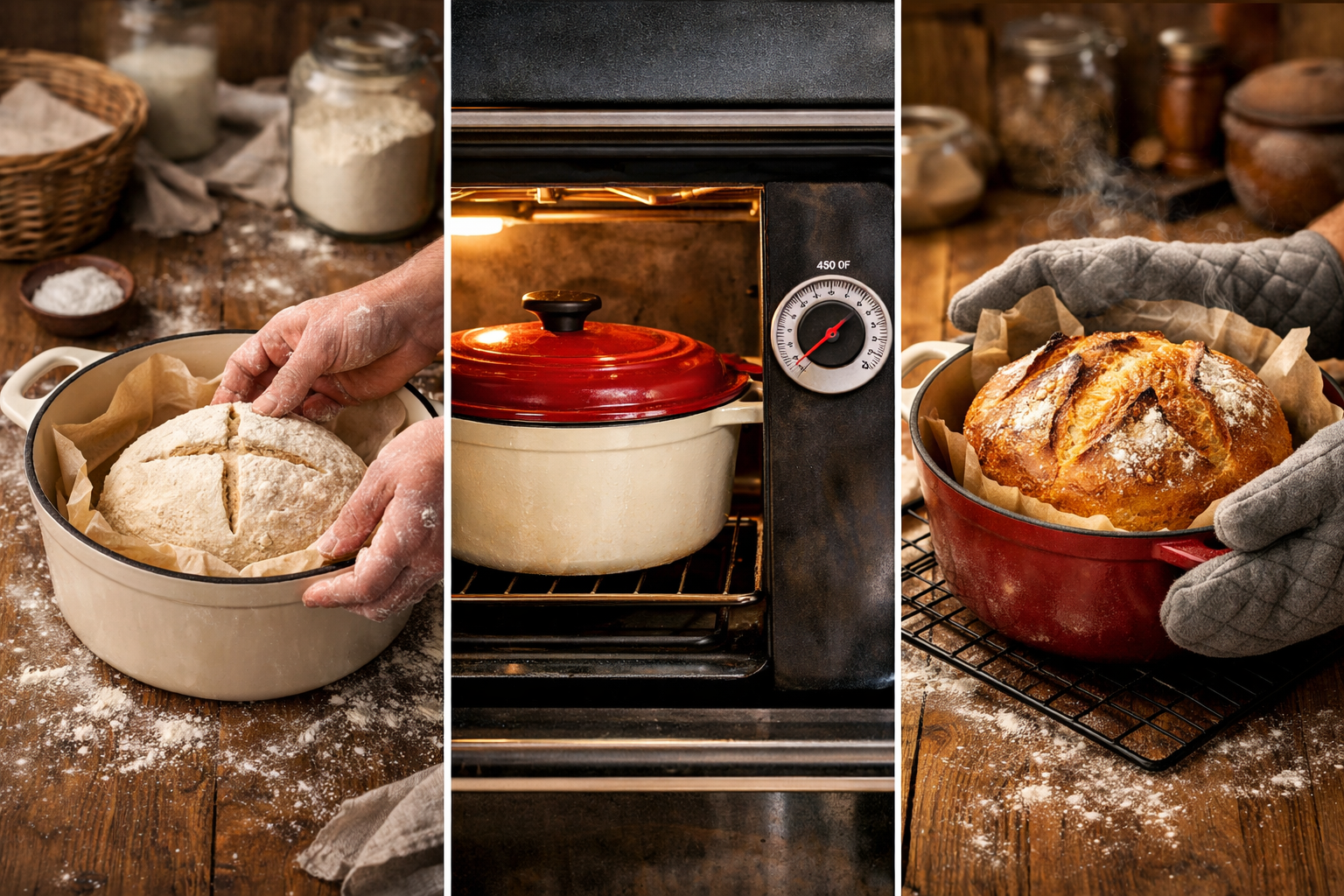
This is the technique that made Dutch oven bread baking mainstream. It requires minimal skill and produces bakery-quality results.
- Mix dough — flour, water, salt, and a small amount of yeast. No kneading required.
- Ferment — let the dough rise 12-18 hours at room temperature.
- Preheat — place the Dutch oven (with lid) in your oven at 450°F for 30 minutes.
- Shape and load — gently shape the dough and carefully lower it into the screaming-hot pot.
- Bake covered — 30 minutes with the lid on (steam phase).
- Bake uncovered — remove the lid and bake 15-20 more minutes until deep golden brown.
The result: a crackling crust with an open, airy crumb that rivals professional bakeries. If you’re also exploring sourdough, a proofing basket helps shape your loaves before they go into the Dutch oven.
Braising (Intermediate)
Braising is slow cooking meat or vegetables in a small amount of liquid inside a covered pot. The Dutch oven’s heavy lid and thick walls create a self-contained environment where flavors concentrate over hours.
- Sear the protein on the stovetop in the Dutch oven (high heat, 2-3 minutes per side).
- Build aromatics — sauté onions, garlic, and herbs in the same pot.
- Add liquid — broth, wine, or tomatoes, enough to come halfway up the protein.
- Cover and transfer to a 300-325°F oven for 2-4 hours.
Top 5 One-Pot Meals in a Dutch Oven
- Classic beef stew — chuck roast, root vegetables, red wine, herbs (3 hours at 325°F)
- Chicken and dumplings — whole chicken pieces braised in broth with drop dumplings added in the last 20 minutes
- French onion soup — caramelized onions, beef broth, topped with crusty bread and melted Gruyère
- Chili — ground beef or beans, tomatoes, spices, slow-cooked for deep flavor development
- Ratatouille — layered summer vegetables in tomato sauce, baked until tender
These one-pot meals showcase the Dutch oven as a truly versatile cooking pot that moves from stovetop to oven without switching vessels. For more on cookware that transitions between heat sources, see this oven-safe cookware guide.
How Should You Care for and Maintain a Dutch Oven?
Proper care extends a Dutch oven’s lifespan from years to generations. The approach differs based on whether you own enameled or traditional cast iron.
Enameled Cast Iron Care
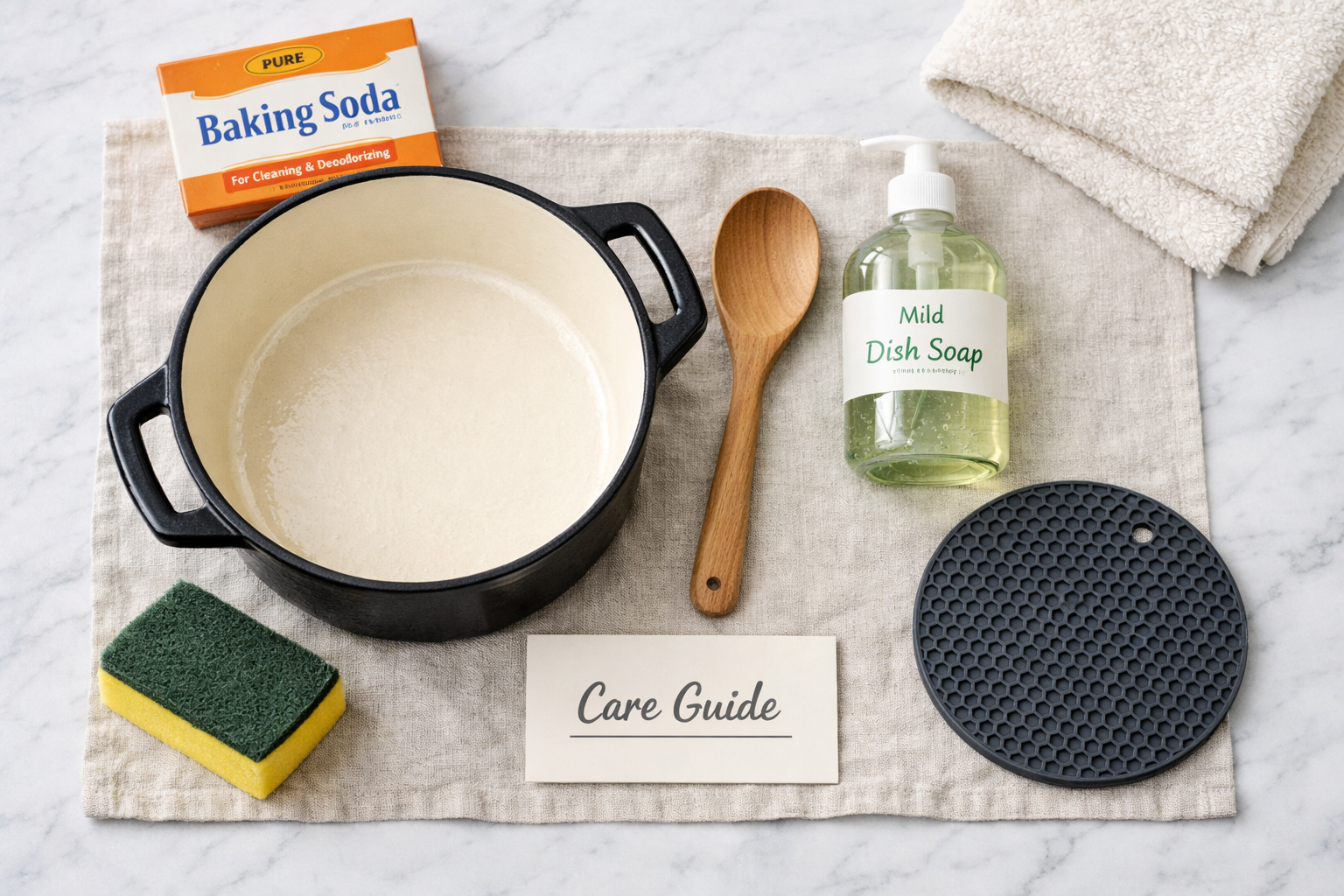
- Wash with warm water, mild dish soap, and a soft sponge after each use. Enameled cast iron is not the same as bare cast iron — soap is perfectly fine.
- Remove stuck food by filling the pot with warm water and a tablespoon of baking soda, then simmering for 10-15 minutes. Scrape gently with a wooden spoon.
- Avoid thermal shock — never plunge a hot Dutch oven into cold water. Let it cool gradually.
- Don’t use metal utensils on the enamel interior. Wooden, silicone, or nylon tools prevent scratching.
- Store with the lid slightly ajar or place a paper towel between the lid and pot to allow air circulation and prevent moisture buildup.
- Skip the dishwasher for premium brands — hand washing preserves the enamel finish longer.
Traditional Cast Iron Care
- Hand wash only — no soap (or very minimal soap). Hot water and a stiff brush work best.
- Dry immediately and thoroughly. Cast iron rusts quickly when left wet.
- Apply a thin layer of cooking oil after each wash and wipe with a paper towel.
- Re-season periodically by coating with a thin layer of flaxseed or vegetable oil and baking upside down at 450°F for one hour.
For more tips on keeping cookware in top condition, this guide on simple bakeware cleanup covers complementary techniques.
Common mistake: Using high heat on an empty enameled Dutch oven for extended periods. While preheating for bread baking is fine (and necessary), leaving an empty enameled pot on a high burner for more than a few minutes can damage the enamel coating. Always follow the manufacturer’s preheating guidelines.
Is a Premium Dutch Oven Worth the Investment?
Click for Latest Prices and Availability
Yes, for frequent bakers and cooks, but only if you’ll use it regularly. A $400+ Dutch oven used weekly for 20 years costs roughly $0.38 per use. A $100 Lodge used with the same frequency costs about $0.10 per use but may need replacement after 8-12 years of heavy use due to enamel wear.
Cost-Benefit Breakdown
| Scenario | Best Brand Choice | Estimated Cost | Expected Lifespan | Cost Per Year |
|---|---|---|---|---|
| Weekend baker, budget-conscious | Lodge | $80–$100 | 8-12 years | $8–$12 |
| Regular baker, wants quality | Made In | $269 | 15-20 years | $13–$18 |
| Daily cook, lifetime investment | Le Creuset or Staub | $350–$500 | 30+ years | $12–$17 |
The generational value angle: Le Creuset and Staub Dutch ovens routinely appear in estate sales and vintage shops still in working condition after 40-50 years.
Many families treat them as heirloom kitchen tools, passed from parent to child. This generational durability is part of what justifies the premium price, and it’s something no budget brand can currently match.
Choose a budget brand if: You’re new to Dutch oven cooking, bake occasionally, or want to test whether this style of cooking fits your routine before committing to a premium purchase.
Choose a premium brand if: You cook or bake multiple times per week, value cookware aesthetics, want a lifetime warranty, or plan to pass the pot down to family.
For a broader look at what to consider when selecting cookware, material quality and expected lifespan should always factor into the decision.
What About Sustainability and Health Considerations?
Cast iron Dutch ovens are among the most sustainable cookware options available. A single pot that lasts 30-50 years displaces multiple cheaper pots that end up in landfills. Both Le Creuset and Lodge manufacture using recycled iron in their foundries.
Environmental Impact
- Longevity reduces waste — one Dutch oven replaces 3-5 cheaper alternatives over a lifetime
- Recyclable material — cast iron is infinitely recyclable
- No chemical coatings — unlike some non-stick cookware, enameled cast iron uses a glass-based coating free of PTFE and PFOA
- Energy efficiency — excellent heat retention means lower energy consumption during slow cooking
Health Benefits of Cast Iron Cooking
Traditional (bare) cast iron cookware leaches small amounts of dietary iron into food, which can be beneficial for people with iron deficiency. Enameled cast iron doesn’t leach iron because the enamel barrier prevents contact between food and the iron substrate.
Both types are free of the synthetic chemicals found in some non-stick coatings. If non-toxic cookware is a priority, explore eco-friendly cookware options and cookware free of PFAS risks for additional guidance.
International Cooking Styles: Dutch Ovens Around the World
The Dutch oven isn’t just a Western kitchen essential. Variations of this heavy, lidded pot appear in cooking traditions worldwide:
- South Africa (Potjie): A three-legged cast iron pot used over open coals for layered stews where ingredients are added in stages and never stirred.
- Japan (Nabemono): Heavy pots used for communal hot pot cooking, where the Dutch oven’s heat retention keeps broth simmering at the table.
- Morocco (Tagine-style): While traditional tagines have conical lids, Dutch ovens replicate the slow-braising technique beautifully for Moroccan-spiced lamb and vegetable dishes.
- Australia (Camp Oven): Cast iron Dutch ovens with legs and a flanged lid for holding coals are a staple of outback cooking.
- France (Cocotte): Le Creuset and Staub are called “cocottes” in France, used daily for cassoulet, ratatouille, and coq au vin.
These global traditions underscore the Dutch oven’s role as a universal culinary tool, not just a piece of trendy kitchen cookware, but a fundamental cooking vessel that transcends cultures.
Conclusion: Choosing the Right Dutch Oven Brand
The best Dutch oven brand depends on how often you cook, what you’re willing to spend, and how long you want the pot to last.
For most baking lovers in 2026, here’s the decision framework:
- Start with Lodge if you’re testing the waters or baking bread occasionally. At under $100, the risk is minimal and the performance is strong.
- Step up to Made In ($269) if you want premium construction without the premium price tag, especially for high-heat bread baking.
- Invest in Le Creuset or Staub ($350-$500) if you cook daily, want a lifetime warranty, and view cookware as a long-term kitchen investment. Le Creuset’s new Forêt color and 100th-anniversary collection make 2026 a particularly interesting year to buy.
- Consider Misen if kitchen storage is tight and the 2-in-1 design appeals to you.
- Explore Xtrema if non-toxic ceramic construction is your top priority and you’re willing to trade some heat retention for lighter weight and easier cleanup.
No matter which brand you choose, a Dutch oven will become one of the most-used pieces in your kitchen. It bakes bread, braises meat, simmers soup, and fries chicken, all in a single, durable pot that can outlast every other piece of cookware you own.
Click for Latest Prices and Availability
Frequently Asked Questions
What size Dutch oven is best for bread baking?
A 5 to 6-quart round Dutch oven works best for standard artisan bread loaves. This size accommodates dough that uses 3-4 cups of flour while leaving enough room for oven spring. Oval shapes work for elongated loaves like batards.
Can I use a Dutch oven on a glass top stove?
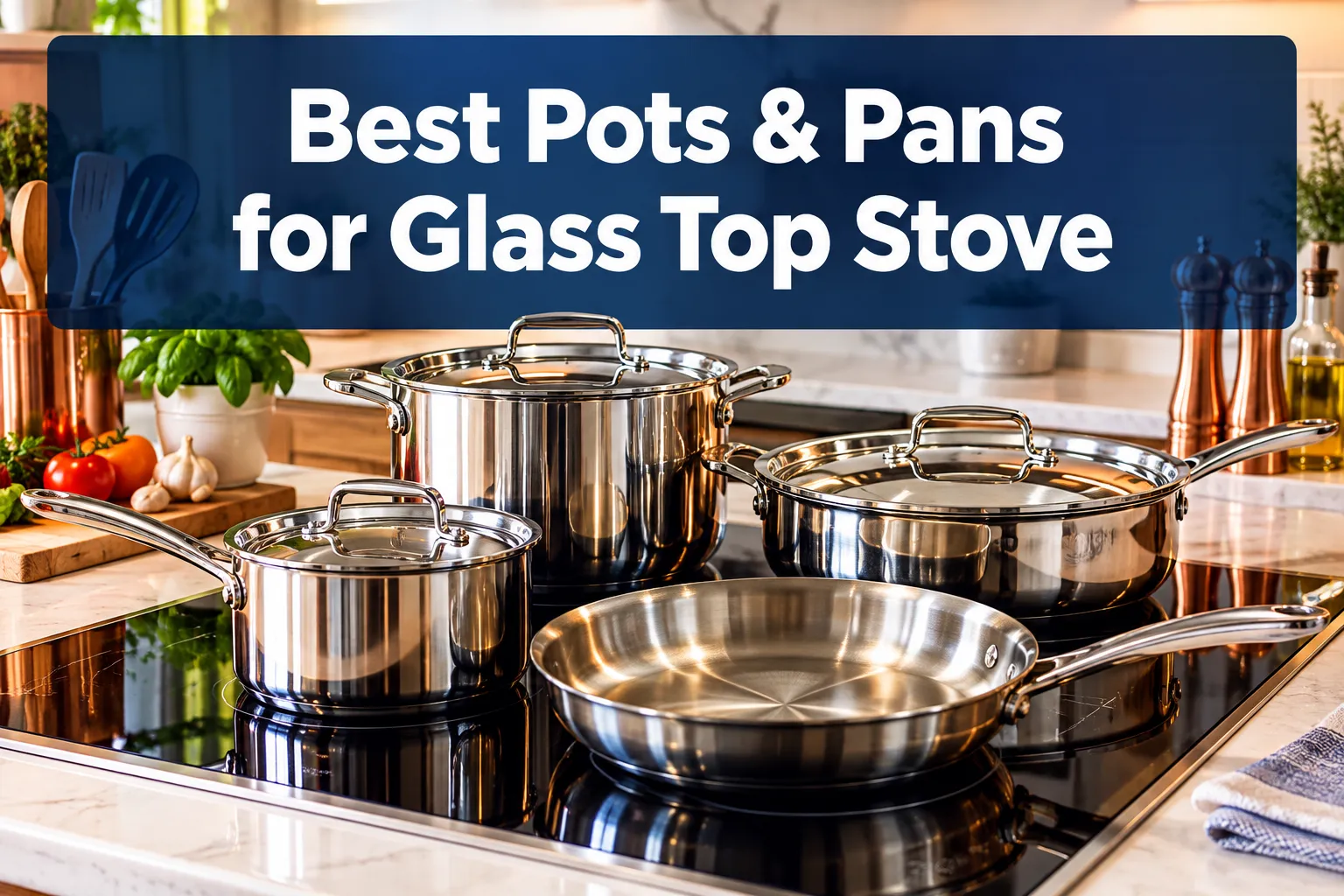
Yes, but lift it — don’t slide it. Cast iron can scratch glass cooktops. Place it gently and avoid dragging. For more guidance, see this cookware guide for glass top stoves.
How do I season a cast iron Dutch oven?
Wash the pot, dry it completely, apply a very thin layer of vegetable or flaxseed oil to all surfaces, place it upside down in a 450°F oven for one hour, then let it cool inside the oven. Repeat 2-3 times for a strong initial seasoning. Enameled Dutch ovens do not need seasoning.
What’s the difference between a Dutch oven and a cocotte?
They’re the same thing. “Cocotte” is the French term for a Dutch oven. Le Creuset and Staub use both terms interchangeably in their product lines.
Do Dutch ovens work on induction cooktops?
Yes. Cast iron (both enameled and traditional) is naturally magnetic and works on all induction cooktops without adapters.
Is Le Creuset really worth the price over Lodge?
Le Creuset offers superior enamel durability, more color options, a lifetime warranty, and better resale value. Lodge offers roughly 80% of the cooking performance at 20% of the price. The “worth it” calculation depends on frequency of use and personal budget.
Best Dutch Oven Brands: FAQs
Can I put a cold Dutch oven into a hot oven?
For enameled cast iron, it’s best to avoid extreme temperature changes. Place the Dutch oven in a cold oven and let them heat up together, or preheat the pot gradually. Bare cast iron handles thermal shock better but gradual heating is still recommended.
How heavy is a typical Dutch oven?
A 5.5-quart enameled cast iron Dutch oven weighs approximately 11-13 pounds empty. Le Creuset tends to be slightly lighter than Staub at comparable sizes. The Misen 2-in-1 with grill lid can exceed 17 pounds.
What can I cook in a Dutch oven besides bread?
Stews, braises, soups, chili, fried chicken, roasted vegetables, pasta sauces, cobblers, whole roasted chicken, rice dishes, and deep-fried foods. It’s one of the most versatile pieces of kitchen cookware available.
How long do Dutch ovens last?
Premium enameled brands (Le Creuset, Staub) can last 30-50+ years with proper care. Budget enameled brands typically last 8-15 years. Traditional bare cast iron, if maintained, can last indefinitely — some family pieces are over 100 years old.
Should I buy round or oval?
Round is more versatile for bread baking, soups, and stovetop use (better heat distribution on round burners). Oval works better for roasting whole chickens, long cuts of meat, or baking elongated bread loaves.
Are Dutch ovens safe for acidic foods like tomato sauce?
Enameled Dutch ovens are completely safe for acidic foods — the enamel creates a non-reactive barrier. Traditional bare cast iron can react with acidic ingredients, potentially imparting a metallic taste and degrading the seasoning layer. For long-simmered tomato sauces, enameled is the better choice.
Key Takeaways
- Le Creuset and Staub lead the premium Dutch oven market in 2026, with Le Creuset celebrating its centennial and Staub offering best-in-class moisture retention.
- Lodge remains the best value brand, but its USA Enamel line is being discontinued — buy now if interested.
- Made In offers the best balance of price and professional-grade performance at $269.
- Enameled cast iron is ideal for bread baking because it traps steam, distributes heat evenly, and requires no seasoning.
- A quality Dutch oven is a kitchen investment that pays for itself over years of daily use.
- Proper care (gentle washing, avoiding thermal shock, using non-metal utensils) extends lifespan dramatically.
- Cast iron Dutch ovens are among the most sustainable and health-conscious cookware choices available.
- Choose round shapes for bread baking and general cooking; oval for roasting and elongated loaves.
- The best brand for you depends on budget, cooking frequency, and how long you want the pot to last.