Best Bakeware For Cakes
Last updated: March 17, 2026
Quick Answer: The Best Bakeware For Cakes depends on three things: the material (aluminized steel conducts heat most evenly for most bakers), the coating (PFOA-free nonstick saves cleanup and protects release), and the size (9-inch rounds cover the widest range of standard recipes).
If you’re building a bakeware kit from scratch, start with a pair of 9-inch round pans in aluminized steel with a ceramic-reinforced nonstick coating, then expand from there.
Key Takeaways
- Aluminized steel is the most reliable material for even baking and long-term durability in home kitchens.
- PFOA-free nonstick coatings are the current safety standard; ceramic-reinforced versions tend to last longer than standard PTFE coatings.
- Pan size matters more than most bakers realize, a 9-inch pan and an 8-inch pan are not interchangeable without adjusting bake time and batter volume.
- Darker pans absorb more heat and can cause over-browning on the edges; lighter-colored pans give more control.
- Springform pans are essential for cheesecakes and delicate tortes but are not a substitute for standard round pans in layered cakes.
- Proper pan preparation (greasing, flouring, or parchment lining) matters as much as the pan itself for clean release.
- Budget-friendly pans can perform well if they’re made from quality materials, price alone doesn’t predict baking results.
- Warping is the most common failure point in cheap pans; look for reinforced rims or rolled edges as a sign of structural quality.
Why Cake Pan Choice Actually Affects Your Results
The pan you bake in directly influences how heat reaches your batter, how evenly the cake rises, and whether it releases cleanly. This isn’t a minor detail.
A thin, dark pan bakes the edges faster than the center, which causes doming, cracking, and uneven layers. A pan with poor nonstick coverage turns a beautiful cake into a frustrating demolition project.
And a pan that warps under oven heat will produce cakes that are thicker on one side — a real problem when you’re stacking layers.
For home bakers who want consistent, professional-looking results, understanding bakeware materials and construction is the single most practical investment of time before spending money on pans.
Quick Comparison: Cake Pan Types and Materials
| Pan Type | Best Material | Ideal Size | Nonstick Needed? | Best For |
|---|---|---|---|---|
| Round layer cake pan | Aluminized steel | 8″ or 9″ | Yes (PFOA-free) | Layer cakes, birthday cakes |
| Springform pan | Aluminized steel | 9″ or 10″ | Yes | Cheesecakes, tortes, mousse cakes |
| Bundt pan | Cast aluminum | 10–12 cup | Yes (heavy-duty) | Bundt cakes, pound cakes |
| Loaf pan | Aluminized steel | 9″x5″ | Optional | Pound cake, quick breads |
| Sheet/slab pan | Aluminized steel | Half-sheet | Optional | Sheet cakes, Swiss rolls |
| Tube pan / angel food | Uncoated aluminum | 10″ | No | Angel food, chiffon cakes |
Check Price and Availability on Amazon
What Cake Pan Materials Are Actually Worth Using?
Aluminized steel is the best all-around material for most home bakers. It heats evenly, resists warping better than pure aluminum, and holds a nonstick coating well. Pure aluminum is excellent for angel food and chiffon cakes (where you want the batter to grip the sides), but it reacts with acidic batters over time.
Here’s how the main materials compare:
Aluminized steel conducts heat efficiently and distributes it evenly across the pan surface. It’s more durable than bare aluminum and less prone to denting. Most professional-grade home bakeware uses this material.
Cast aluminum is heavier and retains heat longer, which works well for Bundt pans where you want the intricate surface to release cleanly. The extra mass helps the batter set in the details before the pan cools.
Nonstick-coated steel is common in budget pans. Quality varies widely. Look for ceramic-reinforced coatings or multi-layer PTFE coatings labeled PFOA-free. Thin single-layer coatings scratch easily and degrade within a year or two of regular use.
Glass and ceramic bakeware bakes more slowly and holds heat longer after leaving the oven, which can cause overbaking. These materials work better for casseroles and fruit crumbles than for precision layer cakes.
Silicone is flexible and releases cleanly, but it doesn’t conduct heat well enough for cakes that need a set crust or defined edge. It’s better suited to individual molds and novelty shapes than standard round pans.
For more on healthy, non-toxic bakeware options, see this guide to PFOA-free and PFAS-safe bakeware.
The 9-Inch Round Pan: The Workhorse of Cake Baking
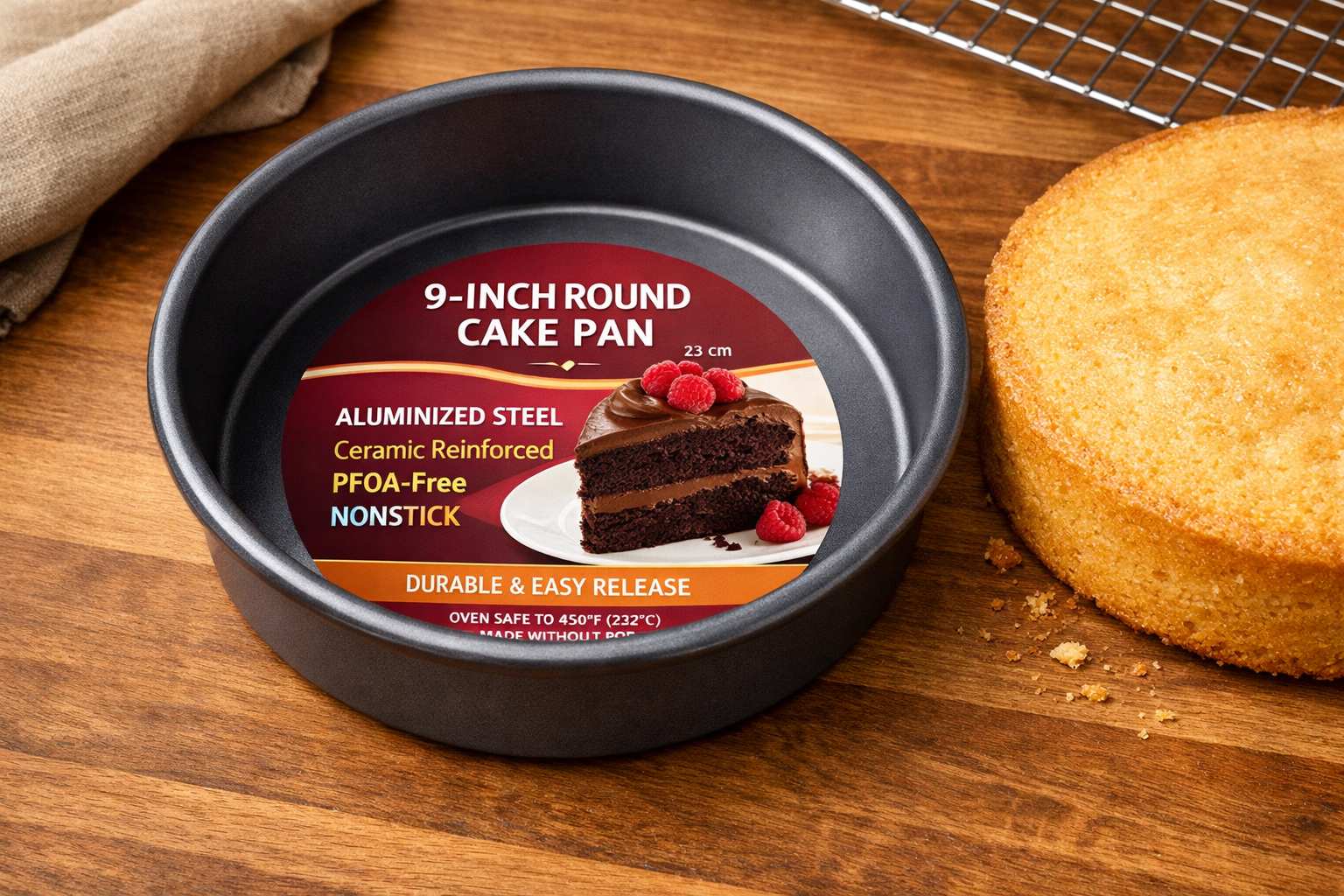
A 9-inch round aluminized steel pan with a ceramic-reinforced PFOA-free nonstick coating is the single best starting pan for most home bakers. It fits the majority of standard layer cake recipes, produces even layers, and cleans up easily.
Key Features to Look For in a Round Cake Pan
- Material: Aluminized steel (not thin carbon steel or coated tinplate)
- Coating: Ceramic-reinforced or multi-layer PTFE, explicitly labeled PFOA-free
- Color: Light to medium gray or silver — not dark black, which absorbs too much heat
- Rim: Rolled or reinforced edge to prevent warping
- Depth: At least 2 inches; 2.5 inches gives more flexibility with batter volume
- Straight sides: Tapered sides make stacking layers harder to level
Who This Type of Pan Is Best For
Professional home bakers, frequent entertainers, and anyone who bakes layer cakes more than a few times a year. A pair of 9-inch rounds is the foundation of a functional bakeware collection.
✅ Pros of aluminized steel round pans:
- Even heat distribution reduces doming and edge overbrowning
- Durable enough to last a decade or more with proper care
- PFOA-free ceramic-reinforced coatings release cleanly without heavy greasing
- Lightweight compared to cast iron or glass
- Compatible with most standard recipes without time adjustments
❌ Cons to be aware of:
- Nonstick coatings require hand-washing to preserve longevity
- Metal utensils will scratch the coating — always use silicone or wood
- Quality varies significantly between brands at similar price points
- Light-colored pans may need slightly longer bake times than dark pans
For a broader look at building a complete baking kit, the bakeware essentials guide for new bakers is a practical starting point.
How to Choose the Right Pan Size for Your Recipe
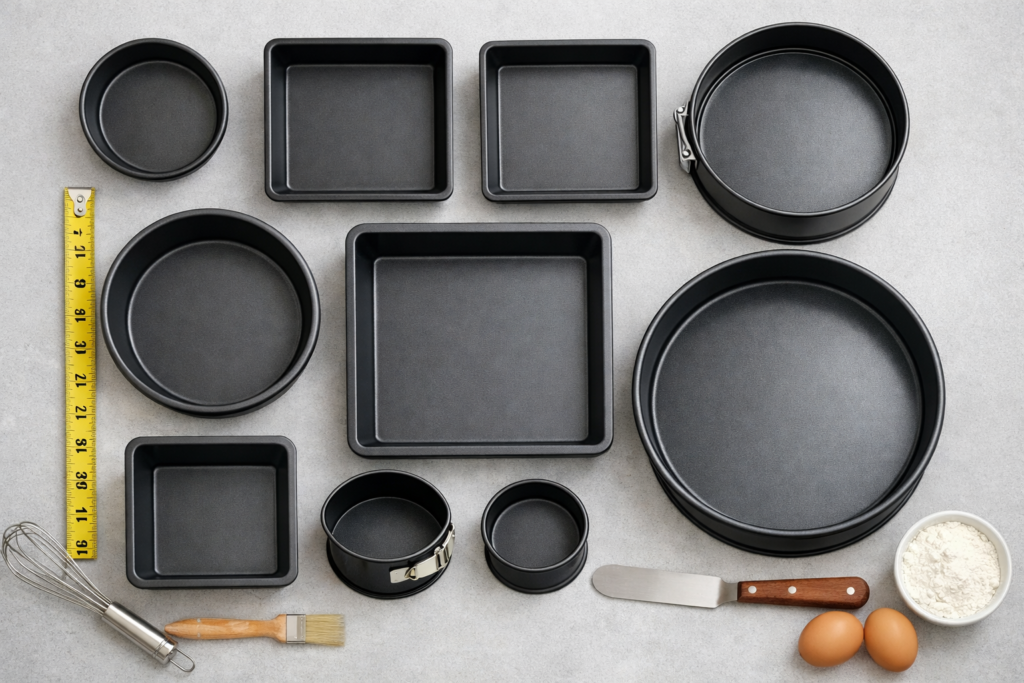
Pan size is not interchangeable. Swapping an 8-inch pan for a 9-inch pan changes the batter depth by roughly 20–25%, which affects bake time, rise, and texture.
Use this as a general rule:
- 8-inch round: Produces taller layers with a slightly denser crumb. Better for recipes that call for 3 or more layers.
- 9-inch round: The standard for most American layer cake recipes. Produces flatter, wider layers that stack cleanly.
- 10-inch round: Used for larger celebration cakes; batter must be increased proportionally.
If a recipe calls for an 8-inch pan and you only have a 9-inch, reduce the bake time by roughly 5 minutes and start checking for doneness early. The opposite applies when going from 9-inch to 8-inch — add time and watch for the center to set.
What Makes a Nonstick Coating Safe and Durable?
Look for pans labeled PFOA-free, and ideally PFAS-free, with a ceramic-reinforced or multi-layer coating. PFOA was phased out of most cookware manufacturing by the mid-2010s, but it’s still worth confirming on the label.
Ceramic-reinforced nonstick coatings tend to be more scratch-resistant than standard PTFE coatings and can withstand slightly higher oven temperatures. However, no nonstick coating is truly indestructible. The practical lifespan of a well-maintained nonstick pan is roughly 3–5 years of regular use before the coating begins to thin.
To extend coating life:
- Hand-wash with warm soapy water and a soft sponge
- Avoid metal utensils entirely
- Don’t preheat an empty nonstick pan
- Store pans with a cloth or pan protector between them to prevent scratching
For a deeper look at nonstick safety standards and what to avoid, this resource on cookware free of PFAS risks covers the topic clearly.
Check Price and Availability on Amazon
Specialty Pans Worth Adding to Your Collection
Once you have a solid set of round pans, a few specialty shapes dramatically expand what you can bake.
Springform pan (9-inch): Essential for cheesecakes, no-bake tarts, and flourless chocolate cakes. The removable sides let you unmold delicate cakes without flipping. Look for a tight-fitting latch and a base that sits flush with no gap — leaking springforms are a common frustration.
Bundt pan (10–12 cup): The fluted interior creates a decorative cake without any decorating skill. Cast aluminum Bundt pans release most cleanly; grease every crevice thoroughly with softened butter and a pastry brush, then flour lightly. The Ballarini scalloped cake pan is one example of a decorative pan worth considering for special occasions.
Loaf pan (9×5 inch): Doubles as a pound cake pan and a quick bread pan. Aluminized steel is the best choice here too. The ChefMade loaf pan is a well-regarded option in this category.
Tube pan (angel food): Uncoated aluminum only — angel food cake needs to cling to the sides to rise properly. Never use a nonstick tube pan for angel food cake.
For bakers working with limited cabinet space, this guide to bakeware for small kitchens covers stackable and multi-use options.
Buying Guide: What to Prioritize at Each Budget Level
Under $20 per pan: Focus on aluminized steel construction with a rolled rim. Avoid thin carbon steel or single-layer dark nonstick coatings. At this price, you can find serviceable pans from established brands — just don’t expect the coating to last more than 2–3 years. See budget-friendly nonstick baking pans for specific picks.
$20–$40 per pan: This is where quality noticeably improves. Ceramic-reinforced coatings, heavier gauge steel, and reinforced rims become standard. A pair of 9-inch pans in this range will serve most home bakers well for 5+ years.
$40+ per pan: Professional-grade construction, thicker gauge metal, and multi-layer coatings. Worth the investment if you bake weekly or run a cottage bakery. Fat Daddio’s and similar professional lines fall into this tier — the Fat Daddio’s cake pan overview covers what sets them apart.
What to skip regardless of budget:
- Dark-colored thin pans (overbrowning is nearly unavoidable)
- Pans with riveted handles that can trap batter
- Glass pans for layer cakes (heat retention is too uneven)
- Any pan without a clearly labeled nonstick safety standard
FAQ: Common Questions About Cake Bakeware
Q: Do I need to grease a nonstick cake pan?
Yes, even nonstick pans benefit from a light coating of butter or baking spray, especially for cakes with sugar-heavy batters that can caramelize and stick. For most layer cakes, grease the pan, line the bottom with parchment, and grease the parchment.
Q: Can I use the same pan for a cheesecake and a layer cake?
A standard round pan works for both, but a springform pan is much easier for cheesecakes. Using a standard pan for cheesecake means you’ll need to flip it to unmold, which risks cracking.
Q: Why does my cake dome in the center?
Doming usually means the oven temperature is too high or the pan is too dark, causing the edges to set before the center rises. Try reducing oven temperature by 25°F and using a lighter-colored pan. Baking strips (wet fabric strips wrapped around the pan) also help produce flat layers.
Q: How many cake pans do I actually need?
For most home bakers, two 9-inch round pans and one 9×5-inch loaf pan cover the majority of recipes. Add a springform pan if you make cheesecakes, and a Bundt pan if you want decorative cakes without the need for frosting skills.
Q: Is it worth buying a cake pan set versus individual pans?
Sets offer better value per pan and ensure consistent sizing across your collection. The downside is that sets sometimes include sizes you rarely use. If you bake a specific type of cake regularly, buy those pans individually and invest more in quality. The cake pan set buying guide compares popular sets side by side.
Q: How do I know when a nonstick coating needs replacing?
If you see flaking, peeling, or significant scratching that exposes the base metal, replace the pan. A coating that’s simply dull or slightly worn but intact is still safe to use — just re-grease more carefully.
Final Verdict: What to Buy and When
For most home bakers, the best starting investment is a pair of 9-inch aluminized steel round pans with PFOA-free ceramic-reinforced nonstick coatings. Buy in the $20–$40 range per pan, choose a light to medium color, and look for a rolled rim. That combination handles the widest range of recipes with the most consistent results.
Add a 9-inch springform pan next if you make cheesecakes or delicate tortes. Then a Bundt pan if decorative cakes appeal to you. Beyond that, specialty pans like financier molds, tart pans with removable bottoms, and brioche molds are worth exploring once your core collection is solid.
The bottom line: Best Bakeware For Cakes doesn’t have to be expensive, but it does need to be the right material, the right color, and the right size for what you’re actually baking. Start with the basics, buy quality where it counts, and your results will show it.
Check Price and Availability on Amazon
Related reading:
- Bakeware Essentials for New Bakers
- Budget-Friendly Nonstick Baking Pans
- Healthy Non-Toxic Bakeware Guide
- Bakeware for Small Kitchens
-
Check Price and Availability on Amazon

One response to “Ultimate Guide to Best Cake Bakeware: Choosing the Perfect Pans for Stunning Desserts”
[…] complete set typically includes a half-sheet pan, quarter-sheet pan, loaf pan, round cake pans, and a muffin tin. Not every set delivers all of […]