Gluten Free Bread Pan
Last updated: May 30, 2026
Quick Answer: The best Gluten Free Bread Pan is a high-sided, heavy-gauge aluminized steel or light-colored nonstick loaf pan that supports batter-like dough, distributes heat evenly, and releases cleanly.
For most home bakers, a 9×5-inch or 8.5×4.5-inch nonstick pan works well, while serious bakers often prefer the USA Pan Pullman-style loaf pan for maximum structure and rise.
Key Takeaways
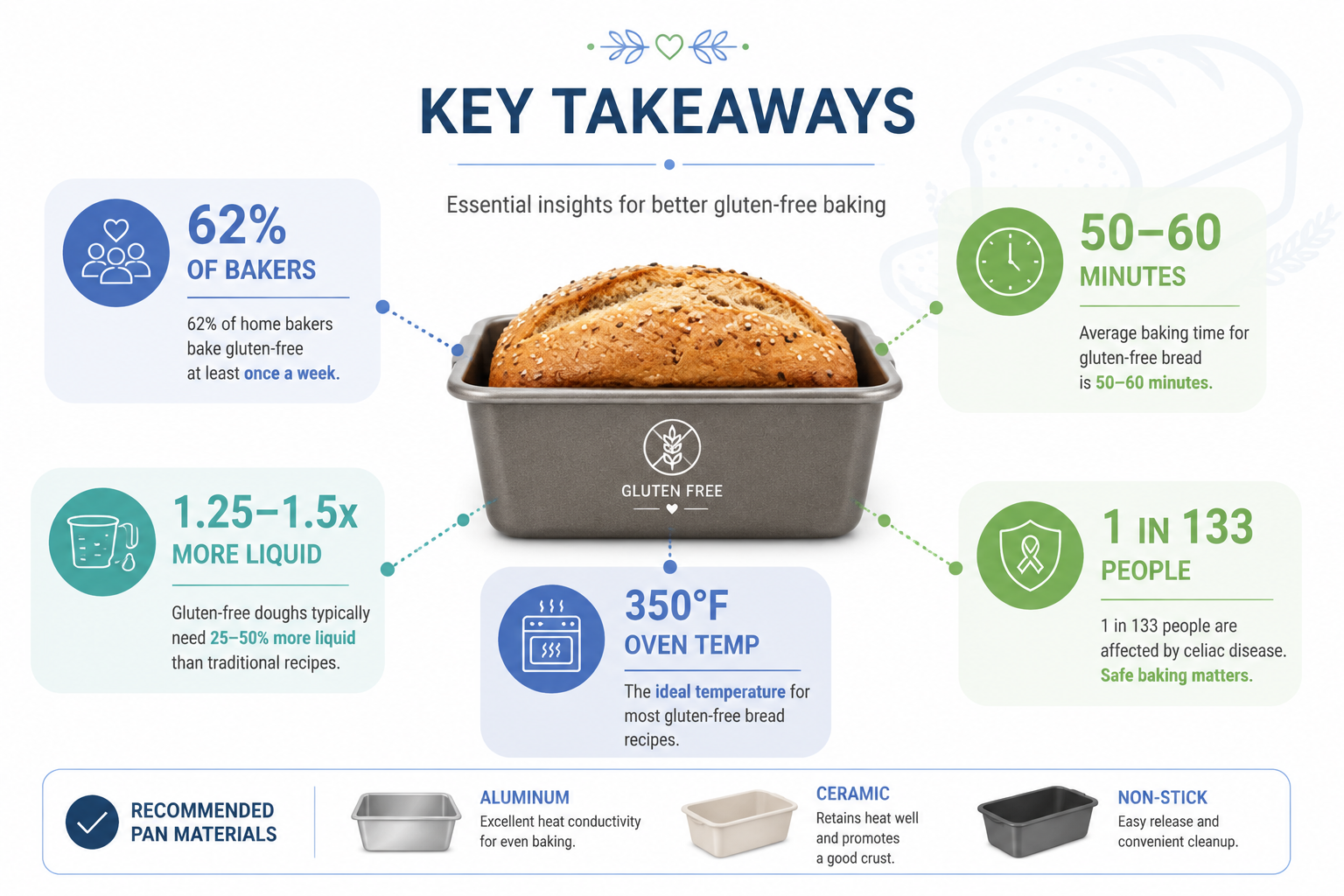
- Gluten-free bread dough is wet and batter-like, so it needs a pan with high, straight sides to hold its shape while baking.
- Pan material matters: heavy-gauge aluminized steel conducts heat evenly and prevents the dense, gummy centers common in gluten-free loaves.
- Lighter-colored pans are better for gluten-free baking because gluten-free doughs brown faster than wheat-based doughs.
- The wrong pan size is one of the most common and overlooked reasons gluten-free bread fails.
- Nonstick coatings reduce sticking and make cleanup easier, but you should verify the coating is free from PFOA and PTFE if that matters to you.
- Top recommended pans include the USA Pan 13x4x4-inch Pullman pan, the King Arthur Baking gluten-free loaf pan, the gfJules stainless steel pan, and the Chicago Metallic Professional 9-inch gluten-free loaf pan.
- Proper greasing technique, batter depth, and oven temperature all interact with pan choice to determine your final loaf quality.
- Pan durability and maintenance directly affect long-term baking performance and cost-effectiveness.
Browse the Best Gluten Free Bread Pans on Amazon
What Exactly Is a Gluten Free Bread Pan?
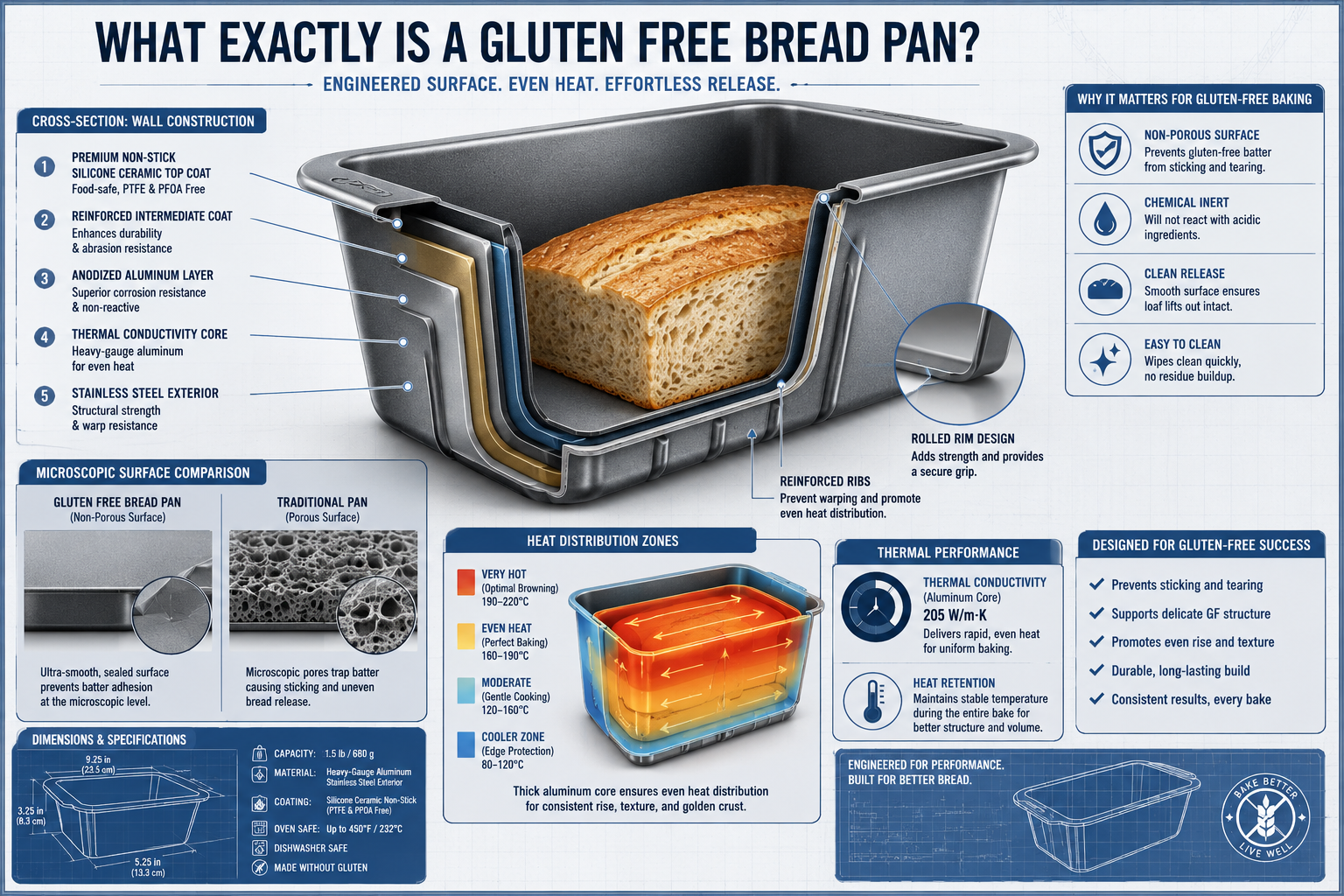
A gluten free bread pan is a loaf pan specifically suited to the structural and thermal demands of gluten-free bread baking. It is not always a unique product category, but the term refers to pans that address the specific challenges gluten-free doughs present: wet consistency, poor structural integrity, and a tendency to collapse or brown unevenly.
Most gluten-free bread pans share several features:
- High, straight sides (at least 2.5 to 3 inches tall) to support rising batter
- Heavy-gauge construction for even heat distribution
- Light or medium color finish to prevent over-browning
- Nonstick interior for clean release of dense, sticky loaves
Some brands, like King Arthur Baking and gfJules, have developed pans explicitly marketed for gluten-free use. Others, like the USA Pan Pullman loaf pan, are professional-grade tools that gluten-free bakers have adopted because of their superior performance.
How Is a Gluten Free Bread Pan Different from Regular Bread Pans?
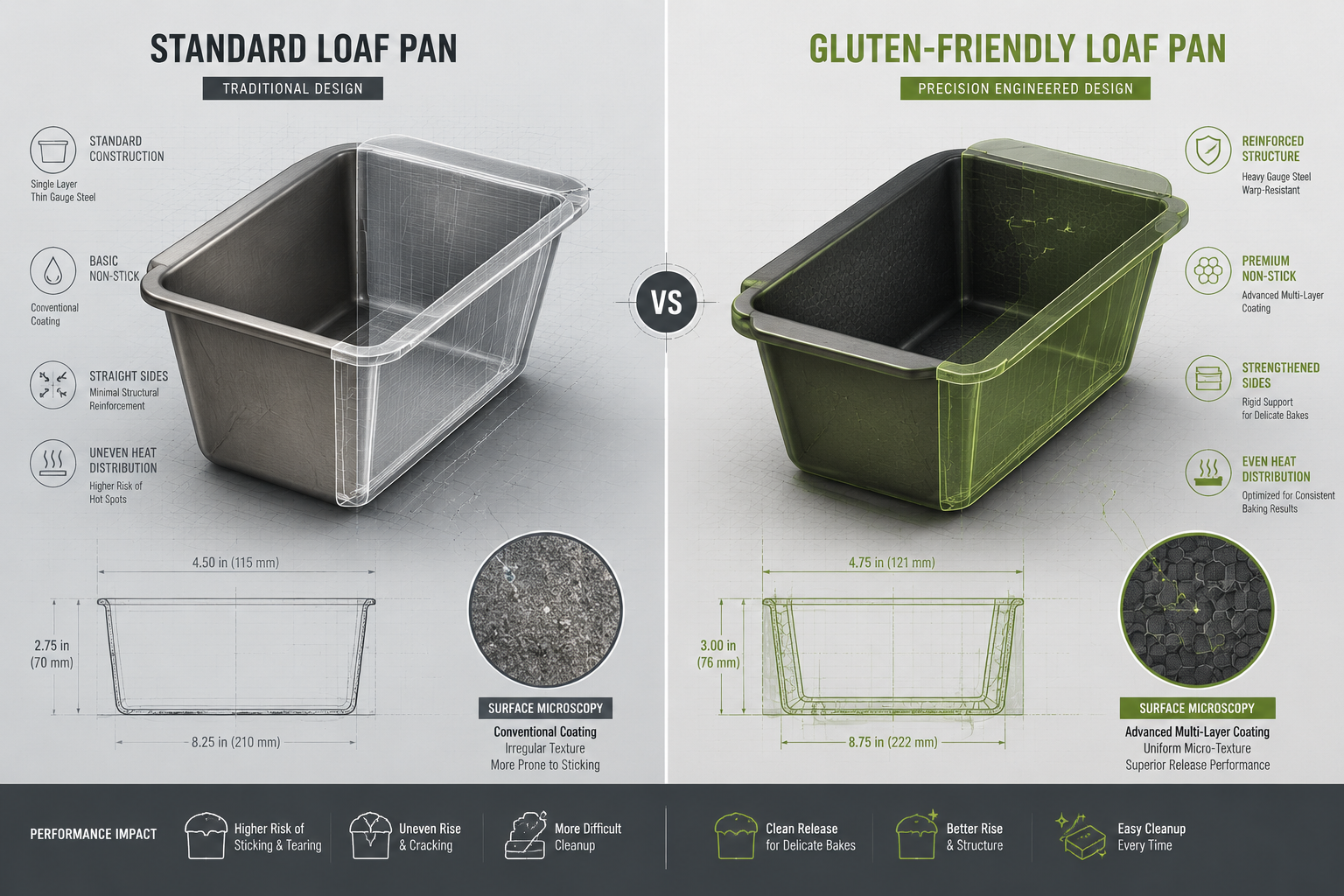
A gluten free bread pan differs from a standard loaf pan primarily in its side height, color, and material weight. Regular bread dough is elastic and holds itself together because of gluten strands. Gluten-free dough lacks that structure entirely, behaving more like a thick cake batter.
Key differences at a glance:
| Feature | Standard Bread Pan | Gluten Free Bread Pan |
|---|---|---|
| Side height | 2 to 2.5 inches typical | 2.5 to 4 inches preferred |
| Color | Dark or medium | Light to medium |
| Material weight | Varies widely | Heavy-gauge preferred |
| Nonstick coating | Optional | Strongly recommended |
| Lid option | Rare | Common (Pullman style) |
Pastry chef Alysha Dinatale notes that high-sided pans are essential for gluten-free baking because they force the dough to rise vertically rather than spread outward. She also recommends lighter-colored pans specifically to prevent the rapid surface browning that gluten-free doughs are prone to.
A standard dark nonstick loaf pan can cause the crust to over-brown before the interior sets, leaving you with a burnt exterior and an undercooked, gummy center.
Browse the Best Gluten Free Bread Pans on Amazon
Why Do You Need a Special Pan for Gluten Free Bread?
You need a pan suited to gluten-free baking because the absence of gluten fundamentally changes how bread dough behaves in the oven. Without gluten’s elastic network, the dough cannot trap gas bubbles efficiently, support its own weight, or maintain structure during the critical early baking phase.
Here is what happens without the right pan:
- Collapse: The loaf rises, then falls in the center as steam escapes and the structure fails.
- Dense, gummy texture: Uneven heat causes the interior to stay wet while the exterior overbakes.
- Sticking: Gluten-free doughs are stickier than wheat doughs and cling to poorly coated pans.
- Flat loaves: Without high sides, the batter spreads instead of rising.
According to research from Gluten Free Cooking School, using a pan size different from what a recipe specifies is one of the most common hidden causes of gluten-free bread failures.
A batter designed for an 8.5×4.5-inch pan will bake very differently in a 9×5-inch pan, because the batter sits lower and loses the side support it needs to rise properly.
For people with celiac disease, there is an additional consideration: the pan itself must be free from cross-contamination. Older nonstick pans with scratched coatings can harbor gluten residue from previous baking, making a dedicated Gluten Free Bread Pan a practical necessity, not just a preference.
What Size Pan Do You Need for Homemade Gluten Free Bread?
For most standard gluten-free sandwich bread recipes, an 8.5×4.5-inch loaf pan is the ideal size. A 9×5-inch pan is also common but works best for recipes with higher batter volumes.
Size guide by use:
- 8.5×4.5 inches: Best for most homemade gluten-free sandwich loaves. Batter fills the pan to the right depth for a good rise.
- 9×5 inches: Works for larger recipes or denser loaves. Too large for standard recipes and will produce a flat, wide loaf.
- 9x4x4 inches (Pullman style): Excellent for uniform, square sandwich slices. The lid controls rise and creates a tight crumb.
- 7.5 to 8 inches: Suitable for smaller batch recipes or mini loaves.
A practical decision rule: always match your pan size to what the recipe specifies. If your recipe was developed for an 8.5×4.5-inch pan and you use a 9×5-inch pan, your loaf will be shorter, denser, and may not bake through properly.
For those who bake frequently, having both an 8.5×4.5-inch and a 9×5-inch pan covers most recipes. You can find detailed guidance on specialty pan shapes in our complete guide to Pullman loaf pans.
Best Gluten Free Bread Pans Under $50: Top Recommended Brands
The best gluten-free bread pans under $50 offer heavy-gauge construction, reliable nonstick performance, and the right dimensions for standard recipes. You do not need to spend a lot to get excellent results, but you do need to buy thoughtfully.
Top picks for 2026:
1. USA Pan 13x4x4-inch Pullman Loaf Pan
Made from heavy-gauge aluminized steel with a corrugated surface and nonstick coating, this pan delivers exceptionally even heat distribution. The corrugated design increases surface area and promotes airflow beneath the loaf. It is highly regarded by gluten-free bakers for its ability to support batter-like dough and produce a consistent, well-risen loaf. The USA Pan brand is also known for its American manufacturing standards. See our full USA Pan loaf pan review for more detail.
2. King Arthur Baking Gluten-Free Loaf Pan
Reviewed positively by The Kitchn, this pan was designed with gluten-free baking in mind. It provides better rise and structure than generic loaf pans and is sized specifically for common gluten-free recipes.
3. gfJules Stainless Steel Bread Pan (9x5x2 inches)
This pan is made from stainless steel with straight, high sides and is oven-safe to 450 degrees Fahrenheit. It is free from lead, cadmium, PFOA, and PTFE, making it a strong choice for bakers who want to avoid synthetic coatings entirely. The straight sides are particularly effective at supporting gluten-free yeast breads.
4. Chicago Metallic Professional 9-Inch Gluten-Free Loaf Pan
Specifically designed for gluten-free baking, this pan offers the right dimensions and material quality for consistent results. It is widely available and well-regarded for everyday use.
5. Fox Run 7.5-Inch Bread Pan
A solid budget option with tin-plated steel construction. Users report good results with gluten-free recipes, particularly for smaller batch loaves.
For more options across price points, our guide to top affordable nonstick baking pans covers a broader range of choices.
Browse the Best Gluten Free Bread Pans on Amazon
Are Nonstick or Ceramic Pans Better for Gluten Free Baking?
For gluten-free bread baking, traditional nonstick (PTFE-based) pans and ceramic-coated pans both work, but they have different strengths. Heavy-gauge aluminized steel with a nonstick coating is generally the most reliable choice for consistent results.
Nonstick (PTFE/aluminized steel):
- Excellent heat conductivity and even baking
- Reliable release, even with sticky gluten-free batters
- Durable when used with silicone or wooden utensils
- Some bakers prefer to avoid PTFE coatings due to health concerns at high temperatures
Ceramic-coated pans:
- Free from PTFE and PFOA
- Good nonstick performance when new, but ceramic coatings can degrade faster with heavy use
- Slightly less heat-conductive than aluminized steel
- A good option for health-conscious bakers
Stainless steel (uncoated):
- Durable and easy to clean
- Requires thorough greasing to prevent sticking
- Even heat distribution, though not as good as aluminized steel
Silicone pans:
- Very flexible, which makes release easy
- Poor heat conductivity leads to uneven baking and pale crusts
- Not recommended as a primary pan for gluten-free bread
Decision rule: Choose a nonstick aluminized steel pan if you want the most reliable everyday performance. Choose a ceramic-coated pan if you prefer to avoid synthetic coatings. Avoid silicone as your primary pan unless you are baking quick breads where crust quality is less important.
If you want to explore the health and safety dimensions of nonstick coatings further, our guide on cookware free of PFAS risks is worth reading before you buy.
Can You Use a Regular Metal Loaf Pan for Gluten Free Bread?
Yes, you can use a regular metal loaf pan for gluten-free bread, but results will vary depending on the pan’s color, side height, and coating quality. A standard dark, thin-gauge metal pan is likely to produce over-browned crusts, uneven baking, and sticking.
If you use a regular pan, follow these adjustments:
- Grease generously with butter, oil, or a nonstick spray, and line with parchment paper for insurance.
- Lower your oven temperature by 10 to 25 degrees Fahrenheit if using a dark pan to reduce surface browning.
- Choose a lighter-colored pan if you have the option, as it will brown more gradually.
- Check for scratches or damage in the nonstick coating, which can cause sticking and, for celiac bakers, potential gluten cross-contamination from previous use.
A regular pan works in a pinch, but if you bake gluten-free bread regularly, investing in a dedicated pan pays off quickly in better results and less frustration.
How to Prevent Gluten Free Bread from Sticking in the Pan
Preventing gluten-free bread from sticking requires a combination of proper pan preparation and the right pan choice. Gluten-free batters are stickier than wheat-based doughs because they contain more moisture and binding agents like xanthan gum or psyllium husk.
Step-by-step pan preparation:
- Grease the entire interior of the pan with butter, coconut oil, or a nonstick cooking spray, including corners and edges.
- Line with parchment paper cut to fit the bottom and up both long sides, leaving a small overhang for easy lifting.
- Lightly flour the parchment with a gluten-free flour like rice flour if the recipe is particularly sticky.
- Avoid overfilling the pan, as batter that overflows and bakes onto the rim makes release much harder.
- Allow the loaf to cool in the pan for 10 to 15 minutes before attempting to remove it. Gluten-free bread is fragile when hot.
Common mistake: Pulling the loaf out immediately after baking. Gluten-free bread needs time to set its structure as it cools. Removing it too early causes crumbling and sticking.
For more bakeware care tips, see our guide on simple bakeware cleanup tips.
Common Mistakes When Baking Gluten Free Bread in a Pan
The most common mistakes when baking gluten-free bread in a pan involve pan selection, batter depth, and oven management. Fixing these issues often produces dramatically better results without changing the recipe at all.
Mistake 1: Using the wrong pan size
As noted by Gluten Free Cooking School, mismatched pan size is a hidden cause of many gluten-free bread failures. A batter that sits too shallow in an oversized pan will spread and bake flat. Always match pan size to the recipe.
Mistake 2: Using a dark-colored pan
Dark pans absorb more radiant heat and cause the crust to brown before the interior is set. Use a light to medium-colored pan, or reduce oven temperature by 15 to 25 degrees Fahrenheit.
Mistake 3: Not greasing the pan thoroughly
Gluten-free batters stick aggressively. Skimping on greasing leads to torn loaves and wasted effort.
Mistake 4: Opening the oven door too early
Gluten-free bread relies on steam pressure inside the loaf to rise. Opening the oven in the first 20 minutes releases steam and can cause collapse.
Mistake 5: Using a thin, cheap pan
Thin pans create hot spots and uneven baking. The result is a loaf that is overbaked on the outside and gummy in the center.
Mistake 6: Skipping the cooling period
Gluten-free bread continues to set as it cools. Slicing too early produces a gummy, wet texture even when the loaf is fully baked.
Which Bread Pans Work Best for People with Celiac Disease?
For people with celiac disease, the best bread pans are those that are dedicated exclusively to gluten-free baking and have smooth, undamaged surfaces that do not harbor gluten residue. Cross-contamination from shared bakeware is a real risk.
Key criteria for celiac-safe baking pans:
- Dedicated use only: Keep a separate pan used exclusively for gluten-free baking.
- Smooth, intact nonstick coating: Scratched or pitted surfaces can trap gluten particles from previous use.
- Easy to clean thoroughly: Avoid pans with complex ridges or crevices that are hard to scrub clean.
- PFOA and PTFE-free options: The gfJules stainless steel pan and ceramic-coated pans are good choices for those who want to avoid synthetic coatings entirely.
- Dishwasher-safe construction: Easier deep cleaning reduces cross-contamination risk.
The gfJules 9x5x2-inch stainless steel pan is explicitly designed for gluten-free use and is free from PFOA, PTFE, lead, and cadmium, making it a strong recommendation for celiac households.
For a broader look at non-toxic bakeware options, our non-toxic bakeware set reviews cover the full landscape.
Do Professional Gluten Free Bakers Recommend Specific Pans?
Yes, professional gluten-free bakers consistently recommend heavy-gauge, light-colored nonstick pans with high sides. The USA Pan Pullman loaf pan and the King Arthur Baking gluten-free loaf pan appear most frequently in professional recommendations.
Pastry chef Alysha Dinatale specifically recommends pans with high sides and lighter colors to prevent over-browning and to give gluten-free dough the vertical support it needs to rise properly. Her preference for lighter pans reflects a well-established principle in professional baking: pan color directly affects crust development speed.
The USA Pan 13x4x4-inch Pullman pan is made from heavy-gauge aluminized steel with a corrugated surface that promotes even heat distribution. Professional bakers favor it because the Pullman lid option allows precise control over rise height, which is particularly valuable for gluten-free sandwich bread where uniform slice size matters.
For everyday home baking, the Chicago Metallic Professional 9-inch gluten-free loaf pan is a practical and widely available option that delivers consistent results without the premium price of specialty brands.
Tips for Getting Perfect Gluten Free Bread Texture Every Time
Perfect gluten-free bread texture comes from the right combination of pan choice, batter hydration, oven temperature, and cooling technique. No single factor works in isolation.
Practical tips:
- Use a thermometer: Gluten-free bread is done when the internal temperature reaches 205 to 210 degrees Fahrenheit. Visual cues alone are unreliable.
- Weigh your ingredients: Gluten-free flours vary significantly in density. Volume measurements lead to inconsistent results.
- Do not over-mix: Over-mixing gluten-free batter develops too much air, which then collapses in the oven.
- Use warm water or milk: Activates yeast properly and helps xanthan gum or psyllium husk bind the batter.
- Proof in a warm, draft-free spot: Gluten-free dough is sensitive to temperature fluctuations during proofing.
- Bake on the center rack: This ensures even top and bottom heat.
- Let the loaf cool completely before slicing: At least one hour on a wire rack. Cutting too early produces a gummy, compressed crumb.
The science behind gluten-free bread texture centers on starch gelatinization and protein coagulation from eggs or egg replacers. Without gluten’s elastic network, these processes carry the structural load.
A pan that distributes heat evenly allows these reactions to proceed uniformly, which is why pan quality has such a direct impact on final texture.
For bakers exploring healthy ingredient substitutions, our guide to healthy baking dish ideas offers complementary inspiration.
Browse the Best Gluten Free Bread Pans on Amazon
FAQ: Gluten Free Bread Pan
Q: Can I use a silicone loaf pan for gluten-free bread?
A: Silicone pans are flexible and release bread easily, but they conduct heat poorly and produce pale, soft crusts. They are not ideal for gluten-free bread, which needs even heat to set its structure. Use them only for quick breads where crust quality is less critical.
Q: What is the best material for a gluten-free bread pan?
A: Heavy-gauge aluminized steel with a nonstick coating is the most reliable material. It distributes heat evenly, browns the crust gradually, and releases the loaf cleanly.
Q: How do I know if my pan is the right size for my recipe?
A: Check the recipe for the specified pan size and match it exactly. Using a larger pan produces a flat, dense loaf. Using a smaller pan can cause overflow and uneven baking.
Q: Do I need to grease a nonstick gluten-free bread pan?
A: Yes. Even nonstick pans benefit from a light greasing when baking gluten-free bread, because the batters are stickier than wheat-based doughs. Parchment paper lining adds extra insurance.
Q: How long do gluten-free bread pans last?
A: A high-quality heavy-gauge pan can last 5 to 10 years or more with proper care. Avoid metal utensils, abrasive cleaners, and dishwasher cycles that degrade nonstick coatings.
Q: Is the USA Pan Pullman pan worth the price for home bakers?
A: Yes, for bakers who make gluten-free bread regularly. The even heat distribution and structural support it provides produce noticeably better results than budget pans, and the durability makes it cost-effective over time.
Gluten Free Bread Pan: FAQs
Q: Can I use the same pan for gluten-free and regular bread if I have celiac disease?
A: No. Shared pans carry cross-contamination risk, especially if the nonstick coating is scratched. Keep a dedicated pan for gluten-free baking.
Q: What temperature should I bake gluten-free bread at?
A: Most gluten-free bread recipes call for 350 to 375 degrees Fahrenheit. If using a dark pan, reduce by 15 to 25 degrees to prevent over-browning.
Q: Why does my gluten-free bread collapse after baking?
A: Collapse is usually caused by under-baking, opening the oven door too early, or using a pan that is too large for the batter volume. Check internal temperature and avoid disturbing the loaf in the first 20 minutes.
Q: Are ceramic-coated pans safe for gluten-free baking?
A: Yes. Ceramic-coated pans are free from PTFE and PFOA and work well for gluten-free baking. They may not last as long as aluminized steel pans, but they are a solid choice for health-conscious bakers. See our ceramic cookware pros and cons guide for more detail.
Q: What is a Pullman loaf pan and is it good for gluten-free bread?
A: A Pullman pan is a rectangular loaf pan with a sliding lid that controls rise height and produces square, uniform slices. It is excellent for gluten-free sandwich bread because the lid provides structural support during baking.
Q: Where can I buy a quality gluten-free bread pan?
A: Quality gluten-free bread pans are available at kitchen specialty stores, Amazon, and directly from brands like USA Pan and gfJules. Our guide to top places to buy quality bakeware online lists the most reliable sources.
Conclusion
Choosing the Gluten Free Bread Pan is one of the most practical steps you can take to improve your gluten-free baking results in 2026. The pan you use directly affects heat distribution, rise support, crust development, and how cleanly the loaf releases after baking.
Your actionable next steps:
- Match your pan to your recipe’s specified size. An 8.5×4.5-inch pan covers most standard recipes.
- Choose heavy-gauge aluminized steel or a ceramic-coated pan in a light to medium color.
- Always grease and line with parchment, regardless of nonstick coating.
- If you have celiac disease, keep a dedicated pan used only for gluten-free baking.
- Invest in a quality pan like the USA Pan Pullman loaf pan or the King Arthur Baking gluten-free loaf pan if you bake regularly. The performance difference over a cheap thin pan is significant.
Ready to upgrade your baking setup? Browse the top-rated gluten free bread pans on Amazon and find the right fit for your kitchen today.
References
[1] Pan Type Baking Gluten Free Bread – https://www.tastingtable.com/1863783/pan-type-baking-gluten-free-bread/?utm_source=openai
[2] Pullman Loaf Pan For Gluten Free Bread – https://www.bakingsubs.com/blog/pullman-loaf-pan-for-gluten-free-bread?utm_source=openai
[3] King Arthur Baking Perfect Gluten Free Loaf Pan Review – https://www.thekitchn.com/king-arthur-baking-perfect-gluten-free-loaf-pan-review-23153170?utm_source=openai
[4] Bread Pan – https://shop.gfjules.com/products/bread-pan?utm_source=openai
[5] Chicago Metallic Professional 9 Inch Gluten Free Loaf Pan – https://www.wayfair.com/kitchen-tabletop/pdp/chicago-metallic-professional-9-inch-gluten-free-loaf-pan-cmat1038.html?utm_source=openai
[6] Fox Run 4670 Bread Pan Tin Plated Steel 7.5 Inch – https://www.opentip.com/Fox-Run-4670-Bread-Pan-Tin-Plated-Steel-7-5-Inch-pr-13076609.html?utm_source=openai
[7] The Hidden Cause Behind GF Bread Failures – https://www.glutenfreecookingschool.com/the-hidden-cause-behind-gf-bread-failures/?utm_source=openai
[8] Little Northern Bakehouse Launches New Gluten Free Sourdough Line – https://www.prnewswire.com/news-releases/from-house-crafted-starter-to-everyday-slice-little-northern-bakehouse-launches-new-gluten-free-sourdough-line-302700091.html?utm_source=openai
[9] T. Marzetti Company Launches New York Bakery Gluten Free Texas Toast – https://www.businesswire.com/news/home/20240821434464/en/T.-Marzetti-Company-Launches-Game-Changing-New-York-Bakery-Gluten-Free-Texas-Toast?utm_source=openai
[10] Canyon Bakehouse Launches Soft Tangy Sourdough Style Gluten Free Loaf – https://www.prismnews.com/hobbies/sourdough-baking/canyon-bakehouse-launches-soft-tangy-sourdough-style-gluten-free-loaf-for-freezer?utm_source=openai