Best Durable Ceramic Cookware
Last updated: October 10, 2026
Quick Answer
The Best Durable Ceramic Cookware in 2026 balances a thick, well-bonded ceramic nonstick coating with a solid aluminum or hard-anodized core, because the base material affects warping and heat retention just as much as the coating affects stick resistance. Brands like GreenPan, Le Creuset, Made In, Caraway, and Ninja now back their ceramic nonstick pans with multi-year guarantees, but independent testing still shows ceramic coatings wear faster than traditional PTFE nonstick under daily use.
Key Takeaways
- Ceramic nonstick cookware typically holds peak nonstick performance for about 1 to 3 years of regular home use, compared with 3 to 5 years for PTFE-coated pans, according to Bottom Line Inc.
- A solid ceramic coating is brittle by nature, so it is more prone to microscopic cracking than flexible PTFE, a point confirmed by America’s Test Kitchen
- Newer ceramic nonstick lines, including Ninja’s NeverQuit and HexClad’s TerraBond, are marketed on durability claims like a three year guarantee and lifetime warranty, a shift from older ceramic cookware that rarely carried such terms
- Hand washing, using only wood or silicone tools, and avoiding thermal shock are the single biggest factors in how long a ceramic pan keeps its nonstick surface
- Most ceramic skillets range from 8 inch to 12 inch cooking surface diameter, and the right size depends on your household size and stove type
- Ceramic cookware works on induction cooktops only if the base contains a magnetic layer; check the label before you buy
- PFAS-free marketing is now standard across ceramic cookware, since ceramic coatings never contained PTFE, PFOA, or other PFAS chemicals to begin with
Check Current Pricing and Availability in the US or in the UK to See Today’s Offers
What Makes Ceramic Cookware Durable
Ceramic cookware durability comes down to three things: the thickness of the base metal, how well the ceramic coating bonds to that base, and how the pan is used and cleaned at home.
A thin, cheap aluminum core with a sprayed-on ceramic layer will warp and flake far faster than a heavy, hard-anodized or forged steel body with a properly cured ceramic nonstick finish.
Most ceramic cookware sold today starts as an aluminum or stainless steel pan, then gets coated with a ceramic or ceramic-based sol-gel layer. That coating is what gives the pan its nonstick ability, but it is also the weakest link.
Because the coating is a hard, glass-like layer rather than a flexible polymer, it does not flex with the metal underneath the way Teflon does. That mismatch is exactly why ceramic coatings crack before the metal body ever fails.
Construction details that genuinely affect durability include:
- Base metal gauge: thicker aluminum or forged steel resists warping under high heat.
- Coating method: multi-layer sol-gel ceramic applications tend to outlast single-coat sprays.
- Rivet and handle attachment: welded or cast handles last longer than screwed-on versions that loosen over time.
- Edge and rim finishing: rolled or reinforced rims resist the chipping that starts most ceramic coating failures.
Choose a heavier set if you cook daily and want the coating to survive years of searing, and choose a lighter, thinner set only if you cook occasionally and prioritize low cost over long-term performance.
For a broader look at how different materials hold up, our beginner’s guide to durable cookware breaks down the trade-offs between ceramic, stainless, and cast iron construction.
Check Current Pricing and Availability in the US or in the UK to See Today’s Offers
Ceramic vs Nonstick Cookware: Which Lasts Longer
Traditional PTFE nonstick, the coating most people call Teflon, generally lasts longer than ceramic nonstick under normal kitchen use. Multiple 2026 tests agree that ceramic coatings lose their nonstick ability faster than PTFE, even though both eventually wear down.
PTFE is a flexible polymer that can absorb minor stress without cracking, so a PTFE skillet typically performs well for about 3 to 5 years before the surface needs replacing, based on findings from Bottom Line Inc.’s expert nonstick cookware picks.
Ceramic, by contrast, is rigid and brittle. Wirecutter’s long-term testing found that ceramic nonstick pans can show noticeable loss of nonstick performance within a handful of months, and in worst cases after only about a dozen uses, even though food releases easily right out of the box.
Here is the difference that matters for your kitchen:
| Factor | Ceramic Nonstick | Traditional PTFE Nonstick |
|---|---|---|
| Typical lifespan | 1 to 3 years | 3 to 5 years |
| PFAS content | None | Contains PTFE, historically made with PFOA |
| Microcracking risk | Higher, coating is brittle | Lower, coating flexes slightly |
| High heat tolerance | Generally higher | Lower, PTFE degrades above 500°F |
| Best for | Lower, slower cooking and PFAS-free priority | Daily high-heat cooking, egg-centric cooks |
So, what is the best nonstick ceramic cookware if you want a longer-lasting option? Look for sets that pair a thick, hard-anodized or forged base with a reinforced multi-layer ceramic coating and a written durability warranty of at least three years.
America’s Test Kitchen notes this combination reduces, but does not eliminate, the microcracking that shortens a ceramic pan’s working life. If avoiding PTFE and PFOA entirely matters more to you than maximum lifespan, ceramic nonstick remains the only mainstream option.
For a side-by-side material breakdown, see our guide comparing Teflon and ceramic cookware.
Best Ceramic Cookware Brands in 2026
The strongest ceramic cookware brands right now combine a durable base, a well-reviewed coating, and a real warranty, not just marketing language.
After comparing testing notes and manufacturer claims across 2026 releases, a handful of models stand out as Highly Recommended or Recommended for people who want their ceramic skillet to survive more than one cooking season.
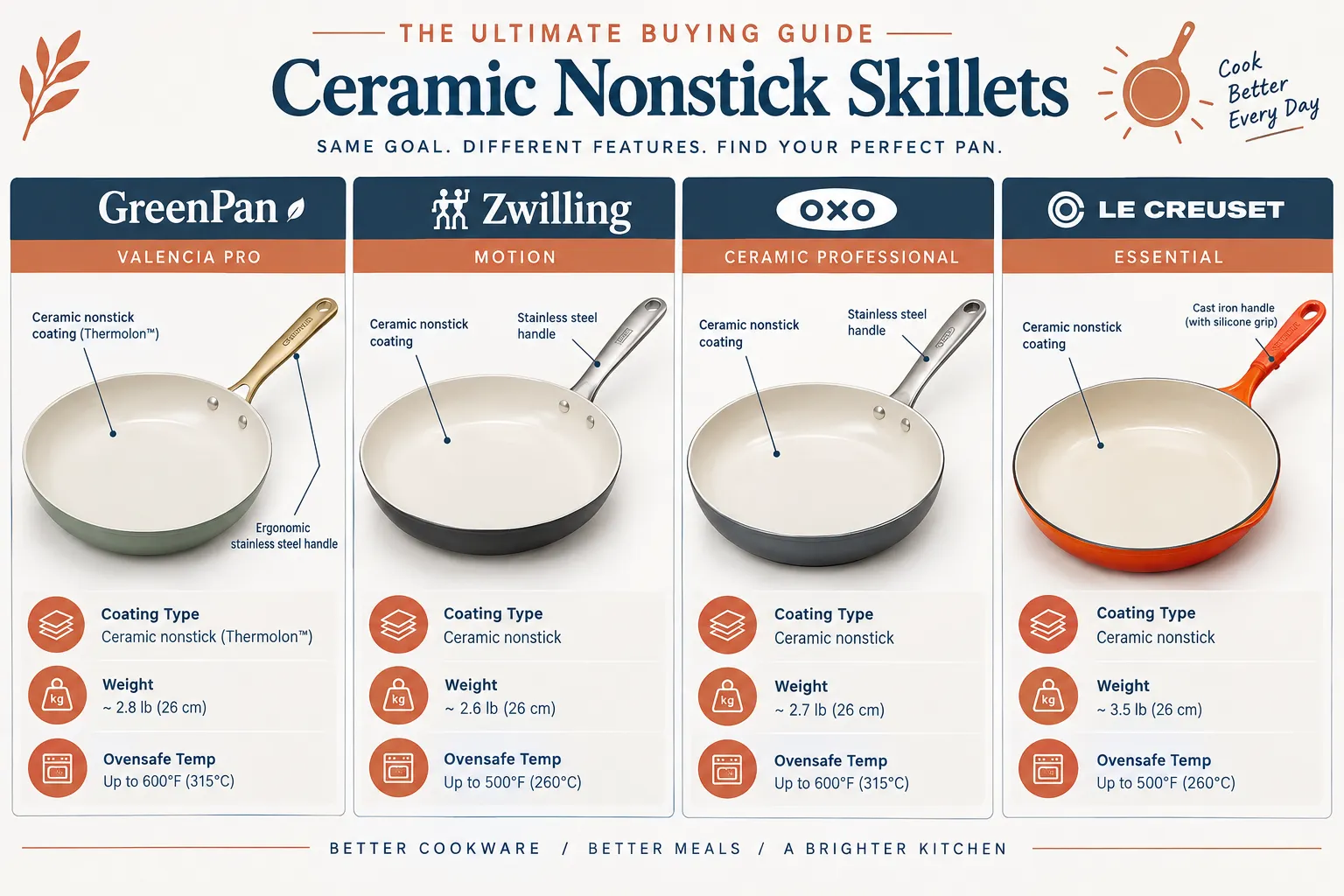
Top Pick: GreenPan Valencia Pro Hard Anodized Nonstick Frypan, 12-Inch. This pan pairs a hard-anodized aluminum body with GreenPan’s ceramic nonstick coating, giving it better warp resistance than standard aluminum ceramic pans while keeping weight manageable for everyday sauté and searing tasks.
Highly Recommended
- Zwilling Motion Ceramic Nonstick 12 Inch Fry Pan: a forged aluminum body with a textured ceramic nonstick surface designed to resist scratching from light metal contact.
- Made In CeramiClad Non Stick Frying Pan (12-inch): a clad construction that sandwiches aluminum between steel layers, then finishes with a ceramic nonstick coating, giving strong heat distribution and a sturdier feel than typical single-layer ceramic pans.
- Le Creuset Essential Non-Stick Ceramic Fry Pan: built on a stainless steel and aluminum base and backed by a 10-year warranty, an unusually long guarantee for a ceramic nonstick pan, according to Forbes’ 2026 ceramic pan guide.
Recommended
- OXO Ceramic Professional Non-Stick 12-Inch Frypan: reinforced coating marketed for improved scratch resistance, a good mid-range option for home cooks upgrading from a basic ceramic set.
- OXO Non-Stick Enhanced Series 12 In Fry Pan: a lighter-weight alternative in the OXO lineup, better suited to occasional cooking than daily high-heat searing.
Best Durable Ceramic Cookware
Two newer entrants worth watching are Ninja’s NeverQuit ceramic line, which launched in September 2026 claiming double the durability of standard ceramic nonstick along with a three-year guarantee on the coating itself, as reported by Homes & Gardens, and Hell’s Kitchen Cookware’s Forged Steel Series, introduced in July 2026, which uses a thick forged steel foundation and dual enamel layers under its ceramic nonstick coating to resist the chipping common in cheaper aluminum-core ceramic pans, per HFN Digital.
If you want a non-toxic, PFAS-free option specifically, our review of Xtrema pure ceramic cookware covers a fully solid ceramic alternative with no metal core at all.
How Long Does Ceramic Cookware Last
A ceramic nonstick pan typically lasts 1 to 3 years before the coating noticeably loses its nonstick ability, though the metal body underneath can last much longer if it does not warp. Lifespan depends heavily on cooking frequency, heat levels, and how the pan is cleaned.
Daily high-heat cooks will see the coating degrade toward the shorter end of that range, while occasional low-to-medium heat cooking can stretch a ceramic pan’s useful nonstick life closer to three years.
Food Network’s ceramic cookware guide recommends hand washing, soft silicone or wooden utensils only, and separate storage to avoid chipping, all of which help push durability toward the upper end of that window.
Common mistakes that shorten lifespan:
- Using metal spatulas or whisks on the coating.
- Stacking pans without protective pan protectors between them.
- Preheating an empty pan on high heat, which stresses the coating.
- Running ceramic cookware through the dishwasher repeatedly, even on sets marketed as dishwasher safe.
Edge case: If you sear meat at very high heat several times a week, expect the nonstick surface to fade closer to the one-year mark regardless of brand, because repeated thermal cycling is the main driver of microcracking, not just time.
Ceramic Cookware Price Comparison: Affordable Durable Sets
Ceramic cookware prices in 2026 range from roughly $60 for a basic two-piece set to $700 or more for premium multi-piece collections, and higher price does not always guarantee longer durability. Mid-range sets between $150 and $350 often offer the best balance of build quality and coating life.
Organic Authority’s 2026 roundup names the GreenPan Spectra set, priced around $699.99, as its “Most Durable” pick, citing an exceptionally durable nonstick surface and strong searing ability that justifies the premium price for frequent cooks. At the other end, Dupe.com’s 2026 comparative scoring gave the Calphalon Premier Hard-Anodized Ceramic 12-Piece Cookware Set an 88 out of 100 specifically for coating durability, suggesting mid-tier hard-anodized sets can rival pricier options.
Decision rule: choose a budget set under $150 if you cook a few times a week and plan to replace cookware every couple of years anyway. Choose a $300-plus set if you cook daily, want a multi-year warranty, and would rather pay more up front than replace pans annually. For more options at the lower end, our guide to affordable cookware sets under $100 and our Carote cookware set review cover budget-friendly ceramic and nonstick picks in detail.
Does Ceramic Cookware Scratch or Chip Easily, and How Do You Prevent It
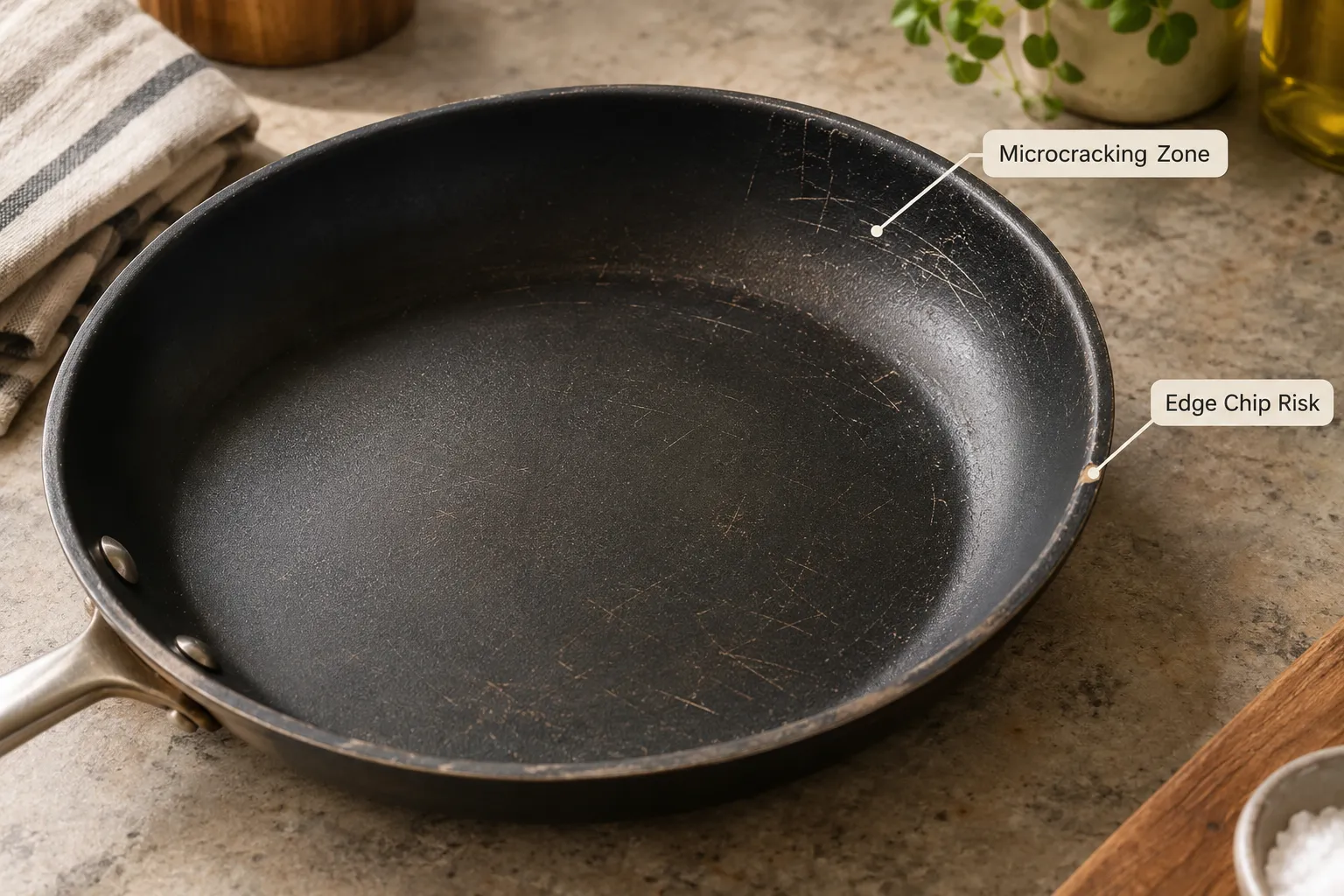
Yes, ceramic cookware scratches and chips more easily than stainless steel or cast iron because the coating is a hard, glass-like layer rather than a flexible metal surface. Most scratching happens at the rim and edges, where impacts during washing or stacking concentrate stress on the thinnest part of the coating.
Check Current Pricing and Availability in the US or in the UK to See Today’s Offers
To prevent chipping on a ceramic skillet or ceramic cookware set:
- Use only wood, silicone, or nylon utensils, never metal.
- Let the pan cool fully before washing it to avoid thermal shock cracking.
- Store pans with a soft liner or pan protector between each piece.
- Avoid banging the pan against the sink or stovetop edge.
- Skip the dishwasher when possible, even on dishwasher-safe labeled sets.
Does ceramic coating wear off over time? Yes, all ceramic nonstick coatings thin out gradually with use, even with careful handling, because every wipe and wash removes a microscopic layer. That is a normal part of a ceramic pan’s life cycle, not necessarily a defect, though it happens faster with metal utensils or high heat abuse.
Newer coatings like HexClad’s TerraBond, rated for oven temperatures up to 900°F and covered by a lifetime warranty according to Home & Gardens, are specifically engineered to resist this wear pattern better than older ceramic formulas.
Is Ceramic Cookware Safe for High Heat, and What Is the Oven Safe Temperature
Most ceramic cookware is safe for high heat cooking on the stovetop and in the oven up to a specific temperature printed on the box, typically between 400°F and 500°F, though some newer bakeware-focused lines claim much higher limits. Always check the manufacturer’s exact rating before broiling or using a pan under a grill.
A standard ceramic nonstick skillet is usually ovensafe to around 400°F to 450°F, which covers roasting, baking, and finishing a sear in the oven. HexClad’s newly announced TerraBond ceramic nonstick bakeware, however, is rated for oven temperatures up to 900°F, an unusually high ceiling for a ceramic coating, according to the Homes & Gardens coverage of the September 2026 launch.
That gap illustrates why checking the specific model’s ovensafe rating matters more than assuming all ceramic cookware behaves the same way.
Quick example: if a recipe calls for finishing a skillet of chicken thighs under a 475°F broiler, a standard 400°F-rated ceramic pan is not the right tool, but a pan rated to 450°F or higher, or a solid ceramic piece without a coating at all, will handle it safely. For more on safe oven temperature ranges across materials, see our oven safe cookware guide.
Best Ceramic Cookware for Induction Cooktops
Ceramic cookware works on induction cooktops only when the base of the pan contains a magnetic metal layer, usually stainless steel or a magnetic aluminum composite, because induction heating requires a magnetic field to generate heat. A purely aluminum or solid ceramic pan without that layer will not heat on an induction surface at all.
Before buying, check the product listing for an induction-compatible yes cooking surface callout, or do the simple magnet test: if a refrigerator magnet sticks firmly to the bottom of the pan, it will work on induction.
Models like the Made In CeramiClad line and many clad ceramic nonstick skillets from GreenPan and Zwilling build in a magnetic stainless layer specifically for this purpose.
Common mistake: assuming any pan labeled “ceramic” automatically works on induction. Many budget ceramic skillets use a pure aluminum base with no magnetic layer, so they will sit cold on an induction burner regardless of coating quality. Our induction cookware guide and best cookware for glass top stove guide walk through compatible materials in more depth.
Ceramic vs Stainless Steel Cookware Durability
Stainless steel cookware generally outlasts ceramic nonstick cookware in raw durability because stainless has no coating to wear off, chip, or lose its nonstick ability over time. Ceramic wins on easy food release for eggs and delicate fish, but stainless steel wins on long-term structural resistance to scratching and heat damage.
A stainless steel pan can last decades with basic care, while even a well-made ceramic nonstick pan will eventually need replacing once the coating degrades, typically within the 1 to 3 year window discussed earlier.
That said, stainless requires more technique, since food sticks more readily without a nonstick layer, and it demands careful preheating to avoid hot spots.
Choose ceramic if: you cook eggs, fish, or delicate foods often and want easy cleanup without much oil. Choose stainless steel if: you prioritize decades-long durability, high-heat searing, and do not mind a slightly steeper learning curve. For a full material comparison, see our breakdown of top stainless steel cookware brands and whether Cuisinart stainless steel cookware is a solid pick.
Affordable Durable Ceramic Cookware Sets and Cookware Set Options
Affordable ceramic cookware sets that still hold up to daily use exist in the $60 to $200 range, and the key is checking base thickness and coating warranty length rather than price alone. A thinner aluminum body with a basic single-layer ceramic coating will cost less but wear out faster than a mid-weight hard-anodized set.
Many popular ceramic cookware lines, inspired by modular designs like Our Place’s cookware set+, now sell individual pieces so you can build a set piece by piece instead of buying a full bundle:
| Model | Cooking Surface Diameter | Capacity | Weight | Ovensafe | Induction-Compatible |
|---|---|---|---|---|---|
| Always Pan 8.5 quot | 8.5 quot | n/a | about 1.5 lb | 450°F | Yes |
| Always Pan 10.5 quot | 10.5 quot | n/a | about 2.3 lb | 450°F | Yes |
| Always Pan 12.5 quot | 12.5 quot | n/a | about 3.1 lb | 450°F | Yes |
| Dual Handle Always Pan 13 quot | 13 quot | n/a | about 3.6 lb | 450°F | Yes |
| Perfect Pot 2.75 qt | n/a | 2.75 qt | about 2.8 lb | 450°F | Yes |
| Perfect Pot 6.5 qt | n/a | 6.5 qt | about 5.4 lb | 450°F | Yes |
Best Durable Ceramic Cookware
For households building out a full kitchen, a Cookware Duo, Always Pan Trio, or Mini Cookware Duo lets you start small, then add a full Cookware Set+ or a combined Cookware + Bakeware Set later without duplicating pieces.
If you want a complete ceramic nonstick set out of the box instead, our Nova Ceramic Nonstick 10 Piece Cookware Set guide and RUYOLIKS ceramic bakeware set review cover two well-reviewed bundled options.
A short note on reading spec sheets: many online listings separate the cooking surface diameter, capacity, durability, ease of use, nonstick ability, and induction-compatible yes cooking surface claim into distinct bullet points, often alongside a quot type quot label describing the pan category and a separate quot children quot warning about small parts not suitable for children under three. Spotting these columns helps you compare a solid ceramic piece against pots pans sold as clad sets, rather than relying on marketing copy alone.
Does Ceramic Cookware Go in the Dishwasher, or Is It Hand Wash Only
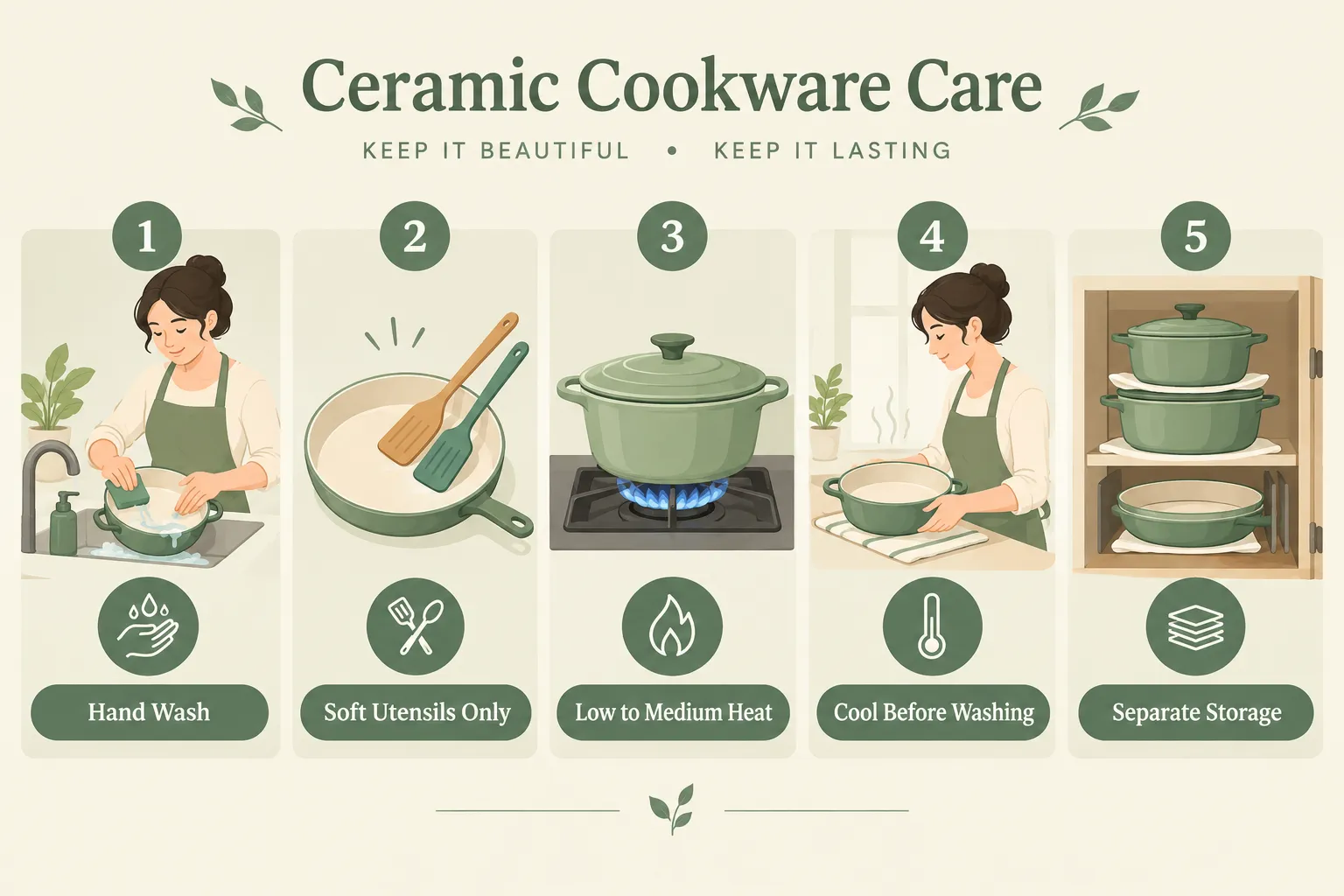
Most ceramic cookware manufacturers recommend hand washing, even when the set is labeled dishwasher safe, because repeated exposure to dishwasher detergent and heat accelerates coating breakdown.
Hand washing with mild soap and a soft sponge is the safest long-term choice for any ceramic nonstick skillet.
Check Current Pricing and Availability in the US or in the UK to See Today’s Offers
Food Network’s nontoxic cookware guide specifically advises against the dishwasher for ceramic pieces and recommends soft utensils only, pairing that advice with separate storage to prevent edge chipping during stacking. Some newer lines push back on this caution.
Ninja’s NeverQuit ceramic set, for instance, markets full dishwasher and metal-utensil safety alongside its three-year coating guarantee, a notable claim given how most ceramic coatings have traditionally reacted poorly to both, as detailed by Homes & Gardens.
Decision rule: if your ceramic cookware set did not launch with an explicit multi-year durability warranty tied to dishwasher use, hand wash it anyway. The small time cost is cheaper than replacing a $200 skillet a year early.
Best Practices for Nonstick, Cast Iron, Carbon Steel, and Other Cookware Care
Every cookware material has its own care rules, and mixing them up is one of the fastest ways to shorten a pan’s life. Ceramic nonstick needs gentle heat and soft tools, cast iron needs seasoning and avoids soap, and stainless steel can handle higher heat and metal utensils without damage.
Quick reference by material:
- Ceramic nonstick: low to medium heat, soft utensils, hand wash, cool before washing.
- Traditional PTFE nonstick: similar gentle care, avoid heat above 500°F to protect the coating.
- Cast iron: season regularly, avoid soaking, dry immediately to prevent rust. See our cast iron seasoning guide for a full walkthrough.
- Carbon steel: similar to cast iron, needs seasoning and careful drying.
- Stainless steel and aluminum: more forgiving of metal utensils and higher heat, but still benefits from avoiding thermal shock.
Because ceramic and traditional nonstick look similar on a shelf, shoppers often apply cast iron logic, like high heat searing, to a ceramic skillet and burn through the coating in months.
Knowing which rules apply to which pan is the single easiest durability win in any kitchen. For more on avoiding PFAS entirely across materials, see our guide to cookware free of PFAS risks.
What to Look for and What to Avoid When Shopping
When shopping for the Best Durable Ceramic Cookware, look for a heavy base metal, a multi-layer ceramic coating, a clearly stated ovensafe temperature, and a written durability warranty of at least three years.
Avoid sets with vague marketing language, no stated oven temperature, or unusually light weight for their size, since light weight often signals a thin, short-lived base.
What to look for:
- Hard-anodized aluminum, forged steel, or clad stainless construction underneath the ceramic coating.
- A stated PFAS-free, PTFE-free, and PFOA-free coating, since ceramic coatings never contain these chemicals but brands now confirm it explicitly amid wider industry transparency pushes, including Caraway Home’s 2026 PFAS-free campaign.
- A specific ovensafe temperature rating, not a vague “oven safe” claim.
- Riveted or cast handles rather than screwed-on plastic handles.
What to avoid:
- Extremely cheap sets with no stated coating thickness or warranty.
- Pans that feel unusually light for their cooking surface diameter and capacity.
- Vague “durable” marketing with no testing data or warranty terms backing it up.
- Mixing metal utensils into a kitchen full of ceramic nonstick cookware, even accidentally.
I learned this one the hard way myself. A few years back I grabbed a metal spatula out of habit while flipping eggs in a ceramic skillet, and within three months there was a visible scratch pattern right where the spatula had scraped the surface each time.
Switching to a silicone turner and hand washing afterward noticeably slowed the wear on the replacement pan. For general shopping criteria across all cookware types, our guide on what considerations are important when selecting cookware is a useful next read.
What Size Skillet Should You Get
The right skillet size depends on how many people you typically cook for and what you cook most often. A 10-inch skillet suits one or two people and everyday tasks like eggs and sautéing vegetables, while a 12-inch skillet handles family meals, searing multiple proteins, or batch cooking.
General sizing guide:
- 8 quot to 8.5 quot: single servings, small omelets, reheating.
- 10 quot to 10.5 quot: two person households, everyday sautéing and eggs.
- 12 quot to 12.5 quot: family cooking, searing, dishes that need more surface area.
- 13 quot and up: batch cooking, entertaining, or households that cook once and eat leftovers for days.
If your kitchen is tight on storage, our guide to cookware ideas for small kitchens covers how to pick sizes that nest and stack efficiently. Whether you choose a single 12 quot skillet or a full cookware set, matching the surface diameter to your actual cooking habits matters more than chasing the largest pan available.
Check Current Pricing and Availability in the US or in the UK to See Today’s Offers
Ceramic Cookware Dangers and Safety Considerations
There are no verified medical risks specific to properly used ceramic cookware, and the main safety consideration is structural, not chemical. Because ceramic coatings contain no PTFE, PFOA, or other PFAS compounds, they avoid the chemical concerns tied to older nonstick formulas, though overheating any coated pan past its rated temperature is never advisable.
The bigger practical risk with ceramic cookware dangers discussion online centers on chipped or flaking coatings being ingested in small amounts, which is why manufacturers recommend replacing a pan once the coating visibly peels or cracks.
This is a durability and product-life issue rather than a documented health hazard when the pan is used and cared for as directed. Just make sure to retire any pan showing significant coating loss rather than continuing to cook on a damaged surface.
For a deeper look at the pros and cons of this material, read our full ceramic cookware pros and cons breakdown, and for non-toxic set shopping specifically, see our list of non-toxic cookware sets to consider.
Frequently Asked Questions
What is the best type of frying pan for different cooking styles?
Ceramic nonstick suits eggs, fish, and low-oil cooking. Traditional PTFE nonstick handles daily high-heat sautéing with a longer coating life. Stainless steel is best for searing and sauces. Cast iron excels at retaining heat for steaks and cornbread. Match the pan to the cooking style rather than buying one pan for everything.
What pots can you use on a ceramic cooktop?
On a ceramic glass cooktop, use flat-bottomed cookware made from stainless steel, aluminum, cast iron with a smooth base, or ceramic-coated pans, since a flat, even base prevents scratching the glass surface. Avoid warped pans, rough cast iron bottoms, or anything with sharp edges that could scratch the cooktop during sliding or lifting.
Can you use oil in a ceramic pan?
Yes, you can and generally should use a small amount of oil or butter in a ceramic pan, even though the coating is naturally nonstick. A light coating of oil improves browning, protects the ceramic surface from dry high-heat stress, and helps maintain the nonstick ability of the coating over a longer period.
Are ceramic pans better than Teflon?
Neither is strictly better; each trades off differently. Ceramic pans are PFAS-free and handle higher heat, but typically lose nonstick performance within 1 to 3 years. Teflon, the common PTFE nonstick coating, usually lasts 3 to 5 years but cannot tolerate the same high heat and contains PTFE, historically linked to PFOA in manufacturing.
Conclusion
The Best Durable Ceramic Cookware in 2026 is not just the prettiest pan on the shelf. It is the set built on a heavy, well-constructed base with a reinforced ceramic nonstick coating, a clear ovensafe temperature, and a real warranty behind the coating itself.
Ceramic will likely never match the raw lifespan of stainless steel or outlast PTFE nonstick coating for coating, but brands like GreenPan, Le Creuset, Made In, Ninja, and HexClad are closing that gap fast with thicker bases, multi-layer coatings, and warranties stretching from three years to a lifetime.
If you are shopping right now, start by matching skillet size to your household, check whether the set is genuinely induction-compatible if you have an induction range, and commit to hand washing with soft utensils from day one.
That single habit change extends ceramic coating life more than almost any brand choice. Shop the GreenPan Valencia Pro or a comparable hard-anodized ceramic nonstick skillet as your starting point, and build out a full cookware set from there once you know which sizes you actually reach for every week.
Ready to compare specific models side by side before you buy?
Check Current Pricing and Availability in the US or in the UK to See Today’s Offers on top-rated ceramic nonstick cookware.

Leave a Reply
You must be logged in to post a comment.