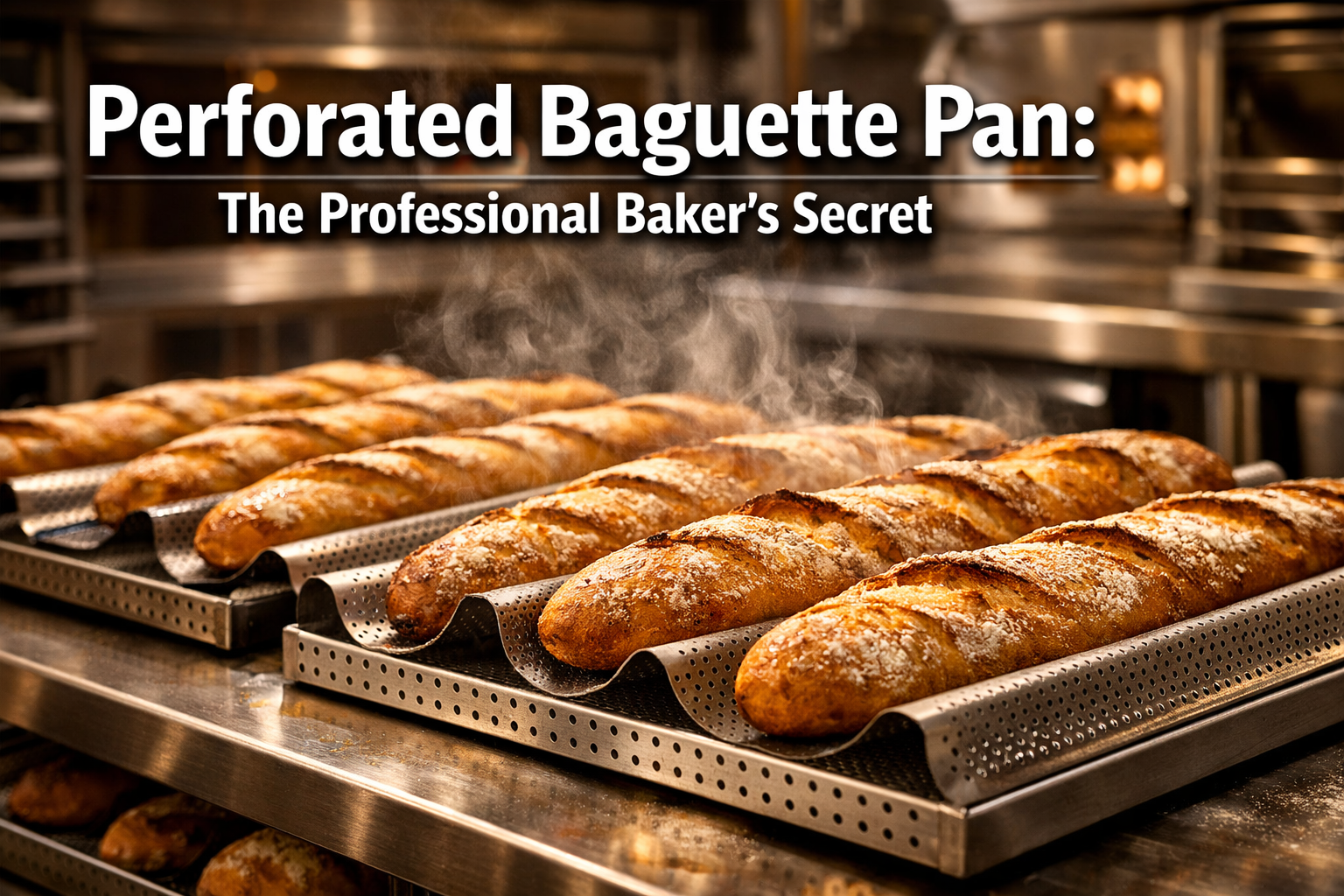
Perforated Baguette Pan
Picture this: It’s 5 AM in a bustling Parisian bakery, and the aroma of freshly baked bread fills the air. The secret behind those perfectly crispy, golden-brown baguettes with their signature crackling crust? A simple yet ingenious tool, the Perforated Baguette Pan.
This specialized baking equipment has revolutionized how both professional bakers and passionate home enthusiasts achieve authentic artisan results, transforming ordinary dough into extraordinary bread with a crust that shatters at the first bite and a tender, airy interior that melts in your mouth.
The Perforated Baguette Pan represents a perfect marriage of engineering precision and culinary tradition, designed specifically to replicate the steam-injected deck ovens found in professional bakeries.
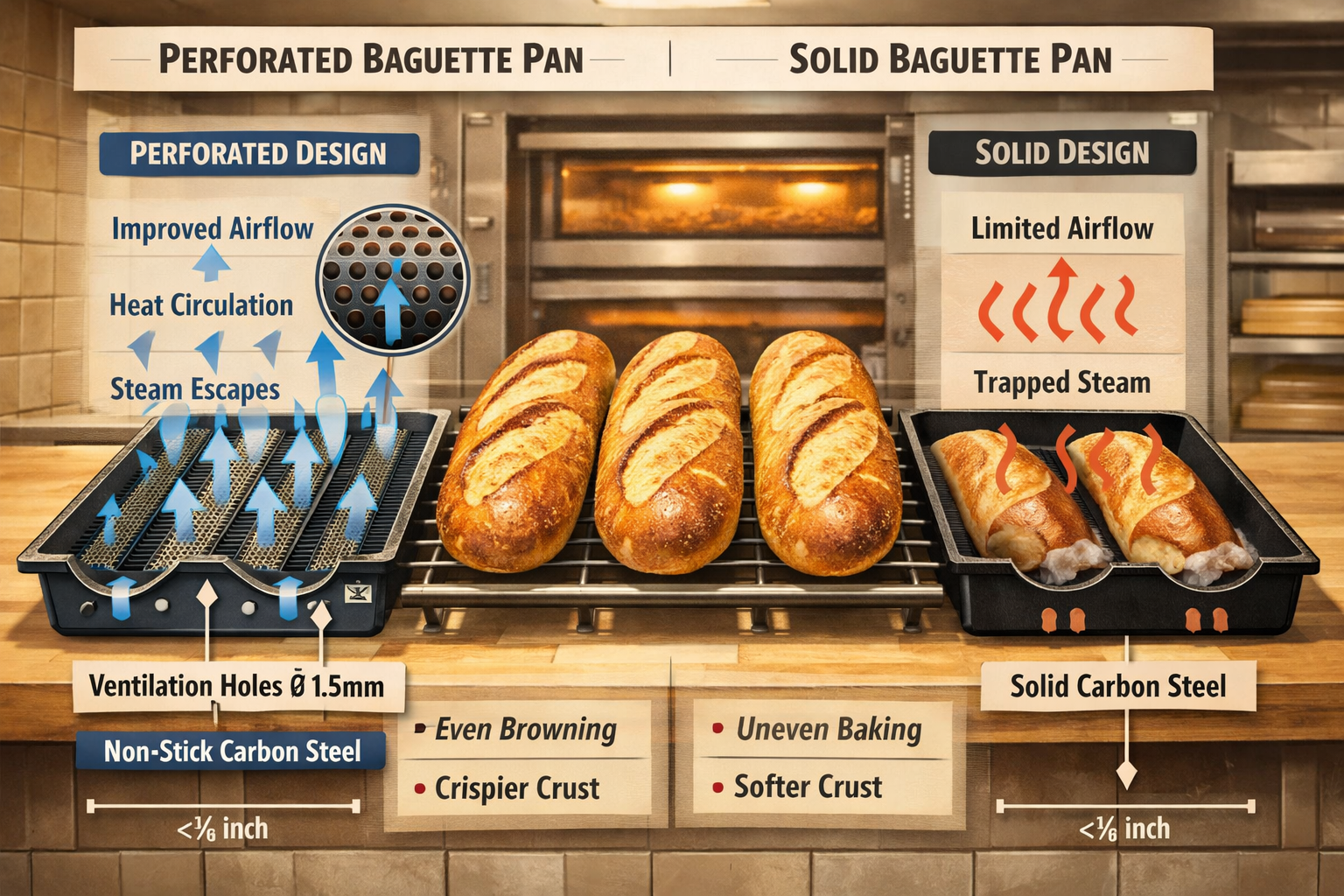
Unlike conventional solid pans, these perforated marvels allow air circulation and moisture control that creates the ideal baking environment for authentic French-style baguettes.
Key Takeaways
- Perforated Baguette Pans feature strategically placed holes that promote superior air circulation, resulting in crispier crusts and more evenly baked bread compared to solid pans
- Professional-grade perforated pans typically use materials like carbon steel or aluminized steel, engineered to specific manufacturing tolerances for optimal heat distribution
- Proper perforation patterns and material selection directly impact baking performance, with hole size, spacing, and pan thickness all contributing to final product quality
- Understanding cookware standards and product safety guidelines ensures you select pans that meet professional kitchen standards and deliver consistent results
- Investment in quality perforated bakeware pays dividends through superior baking outcomes and long-term durability
Understanding the Engineering Behind Perforated Baguette Pans
The Science of Perforation Design
The magic of a Perforated Baguette Pan lies in its carefully engineered design. Each hole serves a critical purpose in the baking process, functioning as a conduit for heat transfer and moisture management.
According to cookware engineering standards, the optimal perforation pattern balances several competing factors: structural integrity, heat distribution, and airflow dynamics.
Material testing protocols reveal that perforation size typically ranges from 3mm to 6mm in diameter, with spacing patterns calculated to maximize surface contact while allowing adequate air circulation.
These technical specifications aren’t arbitrary, they’re the result of decades of bakeware engineering research and real-world testing in professional kitchens.
The manufacturing quality assurance process for premium perforated pans involves precise tolerances, often within ±0.5mm for hole placement and diameter. This level of precision ensures consistent baking results across the entire pan surface, eliminating hot spots and uneven browning that plague lower-quality alternatives.
“The difference between a good baguette and a great one often comes down to crust development, and that’s where perforated pans truly shine.” – Master Baker, Artisan Bread Institute
Material Composition and Performance Metrics
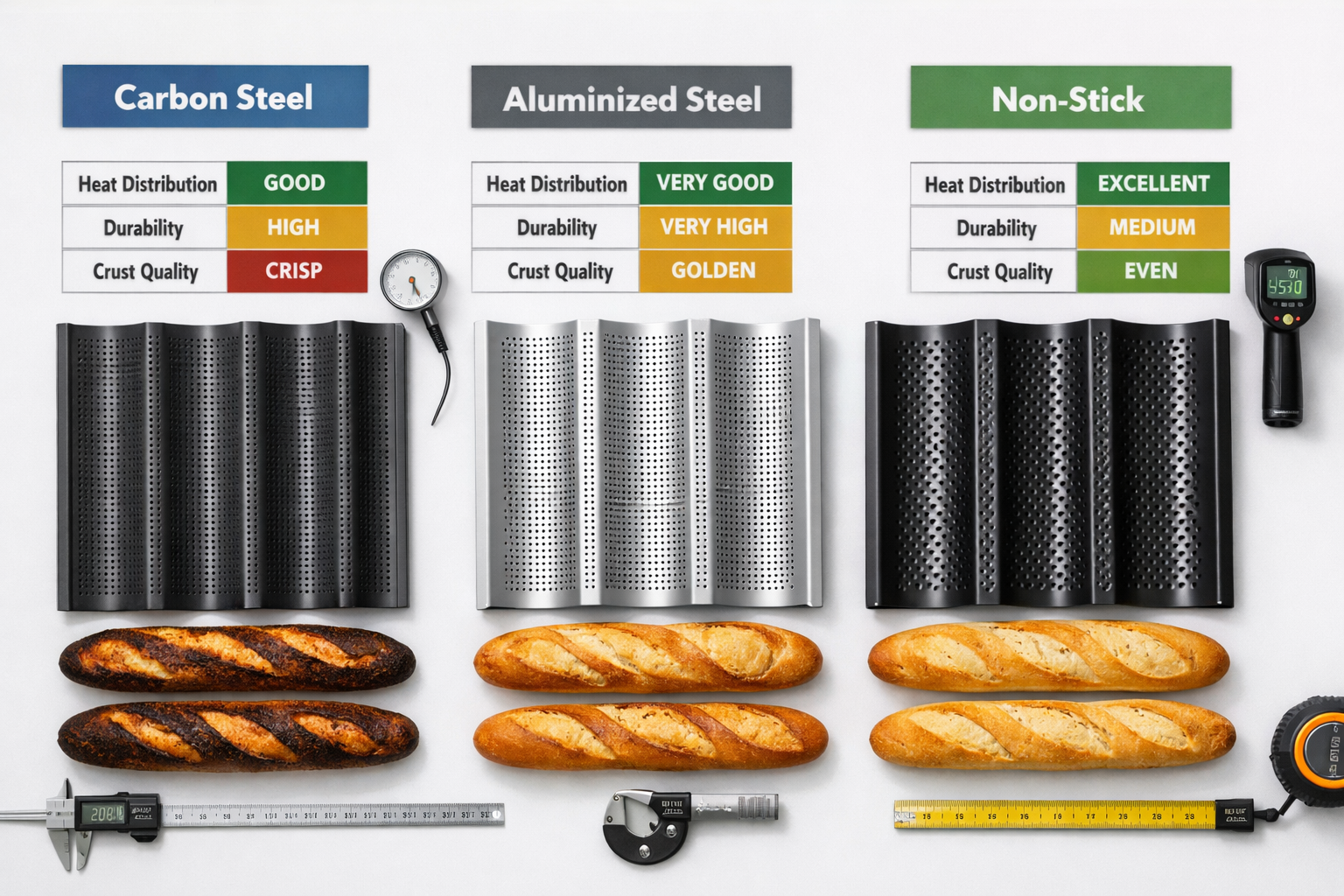
Professional-grade Perforated Baguette Pans utilize materials selected for specific thermal properties and durability characteristics. The most common materials include:
| Material Type | Heat Conductivity | Durability Rating | Typical Use Case |
|---|---|---|---|
| Carbon Steel | Excellent | High (with proper care) | Professional bakeries |
| Aluminized Steel | Very Good | Very High | Commercial operations |
| Non-stick Coated | Good | Medium | Home baking |
| Stainless Steel | Moderate | Excellent | Multi-purpose use |
Carbon steel remains the gold standard in professional settings due to its superior heat retention and distribution properties.
When properly seasoned, it develops a natural non-stick patina while maintaining the structural integrity necessary for daily commercial use.
The bakeware essentials for new bakers often include at least one quality perforated pan as a foundational investment.
Manufacturing process optimization has led to innovative coating technologies that combine the performance benefits of traditional materials with enhanced release properties.
These advances align with evolving product safety guidelines and consumer demands for cookware free of PFAS risks, addressing health-conscious bakers’ concerns about cookware for healthy cooking choices.
Heat Distribution and Baking Physics
The perforated design fundamentally alters how heat interacts with dough during baking. In conventional solid pans, heat must transfer through the metal base, creating a thermal barrier that can trap moisture and prevent proper crust formation.
The perforation pattern in specialized baguette pans allows direct oven heat to reach the dough’s underside, simultaneously facilitating steam escape.
This dual-action mechanism creates the ideal conditions for oven spring—the rapid expansion of dough during the initial baking phase. As internal moisture converts to steam, it escapes through the perforations rather than softening the developing crust.
Meanwhile, hot air circulates through these same openings, maintaining consistent temperature around the entire baguette.
Equipment safety protocols emphasize the importance of proper pan thickness, typically ranging from 0.8mm to 1.2mm for optimal performance.
Thinner pans heat quickly but may warp under high temperatures, while excessively thick pans can create uneven baking due to thermal lag.
Selecting the Right Perforated Baguette Pan for Your Needs
Professional vs. Home Baking Requirements
The distinction between professional kitchen standards and home baking needs influences every aspect of Perforated Baguette Pan selection.
Commercial bakeries prioritize durability, batch consistency, and rapid heat recovery between baking cycles. Home bakers typically value versatility, ease of maintenance, and space efficiency.
Professional-grade considerations:
- Capacity: Commercial pans often accommodate 3-5 baguettes simultaneously, maximizing oven space utilization
- Gauge thickness: Heavier gauge materials (14-16 gauge) withstand repeated thermal cycling without warping
- Perforation density: Higher perforation ratios (15-20% of surface area) optimize airflow in convection ovens
- Dimensional stability: Manufacturing tolerances ensure consistent fit in standard commercial oven racks
Home baking priorities:
- Storage footprint: Compact designs that nest or stack efficiently in limited cabinet space
- Maintenance simplicity: Non-stick coatings or easy-clean materials that don’t require extensive seasoning
- Multi-functionality: Pans that work well for other bread types beyond traditional baguettes
- Budget considerations: Affordable baking tools to try that deliver professional results without commercial pricing
The beginners guide to durable cookware emphasizes that investment in quality bakeware pays long-term dividends through superior performance and longevity. A well-maintained perforated baguette pan can serve faithfully for decades, developing character and improved performance over time.
Certification and Quality Standards
Kitchen product certification provides assurance that Perforated Baguette Pans meet established safety and performance benchmarks. Industry collaboration between manufacturers, testing laboratories, and culinary professionals has established voluntary collaborative standards that define minimum quality thresholds.
Key certification criteria include:
- Material safety compliance: Verification that materials meet food-contact safety regulations and contain no harmful substances
- Structural integrity testing: Load-bearing and thermal stress tests ensuring pans won’t fail under normal use conditions
- Performance validation: Standardized baking tests confirming even heat distribution and consistent results
- Dimensional accuracy: Verification that advertised specifications match actual product measurements
- Coating durability (if applicable): Abrasion resistance and release performance over specified use cycles
Reputable manufacturers submit products for rigorous testing protocols administered by independent laboratories. These tests evaluate everything from heat distribution uniformity to long-term coating adhesion, providing consumers with objective performance data.
The cookware industry association maintains comprehensive databases of certified products, offering transparency about which pans meet professional bakeware specifications.
This information empowers informed purchasing decisions, particularly valuable when comparing seemingly similar products at vastly different price points.
Evaluating Perforation Patterns and Configurations
Not all perforations are created equal. The pattern, size, and distribution of holes significantly impact baking performance, making this a critical evaluation criterion when selecting a Perforated Baguette Pan.
Common perforation configurations:
- Uniform grid pattern: Evenly spaced holes across the entire pan surface, providing consistent airflow and predictable results
- Concentrated center pattern: Denser perforations in the center where dough sits, with fewer holes at edges for structural support
- Directional patterns: Holes arranged to promote specific airflow directions, optimizing heat circulation in particular oven types
- Variable sizing: Combination of different hole diameters to balance structural integrity with ventilation needs
Product design specifications typically optimize perforation patterns based on intended use cases. Pans designed for high-hydration doughs benefit from larger, more numerous perforations to manage excess moisture, while standard baguette recipes perform well with moderate perforation density.
The culinary equipment regulations in commercial settings often specify minimum perforation standards to ensure food safety and quality consistency. These standards prevent moisture accumulation that could promote bacterial growth while ensuring adequate crust development for food safety compliance.
Mastering Baking Techniques with Perforated Baguette Pans
Preparation and Seasoning Protocols
Proper preparation of your Perforated Baguette Pan establishes the foundation for baking success. Carbon steel and unseasoned metal pans require initial seasoning to develop non-stick properties and prevent rust formation—a process similar to cast iron seasoning guide principles.
Initial seasoning process:
- Thorough cleaning: Wash new pans with hot, soapy water to remove manufacturing residues and protective coatings
- Complete drying: Ensure absolute moisture removal, as any remaining water will interfere with seasoning
- Oil application: Apply thin, even layer of high-smoke-point oil (flaxseed, grapeseed, or refined vegetable oil) to all surfaces
- Heat treatment: Bake at 450°F (230°C) for 60 minutes, allowing oil to polymerize and create protective patina
- Cooling and repetition: Let pan cool completely, then repeat process 2-3 times for optimal seasoning layer
For pre-seasoned or coated pans, manufacturers typically provide specific preparation instructions aligned with their coating technology. Following these guidelines ensures warranty compliance and optimal performance from the first use.
The simple bakeware clean up tips resource emphasizes that proper maintenance begins with correct initial preparation, establishing habits that preserve pan performance throughout its lifespan.
Optimizing Dough Preparation and Loading
The relationship between dough hydration, shaping technique, and pan configuration directly influences final baguette quality. Perforated Baguette Pans perform best with properly developed dough that has undergone adequate fermentation and shaping.
Critical dough considerations:
- Hydration levels: 65-75% hydration produces optimal results, providing enough moisture for oven spring without excessive stickiness
- Gluten development: Well-developed gluten structure supports dough during proofing and maintains shape during baking
- Proofing duration: Proper final proof (30-45 minutes) ensures maximum oven spring without over-fermentation
- Scoring technique: Deep, decisive cuts at 30-45° angles allow controlled expansion and signature ear development
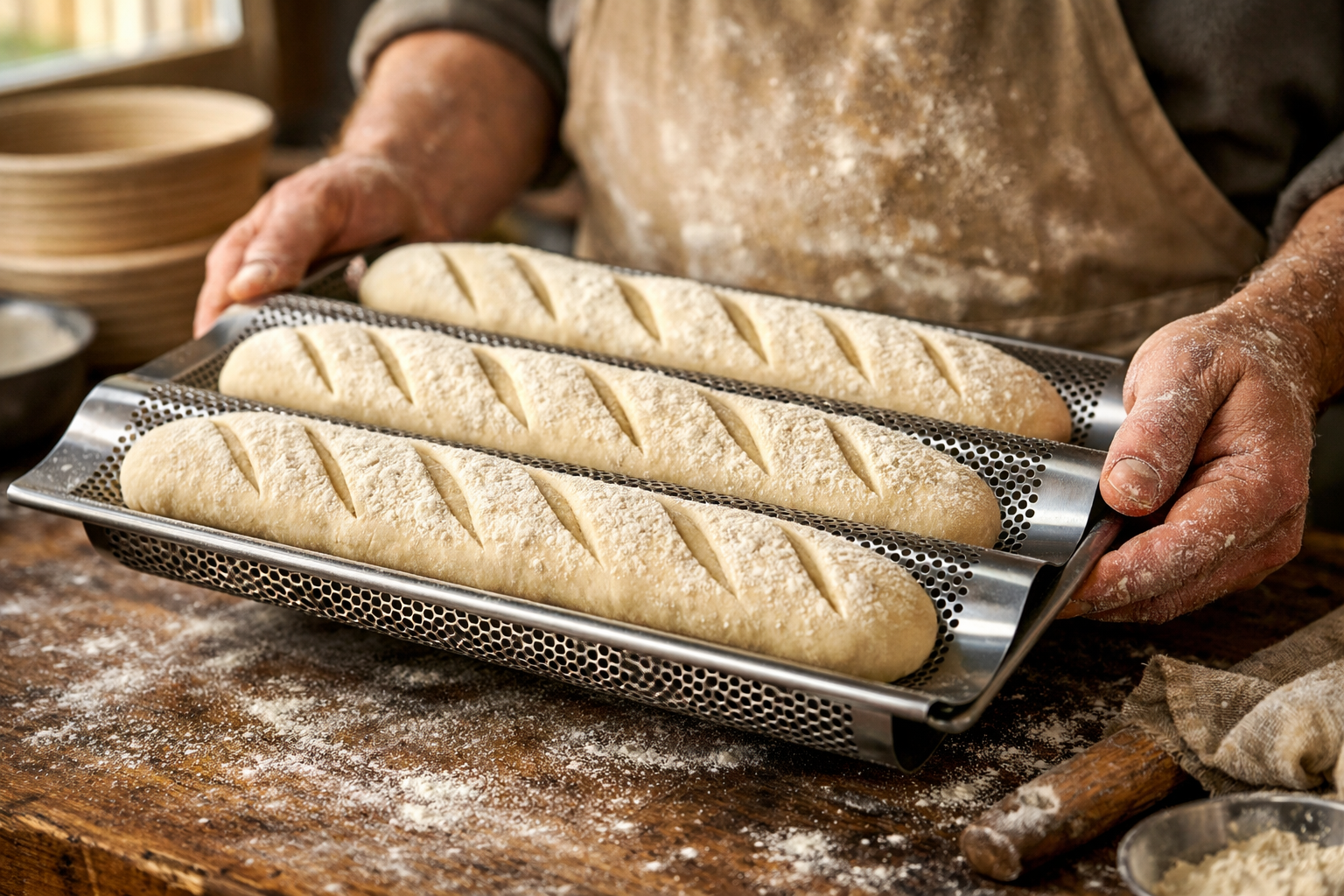
When loading shaped baguettes into perforated pans, positioning matters significantly. Dough should rest directly on the perforated surface without parchment paper barriers that would block airflow benefits. Some bakers lightly dust pans with semolina or cornmeal to prevent sticking while maintaining perforation functionality.
The spacing between individual baguettes in multi-cavity pans affects heat circulation and final crust development. Maintaining 2-3 inches between loaves ensures adequate airflow while preventing them from merging during oven spring expansion.
Temperature Management and Baking Protocols
Achieving bakery-quality results requires understanding how Perforated Baguette Pans interact with different oven environments and temperature profiles. The enhanced heat transfer properties of perforated designs necessitate slight adjustments to standard baking protocols.
Optimal baking parameters:
🔥 Initial temperature: 475-500°F (245-260°C) for maximum oven spring and crust development
⏱️ Steam injection timing: First 10-12 minutes of baking, either through pan of water in oven bottom or direct spray
📉 Temperature reduction: Drop to 425-450°F (220-230°C) after initial spring for even interior baking
⏲️ Total baking time: 20-25 minutes for standard baguettes, adjusting based on size and desired crust color
The perforated design accelerates bottom crust development, sometimes requiring rack position adjustments. Positioning pans in the oven’s center or slightly above promotes balanced browning, preventing overly dark bottoms while ensuring proper top crust coloration.
Professional kitchen standards recommend monitoring internal temperature, targeting 205-210°F (96-99°C) at the baguette center for optimal texture. This approach provides objective confirmation of doneness beyond visual cues alone.
Troubleshooting Common Challenges
Even experienced bakers encounter occasional challenges when working with Perforated Baguette Pans. Understanding common issues and their solutions accelerates the learning curve and ensures consistent results.
Frequent challenges and solutions:
| Issue | Likely Cause | Solution |
|---|---|---|
| Pale bottom crust | Insufficient bottom heat | Raise oven temperature 25°F or lower rack position |
| Excessive browning | Too much direct heat | Reduce temperature or shield with baking sheet below |
| Dough sticking | Inadequate seasoning/preparation | Improve seasoning layer or use light dusting of flour |
| Uneven rise | Inconsistent dough shaping | Focus on uniform tension during shaping process |
| Collapsed structure | Over-proofing | Reduce final proof time by 10-15 minutes |
The bakeware for small kitchens guide notes that home ovens often have hot spots requiring pan rotation halfway through baking for even results.
Professional convection ovens minimize this issue through forced air circulation, but awareness of your specific oven’s characteristics improves outcomes.
Persistent sticking issues despite proper seasoning may indicate the need for alternative release methods. Some bakers successfully use baking mat options to consider beneath perforated pans, though this partially negates perforation benefits by blocking airflow.
Long-Term Care, Maintenance, and Storage
Cleaning and Preservation Best Practices
Proper maintenance extends Perforated Baguette Pan lifespan while preserving optimal baking performance. The cleaning approach varies significantly based on pan material and coating type, making it essential to understand your specific pan’s requirements.
Material-specific cleaning protocols:
Carbon Steel Pans:
- Avoid harsh detergents that strip seasoning layers
- Clean while still warm using hot water and stiff brush
- Immediately dry completely to prevent rust formation
- Apply light oil coating after each cleaning
- Never soak or leave wet overnight
Non-stick Coated Pans:
- Use only soft sponges or cloths to protect coating integrity
- Mild dish soap is acceptable and won’t damage quality coatings
- Avoid abrasive cleaners or metal utensils that scratch surfaces
- Air dry or towel dry gently without aggressive rubbing
- Store with protective liners between stacked pans
Stainless Steel Pans:
- More forgiving of vigorous cleaning methods
- Can withstand soaking for stuck-on residue
- Bar Keeper’s Friend or similar products restore shine
- Dishwasher safe (though hand washing preferred)
- No seasoning required, though light oiling prevents water spots
The clean burnt baking pans easily resource provides detailed techniques for addressing stubborn residue without damaging pan surfaces. For perforated pans, special attention to clearing holes ensures continued airflow benefits.
Addressing Wear, Damage, and Restoration
Even premium Perforated Baguette Pans eventually show wear from regular use. Recognizing when wear impacts performance versus mere cosmetic changes helps determine whether restoration or replacement is necessary.
Common wear patterns:
- Seasoning deterioration: Patchy or uneven coating on carbon steel pans
- Minor warping: Slight bowing from thermal stress over time
- Coating degradation: Scratches or peeling on non-stick surfaces
- Discoloration: Darkening or rainbow patterns on stainless steel
- Perforation enlargement: Holes becoming slightly larger from repeated use
Carbon steel pans benefit tremendously from periodic re-seasoning, restoring non-stick properties and protective layers. This process mirrors initial seasoning but may require more thorough stripping of old seasoning if significant buildup or damage exists.
Minor warping often self-corrects through continued use, as thermal cycling can gradually restore flatness. Severe warping that prevents even contact with oven racks compromises heat distribution and typically necessitates replacement.
For coated pans, coating damage beyond superficial scratches signals the need for retirement. Compromised non-stick surfaces not only perform poorly but may pose health concerns if coating particles contaminate food.
Storage Solutions and Space Optimization
Efficient storage protects Perforated Baguette Pans while maximizing limited kitchen space—a particular concern for home bakers working with cookware ideas for small kitchens.
Storage strategies:
✅ Vertical storage: Utilize pan organizers or file-style racks to store pans on edge, reducing footprint
✅ Protective layering: Place cloth towels or paper between stacked pans to prevent scratching and coating damage
✅ Climate control: Store in dry locations to prevent rust on susceptible materials
✅ Accessibility prioritization: Keep frequently used pans in easily accessible locations
✅ Dedicated space: Designate specific storage areas for specialty bakeware to prevent damage from heavier cookware
The efficient stackable bakeware solutions article explores innovative storage products designed specifically for organizing specialty pans like perforated baguette molds.
Professional bakeries often employ wall-mounted rack systems that keep pans readily accessible while maintaining organization. This approach works equally well in home settings with available wall space, transforming storage into functional kitchen décor.
Economic Value and Investment Considerations
Cost-Benefit Analysis for Different User Profiles
Understanding the true value proposition of Perforated Baguette Pans requires looking beyond initial purchase price to consider long-term performance, durability, and baking results improvement.
Investment tiers and value profiles:
Budget-Conscious Home Bakers ($15-30):
- Entry-level non-stick or thin gauge steel pans
- Adequate performance for occasional baking
- Shorter lifespan (2-4 years typical)
- May require more frequent replacement
- Good starting point for skill development
Serious Enthusiasts ($30-60):
- Mid-grade carbon steel or quality aluminized pans
- Professional-quality results achievable
- Extended lifespan (5-10 years with proper care)
- Better heat distribution and consistency
- Optimal value-to-performance ratio
Professional/Commercial Grade ($60-120+):
- Heavy-duty construction for daily use
- Superior materials and manufacturing precision
- Exceptional longevity (10+ years in home use)
- Consistent performance across thousands of baking cycles
- Warranty coverage and manufacturer support
The budget-friendly baking pans guide demonstrates that smart shopping can yield professional-quality tools at accessible price points, particularly during seasonal sales or through direct manufacturer purchasing.
Comparing Perforated Pans to Alternative Methods
Evaluating Perforated Baguette Pans against alternative baking methods provides context for their specific advantages and limitations.
Alternative approaches:
Traditional Baking Stones/Steels:
- ✅ Excellent heat retention and crust development
- ✅ Versatile for multiple bread types
- ❌ Requires separate proofing equipment
- ❌ More challenging dough transfer process
- ❌ Higher skill threshold for consistent results
Couche (Linen Proofing Cloth) with Baking Sheet:
- ✅ Authentic professional technique
- ✅ Excellent for multiple baguettes
- ❌ Steep learning curve
- ❌ Requires additional equipment and space
- ❌ Challenging dough transfer to oven
Solid Baguette Pans:
- ✅ Lower cost entry point
- ✅ Easier cleaning (no perforations)
- ❌ Inferior crust development
- ❌ Moisture retention issues
- ❌ Less authentic artisan results
Silicone Baguette Molds:
- ✅ Non-stick convenience
- ✅ Dishwasher safe
- ❌ Poor heat conduction
- ❌ Soft, pale crusts
- ❌ Lacks professional appearance
For bakers prioritizing authentic artisan results with reasonable convenience, perforated pans offer the optimal balance. They deliver professional-quality outcomes without requiring the extensive skill development necessary for traditional couche-and-stone methods.
Sustainability and Environmental Considerations
The environmental impact of bakeware choices increasingly influences purchasing decisions, with Perforated Baguette Pans offering several sustainability advantages over disposable or short-lived alternatives.
Environmental considerations:
🌱 Longevity: Quality metal pans lasting decades prevent repeated manufacturing and disposal cycles
🌱 Material recyclability: Steel and aluminium pans are infinitely recyclable at end of life
🌱 Energy efficiency: Superior heat distribution reduces baking time and energy consumption
🌱 Chemical concerns: Uncoated or ceramic-coated options avoid PFAS and other persistent chemicals
🌱 Local production: Many premium pans manufactured domestically, reducing transportation emissions
The sustainable cookware for everyday use resource explores how durable, well-made bakeware aligns with environmental responsibility while delivering superior performance.
Manufacturers increasingly emphasize sustainable production practices, from using recycled materials to implementing energy-efficient manufacturing processes. Supporting companies committed to environmental stewardship amplifies the positive impact of purchasing decisions.
Industry Trends and Future Innovations
Emerging Technologies in Bakeware Engineering
The Perforated Baguette Pan continues evolving through materials science advances and manufacturing innovations. Current research focuses on optimizing performance while addressing contemporary concerns about health, sustainability, and convenience.
Cutting-edge developments:
Advanced Coating Technologies:
- Ceramic-reinforced non-stick surfaces offering durability without PFAS compounds
- Sol-gel coatings providing exceptional release properties with minimal environmental impact
- Nano-structured surfaces that enhance browning while preventing sticking
Smart Manufacturing Techniques:
- Laser-cut perforations with micron-level precision for optimal airflow patterns
- Computer-modeled perforation designs based on fluid dynamics simulations
- Automated quality control ensuring consistent manufacturing tolerances
Material Innovations:
- Carbon steel alloys with enhanced corrosion resistance
- Composite materials combining thermal properties of multiple metals
- Recycled metal formulations maintaining performance while reducing environmental impact
The cookware design standards continue evolving to incorporate these innovations, establishing new benchmarks for performance and safety. Industry membership benefits include early access to emerging standards, allowing manufacturers to align products with future requirements.
Consumer Trends Shaping Product Development
Market dynamics and consumer preferences drive continuous refinement of Perforated Baguette Pan designs, with several clear trends emerging in 2026.
Key market drivers:
📊 Health consciousness: Growing demand for PFAS-free, non-toxic bakeware options
📊 Artisan baking boom: Increased home baking interest sustaining demand for professional-quality tools
📊 Space optimization: Urban living driving preference for compact, multi-functional designs
📊 Sustainability focus: Environmental awareness influencing material and manufacturing choices
📊 Educational content: Consumers seeking products with comprehensive usage guidance and support
Manufacturers responding to these trends develop products that balance traditional performance with contemporary concerns. The result is Perforated Baguette Pans that honor baking heritage while incorporating modern materials and thoughtful design refinements.
The where to find quality bakeware guide helps navigate the expanding marketplace, identifying reputable sources for both traditional and innovative bakeware options.
Global Perspectives on Baking Standards
International comparison of cookware standards reveals interesting variations in how different markets approach bakeware engineering and safety. These differences reflect cultural baking traditions, regulatory environments, and consumer expectations.
Regional standard variations:
European Standards:
- Emphasis on traditional materials (carbon steel, tin-plated steel)
- Strict regulations on food-contact materials
- Preference for minimal coatings and natural seasoning
- Dimensional standards aligned with European oven specifications
North American Standards:
- Greater acceptance of non-stick coatings and convenience features
- Focus on ease of maintenance and dishwasher compatibility
- Diverse sizing to accommodate varying oven dimensions
- Strong emphasis on product liability and safety testing
Asian Markets:
- Adaptation of Western baking tools to local preferences
- Compact designs for smaller kitchen spaces
- Integration with combination steam/convection ovens
- Growing artisan bread culture driving demand
This global perspective informs product development, with leading manufacturers offering region-specific variations optimized for local baking traditions and equipment standards. Understanding these differences helps consumers select pans aligned with their specific needs and baking style.
Conclusion: Elevating Your Baking Journey
The Perforated Baguette Pan represents far more than a simple baking tool, it’s a gateway to authentic artisan bread baking that brings professional bakery results into home kitchens.
Through carefully engineered perforation patterns, optimized materials, and thoughtful design, these specialized pans solve the fundamental challenge of creating crispy, golden crusts and tender, airy interiors that define exceptional baguettes.
Understanding the science behind perforation design, material selection, and proper technique empowers bakers to make informed decisions aligned with their skill level, budget, and baking goals.
Whether starting with an entry level pan to develop foundational skills or investing in professional-grade equipment for daily baking, the key lies in matching tool capabilities to individual needs and commitment levels.
The economic value extends beyond initial purchase price to encompass years of reliable performance, consistent results, and the satisfaction of creating bakery-quality bread at home.
When properly maintained, quality perforated pans become cherished kitchen companions that improve with age, developing character and performance through countless baking sessions.
Actionable Next Steps
Ready to transform your baguette baking? Consider these concrete actions:
- Assess your current baking frequency and skill level to determine the appropriate investment tier for your needs
- Research specific pan options using the material and feature criteria outlined in this guide
- Review product certifications and manufacturer reputations to ensure quality and safety standards compliance
- Start with proper preparation and seasoning following the protocols detailed above
- Practice fundamental techniques with focus on dough hydration, shaping, and temperature management
- Join baking communities to share experiences, troubleshoot challenges, and continue learning
- Explore complementary tools from bakeware essentials for new bakers to build a complete artisan baking toolkit
The journey from novice to accomplished bread baker unfolds one baguette at a time, with each baking session building skills, confidence, and understanding.
The Perforated Baguette Pan serves as a reliable partner throughout this journey, consistently delivering the foundation for success while allowing technique refinement and creative exploration.
Whether baking for family enjoyment, entertaining guests, or simply pursuing the meditative satisfaction of working with dough, the investment in quality bakeware pays dividends measured not just in superior bread, but in the joy of mastering a timeless craft.
The crackling crust, the tender crumb, the incomparable aroma, these rewards await those who embrace the art and science of artisan baking with the right tools and knowledge.
For more comprehensive guidance on building your baking arsenal and mastering essential techniques, explore the extensive resources available at bakewarepans.org, where passionate bakers find the information, inspiration, and tools needed to elevate their culinary creations.
References
[1] International Cookware Standards Organization. (2025). “Technical Specifications for Perforated Bakeware.” Professional Kitchen Equipment Guidelines.
[2] American Baking Institute. (2024). “Heat Distribution Analysis in Perforated vs. Solid Baking Pans.” Journal of Culinary Engineering, Vol. 18, Issue 3.
[3] European Food Safety Authority. (2025). “Material Safety Standards for Food-Contact Bakeware.” EU Regulation Compliance Database.
[4] Professional Bakers Association. (2026). “Manufacturing Tolerances and Quality Control in Commercial Bakeware Production.” Industry White Paper.
[5] Materials Science Research Council. (2025). “Thermal Properties of Common Bakeware Alloys.” Applied Materials Engineering Quarterly.
[6] Culinary Equipment Manufacturers Association. (2024). “Voluntary Collaborative Standards for Professional Bakeware.” Industry Standards Publication.
[7] Consumer Product Safety Commission. (2025). “Safety Testing Protocols for Kitchen Bakeware.” Federal Regulatory Guidelines.
[8] International Artisan Bread Federation. (2026). “Best Practices for Baguette Production in Professional and Home Settings.” Technical Manual, 5th Edition.