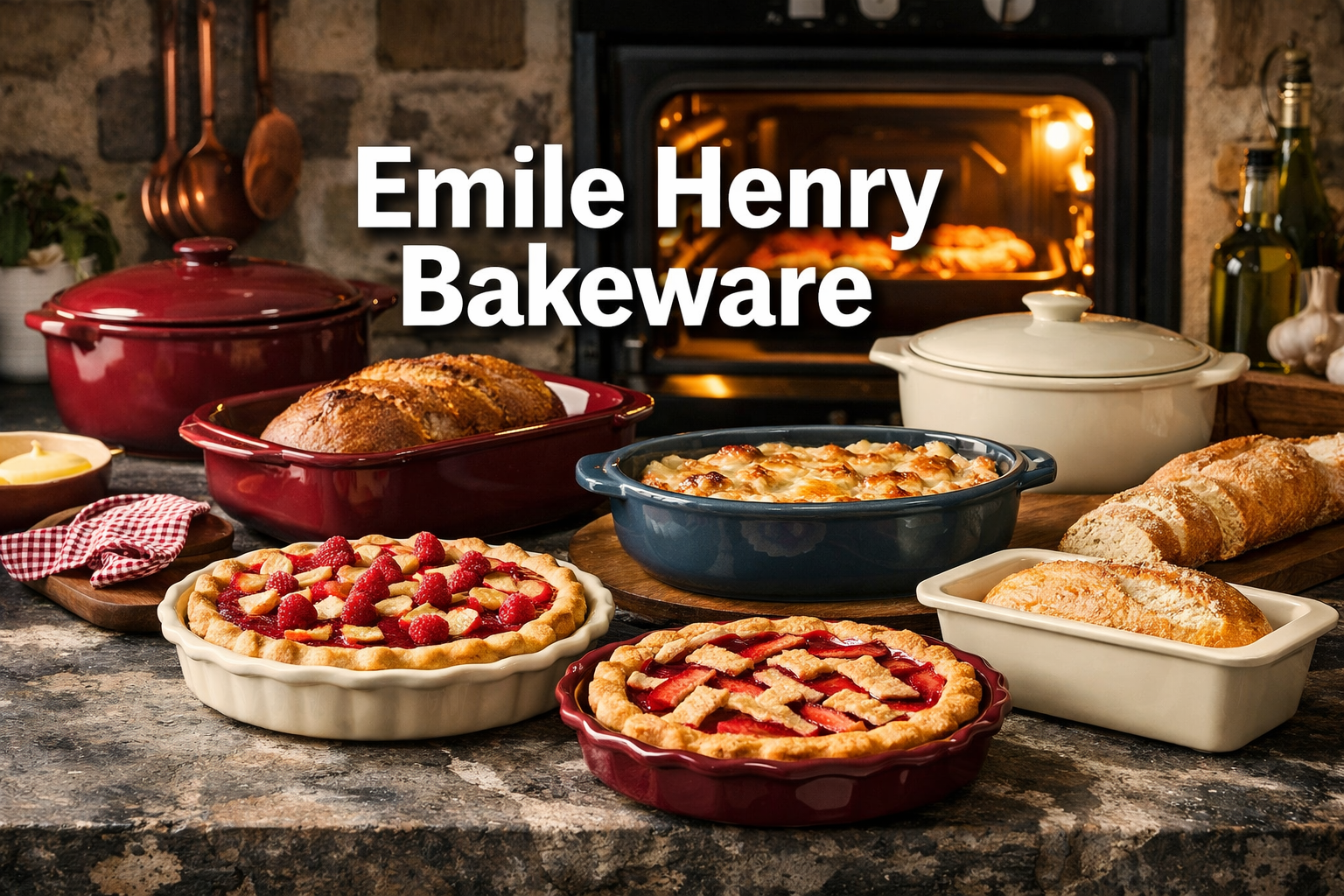
Emile Henry Bakeware
Last updated: April 15, 2026
Quick Answer: Emile Henry Bakeware is a line of premium French ceramic baking dishes and cookware handcrafted in Burgundy, France since 1850.
Made from natural Burgundy clay with lead-free, food-safe glazes, these pieces offer exceptional thermal shock resistance, even heat distribution, and a 10-year limited warranty.
They’re a strong choice for home bakers and serious cooks who want durable, non-toxic, oven-safe bakeware that also looks beautiful on the table. [1][2]
Key Takeaways
- Heritage brand: Emile Henry has manufactured ceramic cookware in Burgundy, France since 1850, over 175 years of continuous production [2]
- Material advantage: Made from natural Burgundy clay, which contributes to superior heat retention and even baking results [1]
- Safety profile: All products are lead-free, cadmium-free, and food-safe; compliant with California Proposition 65 [1]
- Thermal performance: Emile Henry ceramic bakeware goes from freezer to oven to table without cracking, a key practical advantage
- Versatility: Safe for use in conventional ovens, microwaves, dishwashers, and under the broiler [1]
- Warranty: Backed by a 10-year limited warranty, which is well above industry average
- Design: Available in a wide range of colors and styles, from classic burgundy to seasonal limited editions [4]
- Price range: Entry-level pieces start around $40; specialty items and sets run higher
- Best for: Home bakers, gift buyers, and cooks who prioritize non-toxic, long-lasting bakeware over budget options
What Is Emile Henry Bakeware and Who Makes It?
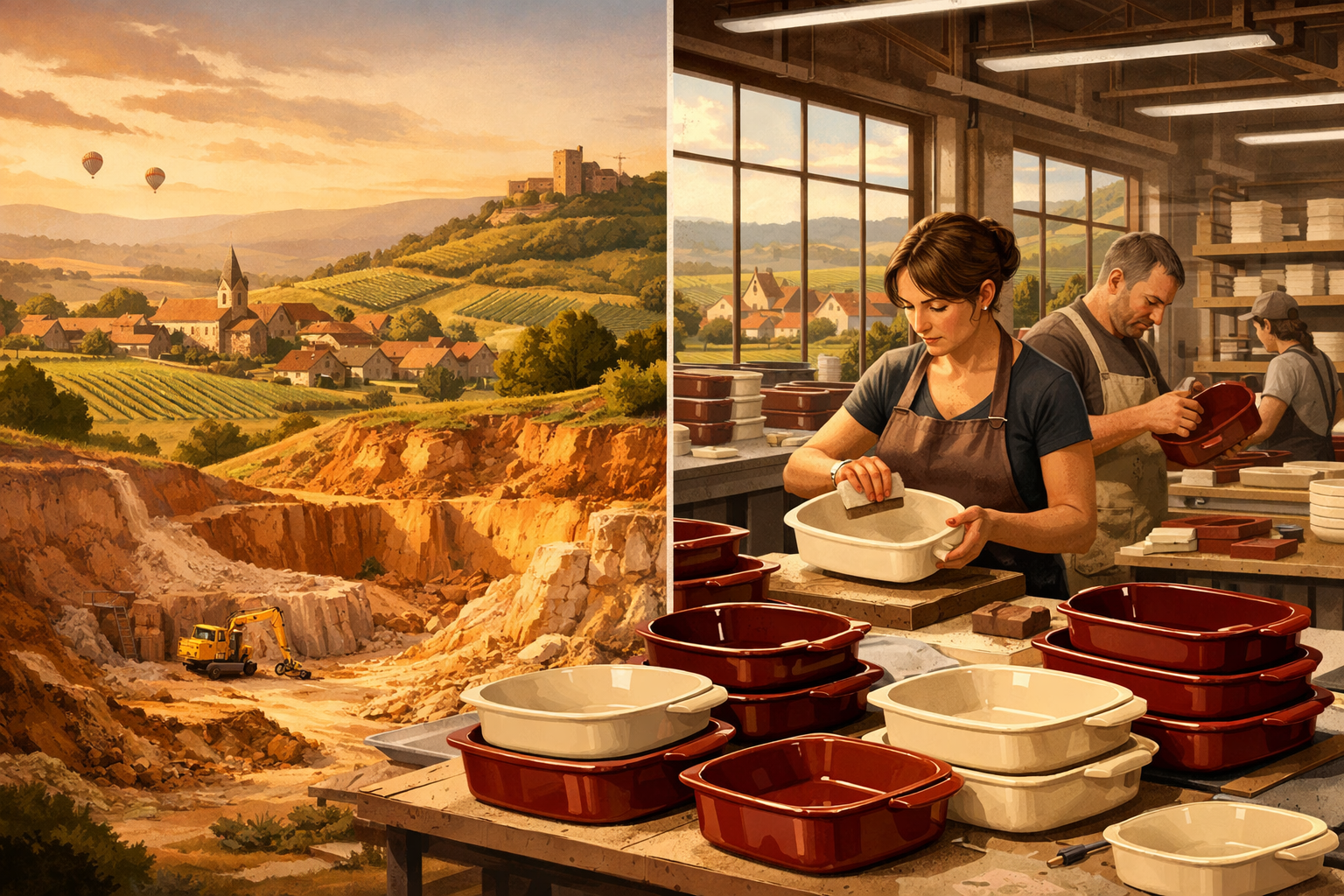
Emile Henry is a family-owned French company that has been producing ceramic cookware and bakeware in Marcigny, Burgundy since 1850. [2][3]
The brand sits in a specific niche: it’s not mass-produced imported ceramic, and it’s not hand-thrown artisan pottery.
It’s a middle ground, industrially consistent but rooted in traditional French ceramic craft, using local Burgundy clay as its primary raw material.
The company’s philosophy, described as “a tradition of Earth and Fire,” reflects its commitment to natural materials and time-tested production methods. [3]
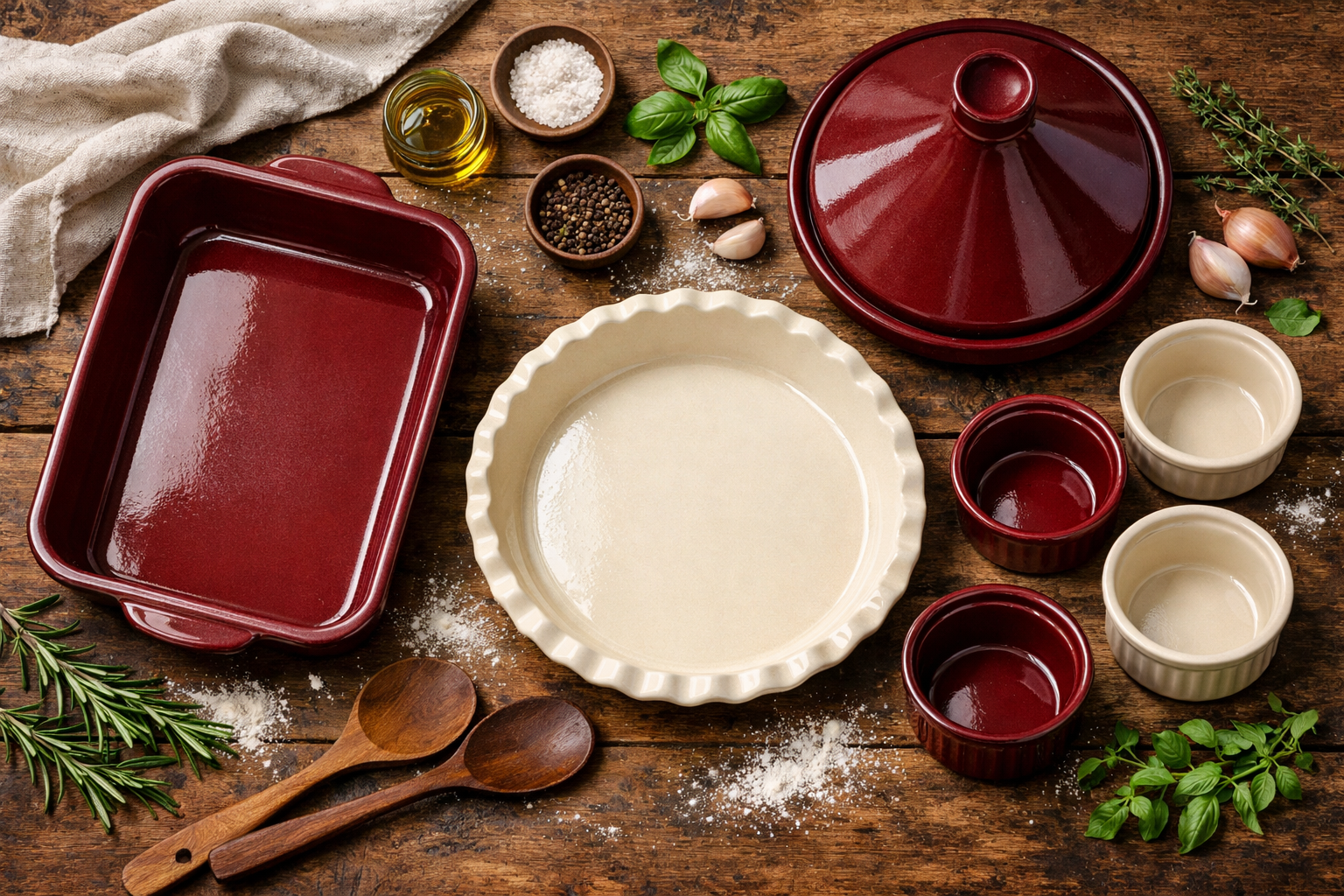
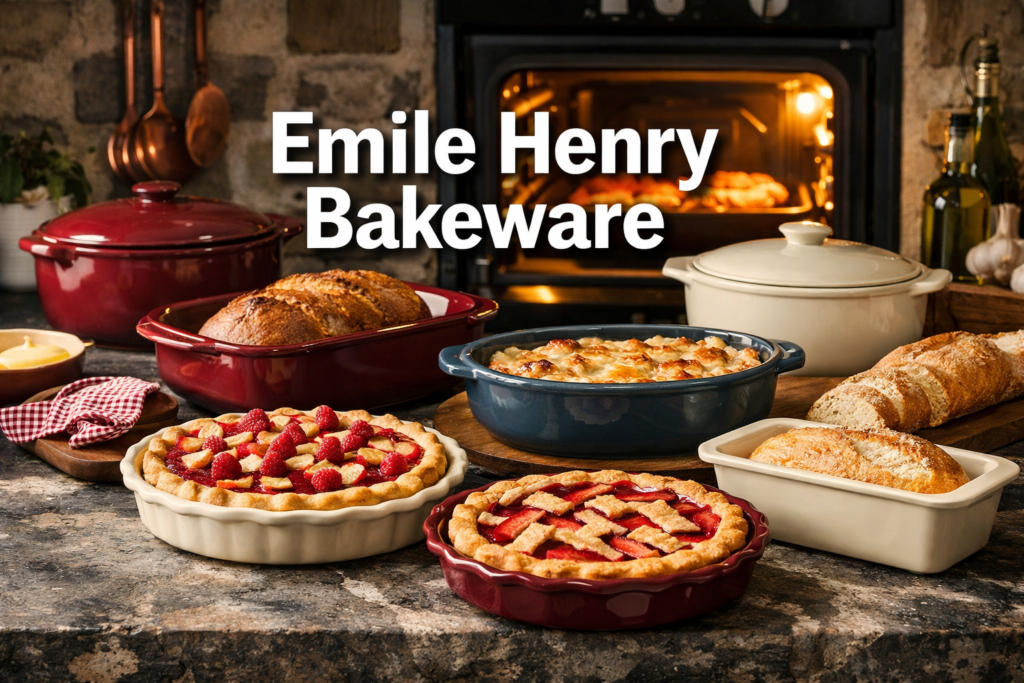
The product line covers everything from everyday baking dishes and pie plates to specialty items like tagines, bread bakers, and pizza stones. [1]
Who is this bakeware for?
- Home bakers who bake frequently and want equipment that lasts
- Cooks who prefer non-toxic, chemical-free bakeware
- Anyone looking for bakeware that doubles as attractive serveware
- Gift buyers seeking a premium, lasting kitchen gift
Who might look elsewhere:
- Budget-focused shoppers (see our top budget bakeware essentials for alternatives)
- Cooks who need induction-compatible bakeware (ceramic doesn’t work on induction stovetops)
- Minimalists who want one all-purpose pan rather than a specialized collection
What Makes Emile Henry Ceramics Unique? (The Burgundy Clay Advantage)
The single biggest differentiator is the clay itself. Emile Henry sources natural clay from the Burgundy region of France, a material with specific mineral properties that affect how the finished ceramic performs in the oven. [2][3]
Why Burgundy clay matters:
| Property | Benefit in Use |
|---|---|
| Dense mineral composition | Retains heat longer after leaving the oven |
| Fine particle structure | Allows thinner walls without sacrificing strength |
| Natural thermal mass | Distributes heat evenly, reducing hot spots |
| Low porosity after firing | Resists staining and odor absorption |
This isn’t marketing language. Ceramic bakeware made from different clay sources genuinely performs differently because clay composition affects how the material responds to heat.
Burgundy clay’s properties are part of why Emile Henry can credibly offer a 10-year warranty, the material is inherently durable when fired correctly.
For a broader look at how ceramic compares to other bakeware materials, our guide to oven-safe bakeware materials covers the full comparison.
How Is Emile Henry Bakeware Manufactured?
Emile Henry produces all of its ceramic bakeware in Marcigny, Burgundy, France. [2] The “Made in France” certification on every piece isn’t incidental, it reflects a specific production process that the company has refined over more than 170 years.
The basic manufacturing process:
- Clay preparation — Raw Burgundy clay is processed and mixed to achieve consistent particle size and moisture content
- Forming — Pieces are shaped using molds that produce consistent wall thickness, critical for even heat distribution
- First firing — Bisque firing at high temperature hardens the clay body
- Glazing — Lead-free, food-safe glazes are applied by hand or machine; the glaze creates the scratch-resistant surface and the signature colors
- Glaze firing — A second high-temperature firing fuses the glaze permanently to the clay body
- Quality inspection — Each piece is checked for dimensional accuracy, glaze coverage, and surface defects
The high firing temperatures used in this process are what give Emile Henry bakeware its thermal shock resistance. The clay and glaze are essentially “pre-stressed” at temperatures far exceeding anything a home oven reaches, which is why the finished piece can move from a freezer to a 500°F oven without cracking.
This manufacturing approach also has environmental implications worth noting.
Using locally sourced Burgundy clay reduces raw material transport distances, and high-temperature ceramic firing produces a product with an exceptionally long service life, reducing the frequency of replacement compared to coated metal bakeware.
If sustainability matters to your purchasing decisions, our guide to sustainable bakeware brand options provides useful context.
What Are the Key Features and Benefits of Emile Henry Bakeware?
Emile Henry ceramic bakeware delivers several practical advantages that set it apart from both coated metal pans and lower-cost ceramic alternatives. [1]
Thermal Shock Resistance
This is the feature most people ask about. Thermal shock occurs when a material expands or contracts too rapidly due to a sudden temperature change, causing cracking or shattering.
Emile Henry’s high-fire manufacturing process produces a ceramic body that handles these transitions reliably, you can move a dish directly from the freezer to a preheated oven.
Practical example: Assemble a lasagna, freeze it, then bake it directly from frozen without transferring to a different pan. This is genuinely useful for meal prep.
“The ability to go from freezer to oven is one of those features that sounds like a minor convenience until you actually use it regularly — then it becomes something you don’t want to give up.”
Even Heat Distribution
Ceramic’s thermal mass means it heats slowly and holds that heat evenly across the entire surface. This matters most for baked goods where hot spots cause uneven browning, pies, gratins, casseroles, and bread. Metal pans can develop hot spots, especially thinner aluminum; ceramic largely avoids this problem.
Non-Toxic, Food-Safe Materials
All Emile Henry glazes are lead-free and cadmium-free. [1] The ceramic body itself is inert once fired — it doesn’t react with acidic foods the way some metals can, and it doesn’t release any coatings into food. For cooks concerned about healthy, non-toxic bakeware, this is a meaningful advantage.
Scratch-Resistant Surface
The high-fire glaze is significantly harder than lower-temperature ceramic glazes. Metal utensils can scratch it over time, but it’s more resistant than most coated non-stick surfaces. Emile Henry recommends wooden or silicone utensils as a precaution.
Versatility
Emile Henry bakeware is marketed for “everything from artisan breads to exquisite desserts.” [1]
The product line genuinely covers a wide range:
- Baking dishes and casseroles
- Pie dishes and tart pans
- Bread bakers (including covered oval bakers for sourdough)
- Tagines and braisers
- Pizza stones
- Ramekins and individual serving dishes
How Does Emile Henry Compare to Other Ceramic Bakeware Brands?
Most ceramic bakeware reviews skip this comparison entirely. Here’s an honest breakdown:
| Brand | Origin | Firing Temp | Warranty | Price Range | Induction Safe |
|---|---|---|---|---|---|
| Emile Henry | France (Burgundy) | High-fire | 10 years | $$–$$$ | No |
| Le Creuset Stoneware | Various | High-fire | Lifetime | $$$–$$$$ | No |
| Staub Ceramics | France | High-fire | Limited | $$$–$$$$ | No |
| Xtrema | USA/China | High-fire | 10 years | $$–$$$ | No |
| Generic ceramic | Various | Lower-fire | Varies | $–$$ | No |
Choose – Emile Henry if: You want proven French manufacturing, a 10-year warranty, and a wide product range at a price point below Le Creuset and Staub.
Pick – Le Creuset stoneware if: You want a lifetime warranty and already invest in the brand ecosystem.
Choice – Generic ceramic if: Budget is the primary constraint and longevity is secondary.
For a deeper look at ceramic cookware trade-offs, see our ceramic cookware pros and cons guide.
What Products Does Emile Henry Currently Offer?
The current Emile Henry USA product lineup includes both core collection pieces and seasonal limited editions. [4] As of 2026, new arrivals include a Limited Edition Pumpkin Pie Dish priced at $39.99, a good entry point for first-time buyers. [4]
Core product categories:
- Rectangular baking dishes — Available in multiple sizes; ideal for lasagna, roasted vegetables, and casseroles
- Round and oval bakers — Covered options work well for braising and bread baking
- Pie dishes — Deep-dish options with fluted edges; the brand’s most iconic product for many home bakers
- Bread bakers — Covered ceramic bakers that mimic a Dutch oven environment for artisan loaves
- Tagines — Authentic North African cooking vessels; one of the brand’s specialty items
- Ramekins and individual dishes — For soufflés, crème brûlée, and individual portions
The vintage Emile Henry bakeware pieces from earlier decades are also collectible, often found at estate sales and antique markets. Older pieces used similar Burgundy clay and high-fire glazes, so they typically remain functional, though the glaze colors and styles differ from current offerings.
How Do You Care for Emile Henry Bakeware?
Proper care extends the life of any ceramic bakeware, and Emile Henry’s pieces are relatively low-maintenance. [1]
Daily care:
- Dishwasher safe, confirmed by the manufacturer [1]
- Hand washing with warm soapy water works equally well
- Avoid abrasive scrubbers that can dull the glaze over time
Handling:
- Allow hot dishes to cool before submerging in cold water (even with thermal shock resistance, sudden extreme cold is unnecessary stress)
- Use wooden, silicone, or nylon utensils to preserve the glaze surface
- Don’t use on stovetop burners, ceramic bakeware is oven-only
Stain removal:
- Soak in warm water with a small amount of baking soda for stubborn stains
- Avoid bleach-based cleaners, which can affect glaze color over time
For more detailed cleaning strategies, our guide on simple bakeware cleanup tips covers ceramic-specific methods.
Storage:
- Stack carefully with a cloth or paper towel between pieces to prevent surface scratching
- Store in a dry location; ceramic is non-porous but moisture can affect long-term storage in very humid environments
What Do Professional Chefs and Serious Home Bakers Say?
Professional endorsement of Emile Henry Bakeware is consistent across culinary circles. French ceramic bakeware has been a fixture in professional kitchens for generations, not because of marketing, but because the performance is reliable and the durability justifies the cost over time.
Common themes in professional feedback:
- Even browning is the most frequently cited performance advantage, particularly for pastry and bread applications
- Presentation value matters in professional settings; Emile Henry dishes move from oven to table without requiring a transfer
- Longevity is a genuine cost advantage in professional use, pieces that last 10–20 years with daily use represent better value than cheaper alternatives replaced every few years
Home bakers who bake bread regularly often specifically seek out Emile Henry’s covered bread bakers as an alternative to a Dutch oven. The ceramic version heats more evenly and is lighter to handle than cast iron, while producing comparable crust results.
Is Emile Henry Bakeware Worth the Price?
Yes, for frequent bakers and cooks who prioritize non-toxic materials and long-term value. The 10-year warranty, proven manufacturing heritage, and genuine performance advantages justify the price premium over budget ceramic alternatives. [1][2]
The math on value:
- A quality Emile Henry baking dish costs roughly $50–$80
- A comparable budget ceramic piece might cost $20–$30 but may need replacement in 3–5 years
- Over 10 years, the Emile Henry piece often costs less per year of use
When it’s not worth it:
- If you bake occasionally and any oven-safe dish will do
- If you’re equipping a first kitchen on a tight budget (our bakeware essentials for new bakers guide has practical starter options)
- If you need induction compatibility
FAQ: Emile Henry Bakeware
Q: Is Emile Henry bakeware really made in France?
Yes. All Emile Henry ceramic bakeware is manufactured in Marcigny, Burgundy, France. The “Made in France” certification appears on every piece. [2]
Q: Can Emile Henry bakeware go from freezer to oven?
Yes. The high-fire manufacturing process gives Emile Henry ceramic its thermal shock resistance, allowing direct freezer-to-oven transitions. [1]
Q: Is Emile Henry bakeware lead-free?
Yes. All glazes are lead-free and cadmium-free, and the products comply with California Proposition 65 standards. [1]
Q: Can I use Emile Henry bakeware in the microwave?
Yes. Emile Henry ceramic is microwave-safe. [1]
Q: Is Emile Henry bakeware dishwasher safe?
Yes. All pieces are dishwasher safe, though hand washing preserves the glaze finish longer. [1]
Q: What is the Emile Henry warranty?
Emile Henry offers a 10-year limited warranty on its bakeware products. [2]
Emile Henry Bakeware: FAQs
Q: Can I use metal utensils with Emile Henry bakeware?
The glaze is scratch-resistant, but the brand recommends wooden, silicone, or nylon utensils to maintain the surface over time.
Q: Does Emile Henry bakeware work on a stovetop?
No. Emile Henry ceramic bakeware is designed for oven, microwave, and broiler use only, not stovetop burners.
Q: Where can I buy Emile Henry bakeware?
Emile Henry products are available through the official Emile Henry USA website and through major retailers. For a broader look at where to find quality bakeware online, see our guide to buying quality bakeware. You can also find a solid selection on Amazon here.
Q: What’s the difference between vintage Emile Henry bakeware and current pieces?
Vintage pieces (pre-1990s) used similar Burgundy clay and high-fire glazes but in different color palettes and styles. Functionally, well-preserved vintage pieces perform comparably to current production.
Q: How does Emile Henry compare to Le Creuset stoneware?
Both are high-quality French-origin ceramic bakeware. Le Creuset offers a lifetime warranty vs. Emile Henry’s 10-year warranty, but Emile Henry typically costs less. Performance is comparable for most home baking applications.
Q: What recipes work best in Emile Henry bakeware?
The even heat distribution makes it particularly well-suited for: fruit pies, gratins, casseroles, artisan bread (in covered bakers), soufflés, crème brûlée, and slow-roasted meats.
Conclusion: Should You Buy Emile Henry Bakeware?
Emile Henry Bakeware earns its reputation. Over 175 years of manufacturing in Burgundy, France has produced a product line that genuinely delivers on its core promises: even heat distribution, thermal shock resistance, non-toxic materials, and durability that justifies the price over time. [2][3]
Actionable next steps:
- Start with one piece — A pie dish or rectangular baker around $50–$80 is a low-risk way to evaluate the brand before committing to a full set
- Check for limited editions — Seasonal pieces like the current Pumpkin Pie Dish at $39.99 offer an affordable entry point [4]
- Browse Amazon — View the current Emile Henry selection on Amazon for pricing, availability, and customer reviews
- Compare your options — If you’re still weighing ceramic against other materials, our guide to oven-safe bakeware materials will help you decide
- Consider your baking frequency — If you bake at least weekly, the investment pays off clearly; if you bake occasionally, a mid-range alternative may serve you just as well
For most serious home bakers in 2026, Emile Henry Bakeware represents the best combination of heritage, performance, safety, and long-term value in the premium ceramic category.
References
[1] Bakeware – https://www.emilehenryusa.com/collections/bakeware
[2] emilehenryusa – https://www.emilehenryusa.com
[3] emilehenry – https://www.emilehenry.com/en/
[4] New Arrivals – https://www.emilehenryusa.com/collections/new-arrivals
View the Current Emile Henry Selection on Amazon


One response to “Emile Henry Bakeware: Complete 2026 Review and Buyers Guide”
[…] conducts heat faster and more evenly than almost any other bakeware material. It’s lightweight, affordable, and the professional bakery standard. Uncoated […]