Non Stick Stainless Steel Cookware Sets
Latest Update: November 17, 2026
Non Stick Stainless Steel Cookware Sets can combine a stainless steel body with a coated, hybrid or uncoated cooking surface, and those surfaces behave differently at the stove. We explain how to identify each construction, choose useful pieces and match care needs to your cooking routine.
Key Takeaways
- Is stainless steel automatically nonstick? No. Bare stainless steel can release food when preheated and used with suitable cooking technique, but it does not behave like a coated pan.
- What should a useful set include? Start with a frying pan, a lidded saucepan and a larger pot, then add pieces that suit your regular meals.
- How do layers affect cooking? An aluminum core helps distribute heat, while the position of the layers affects how heat travels through the pan.
- Should you choose a coated or bare surface? Coated pans suit delicate foods and easy release, while bare stainless steel works well for browning and pan sauces.
- Is a larger set always better value? No. Count the useful pans and pots separately from lids and accessories.
- Can one set cover every cooking task? A mix of coated frying pans and uncoated stainless steel pots can suit different jobs better than one surface throughout.
Shop Now on Amazon Best Deals—>
What nonstick stainless steel cookware actually means
There is such a thing as nonstick stainless steel cookware, but the phrase can describe different designs. A coated pan has a nonstick layer over a stainless steel body, a hybrid pan combines steel and a nonstick surface in a pattern, and an uncoated pan has exposed stainless steel as its cooking surface.
Uncoated stainless steel is not automatically nonstick. Proper preheating, enough cooking fat and patience while food browns can help it release, but bare steel still behaves differently from a coated surface.
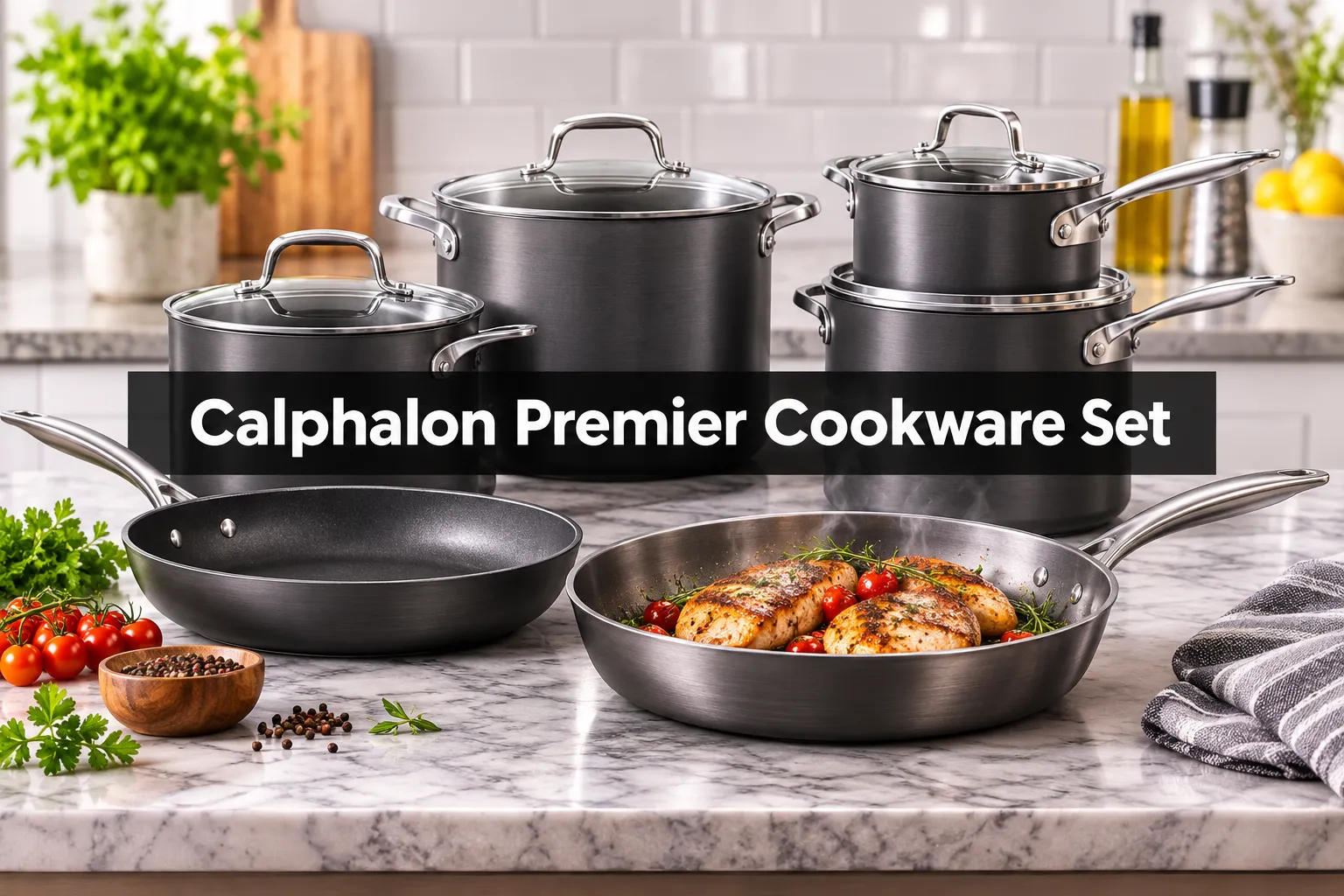
The Calphalon Premier Stainless Steel Cookware Set is described as five-layer stainless steel with aluminum cores and as induction compatible and oven safe; configurations range from 6 to 12 pieces, so check the specifications and included pieces for the exact version you are considering.
A mixed set can include coated frying pans alongside uncoated pots, so identify the surface of each piece rather than treating the entire set as nonstick.
Hybrid cookware has its own patterned or layered surface, which can affect its cooking behavior and care needs. A patterned surface does not by itself show whether metal utensils are suitable or every area is scratch-resistant, so check the maker’s guidance for that exact surface.
For another perspective on stainless and coated cookware, see our comparison of All Clad nonstick and Calphalon cookware.
How the layers affect heating and cooking
Clad cookware bonds its layers across the pan body, while impact bonded cookware concentrates its layered base at the bottom. Full body layers carry heat through the sides as well as the base, while a base focused design distributes heat mainly from the bottom.
Aluminum transfers heat more readily than stainless steel alone, helping reduce hot spots. Stainless steel contributes a durable cooking surface or exterior, depending on where it sits in the pan construction.
Steel grade is one part of a pan’s specification, but it does not by itself tell you how evenly the pan heats; the construction and placement of its layers are more useful clues for that.
Non Stick Stainless Steel Cookware Sets
For a base focused design, the T Fal Stainless Steel Cookware Set has an aluminum core between stainless steel layers in its impact bonded base. Its 11 pieces include two frying pans, two covered saucepans, a covered sauté pan, a covered Dutch oven and a stainless steel steamer insert, and the set costs $169.99.
The Goldilocks Cookware Set uses tri ply construction with an aluminum core, an induction compatible exterior and a nonreactive interior cooking surface. The standard set has four pans and three interchangeable lids, a useful example of a set that covers several pans with fewer lids, and it costs $250.
Shop Now on Amazon Best Deals—>
More layers do not automatically make a pan the right choice for every cook. Choose full body cladding when heat spread up the sides matters, a lighter pan when easy handling matters most, and a responsive construction when you want the pan to react quickly to changes in heat.
Choose useful pieces, not just a high piece count
A useful starter cookware set has a frying pan, a lidded saucepan and a larger pot. Add a sauté pan if you often cook one pan meals or shallow braises, since its broad base and sides handle a wider range of ingredients than a small saucepan.
Match pan size to your usual portions and burner size. A pan that extends far beyond a small burner can heat unevenly, while a pan that is too small can crowd ingredients and make browning harder.
Count practical cooking vessels separately from lids, utensils and other accessories. A high piece count can sound generous while leaving out a pot or pan you use every week, so compare the actual contents before deciding whether a set is worthwhile or individual pieces are a better fit.
For a compact kitchen, a smaller set can be easier to store, especially when its pans nest or its lids stack. The best non stick stainless steel pot set is the one with sizes and vessels that fit your meals, cupboards and cooktop, not simply the most pieces.
Our overview of stainless steel cookware features can help you compare construction and practical design details.
Handles and lids affect daily use as much as the number of pans. A securely attached handle gives a stable grip, a rolled rim helps control pouring, and a lid that fits more than one pan can save cupboard space.
Match the cooking surface to the food
Choose a coated surface for delicate foods such as eggs or thin fish when easy release matters most. Lower to moderate heat helps limit coating wear, and the smooth surface can make cleanup simpler after those meals.
Bare stainless steel suits browning and pan sauce work. As food browns, it can release from the pan after a crust forms, leaving flavorful residue that can be loosened with liquid to build a sauce.
Hybrid cookware offers a middle ground, but a patterned surface does not make it identical to either fully coated cookware or bare stainless steel. Its surface design and care needs depend on its construction.
To reduce sticking on uncoated stainless steel, dry the food, preheat the pan over medium heat for about 3 to 5 minutes, then add oil. Food & Wine also recommends checking readiness with a test rather than relying on timing alone.
Look at the All Clad and Calphalon cookware comparison for examples of how coated and steel surfaces differ in use.
Care for coatings and stainless steel differently
Use silicone, wood or another non abrasive utensil with coated cookware. Avoid scraping or cutting food in the pan, because scratches can shorten the coating’s useful life.
Let hot cookware cool before washing. Sudden temperature changes can stress a coating or distort some pans, while a non abrasive sponge helps clean stainless steel without rough scratching.
Remove food residue promptly from bare steel. Rainbow discoloration is usually a surface heat tint, and it does not mean the pan has become nonstick or immune to stains.
The Le Creuset Toughened Nonstick PRO is described as a hard anodized aluminum set with a stainless steel base and a multilayer PTFE coating reinforced with titanium particles. It is induction compatible and oven safe to 500°F, with lids oven safe to 425°F, and costs $300.
Oven use, dishwasher cleaning and induction compatibility are piece specific details. Handles, lids and coated surfaces can have different limits, so follow each piece’s stated care instructions.
For practical stainless steel cleaning advice, read our guide to caring for a stainless steel pan.
Compare sets by routine, care and long term value
For frequent delicate cooking and quick cleanup, favor a set with clearly defined coated cooking pieces. For searing and pan sauces, prioritize uncoated stainless steel pieces that suit browning and deglazing.
Compare what you can cook with the included pans, how they store and whether their surfaces suit your habits. A broad nonstick claim or a large piece count tells you less than the actual surfaces, vessel sizes and useful lids.
Coated surfaces call for gentler utensils and heat, while stainless steel supports more vigorous browning and rewards careful preheating and prompt cleaning. If your cooking changes from meal to meal, a coated frying pan alongside uncoated stainless steel pots can cover more tasks than expecting one surface to do everything.
To compare candidate sets at home, use the same burner and heat setting for the same kind of food. Notice whether the pan browns evenly, how readily food releases when the surface is intended for that job, and how the pan responds when you adjust the heat.
Non Stick Stainless Steel Cookware Sets Clearance
Try coated and bare-steel pieces for their respective uses rather than treating easy release and browning as one score. Also consider whether the handle feels secure and comfortable during ordinary cooking. These checks help you judge fit for your routine; confirm care and cooktop limits from the specifications.
We see no single cookware brand as right for every household. Among the named options, the T Fal set is a clearly specified choice for buyers seeking uncoated stainless steel pieces, but listed construction and contents alone do not establish long-term durability.
Compare the exact model’s cooktop fit, handles, lids, warranty and care terms, then choose the set that matches your routine.
These are not like-for-like choices: the T Fal and Goldilocks examples are stainless-steel sets, while the Le Creuset example is coated cookware with an aluminum body and stainless steel base.
Choose based on the surface you want for your regular cooking, then check whether each pan and pot has that surface. Where a set comes in different configurations, confirm the exact included vessels, cooktop compatibility and oven limits for the version you are considering; a headline piece count cannot answer those questions.
Frequently Asked Questions
How should I compare claims about nonstick coating safety?
Do not treat a broad “nonstick” label as proof of safety: the coating material and its use and care both matter. Look for a named coating, the maker’s care instructions and stated heat limits.
Can a worn nonstick coating be restored?
Cookware coatings are not generally restored at home. Replace a piece when its surface is substantially damaged or no longer performs as intended, rather than trying to sand or recoat it.
Does a stainless steel pan need seasoning to release food?
No, seasoning is not required. Let the food brown before turning it so it can release from the pan.
Why does stainless steel develop rainbow colored marks?
Rainbow marks are a surface heat tint, and a cleaner made for stainless steel can remove them.
Can stainless steel cookware go in the dishwasher?
Some stainless steel cookware is dishwasher safe, while repeated cycles can dull a polished finish. Hand washing helps preserve the appearance of many stainless surfaces.
Is ceramic nonstick the same as stainless steel nonstick?
No, ceramic nonstick is a coating, while stainless steel refers to the cookware’s body or cooking surface.
Conclusion
The best Non Stick Stainless Steel Cookware Sets make their cooking surfaces and useful pieces easy to distinguish. Choose coated pans for delicate foods, uncoated steel for browning, and a set whose layers, lids, storage needs and care fit the way you cook.

Leave a Reply
You must be logged in to post a comment.