Pizza Steel vs Baking Stone
Last updated: July 2, 2026
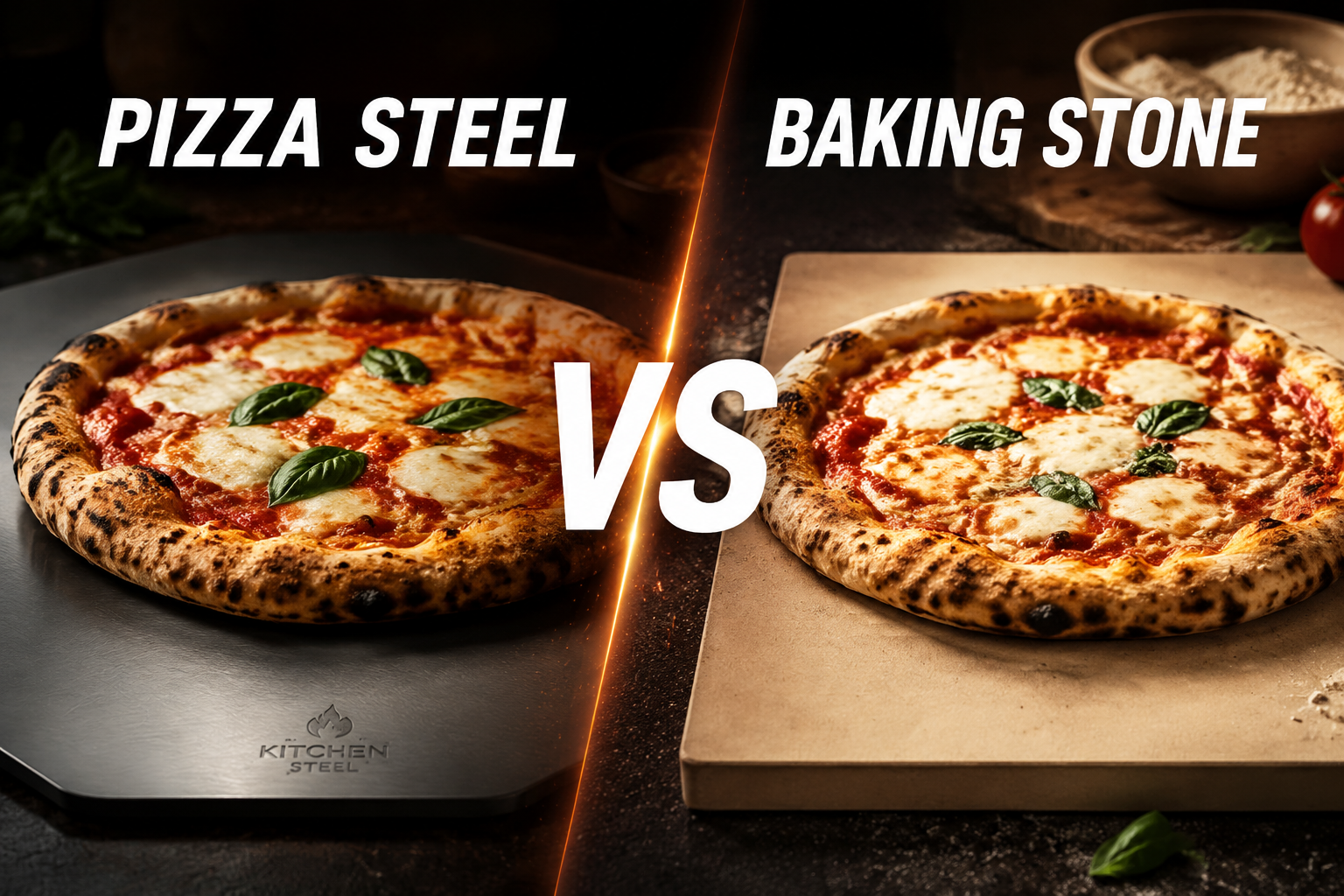
A pizza steel bakes faster and produces a crisper crust due to high thermal conductivity, making it ideal for Neapolitan and New York-style pizza in standard home ovens. A baking stone offers high thermal mass and gentle, even heat distribution, which is better suited for artisan breads and pastries that require longer bake times.
Key Takeaways
- Steels transfer heat much faster than stones, cutting bake times significantly and creating superior bottom browning for pizza.
- Stones absorb and hold heat longer, providing the thermal mass needed for back-to-back baking without severe temperature drops.
- Carbon or stainless steels will not crack from thermal shock, whereas ceramic and cordierite stones can break if exposed to rapid temperature changes.
- Steels require seasoning and rust prevention, similar to cast iron cookware, while stones are porous and must be cleaned without soap.
- The right choice depends on your primary baking goals: choose steel for pizza and searing, and choose stone for bread and pastries.
- Steels are generally heavier and more expensive than basic baking stones, requiring careful handling and storage.
Check Price and Availability on Amazon <—-
Quick Comparison Table
| Product | Price | Material | Thickness | Best For |
|---|---|---|---|---|
| Baking Steel® Original | $129 | Carbon Steel | 1/4″ | Fast, high-heat pizza in home ovens |
| Ooni Pizza Steel | $149 | Stainless Steel | Optimized | Branded steel with money-back guarantee |
| Steelmade Pizza Baking Steel | $119 | Carbon Steel | Heavy-gauge | USA-made versatile steel and griddle |
| FibraMent Home Oven Baking Stone | $99 | Cordierite Composite | 3/4″ | High thermal mass for bread and pizza |
| King Arthur Bread and Pizza Stone | $59.95 | Cordierite | Standard | Affordable, brand-backed all-purpose stone |
| Gi.Metal Pizza Baking Steel | ~$130-$140 | Steel | Standard | European-designed professional-style bakes |
What is the difference between a pizza steel and a baking stone?
A pizza steel is a solid metal plate that uses high thermal conductivity to transfer heat rapidly into dough, while a baking stone is a ceramic or cordierite slab that uses high thermal mass to absorb and slowly release heat. Steels cook pizza in minutes and double as griddles, whereas stones provide the gentle, even heat required for artisan breads.
Heat Conductivity vs Thermal Mass
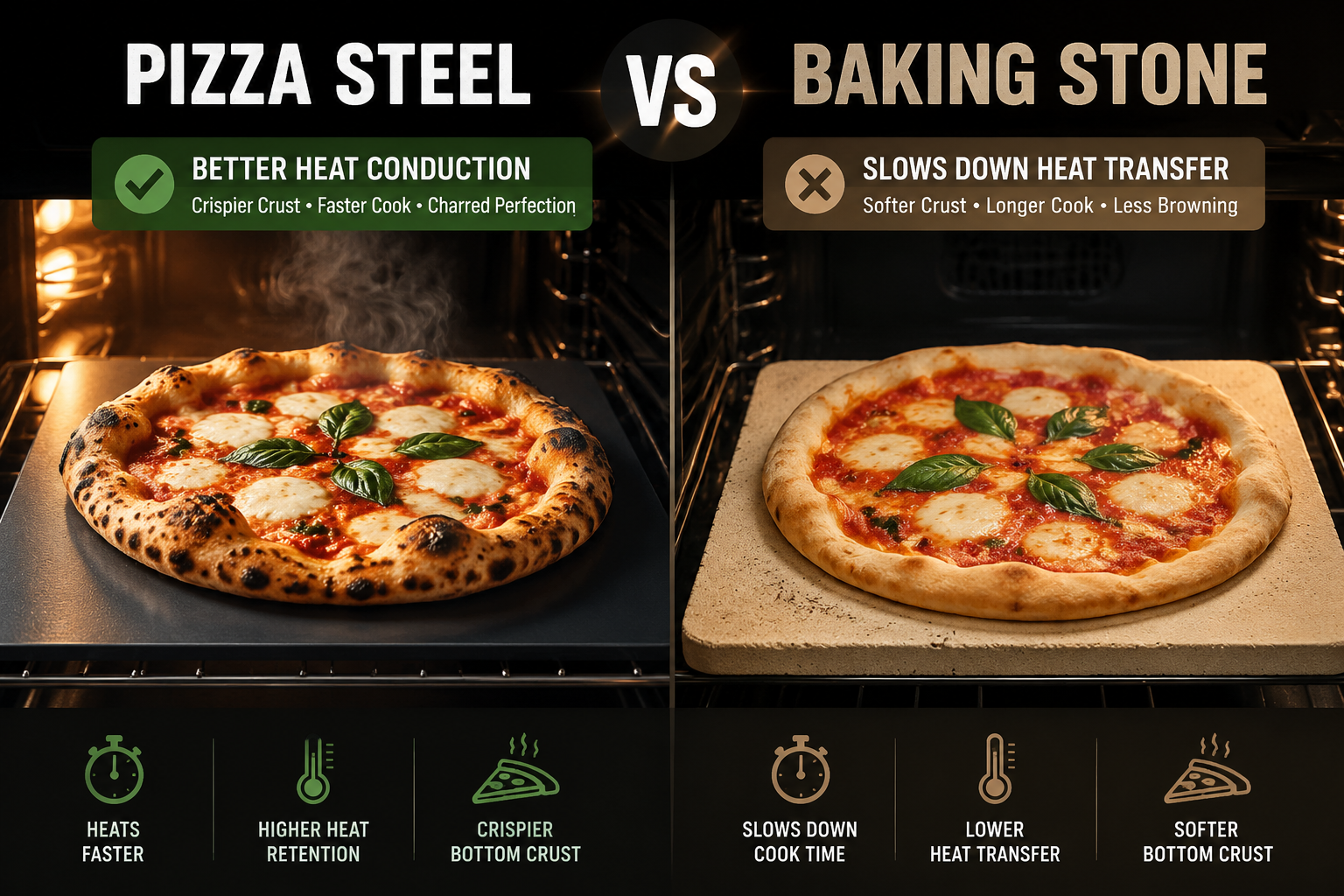
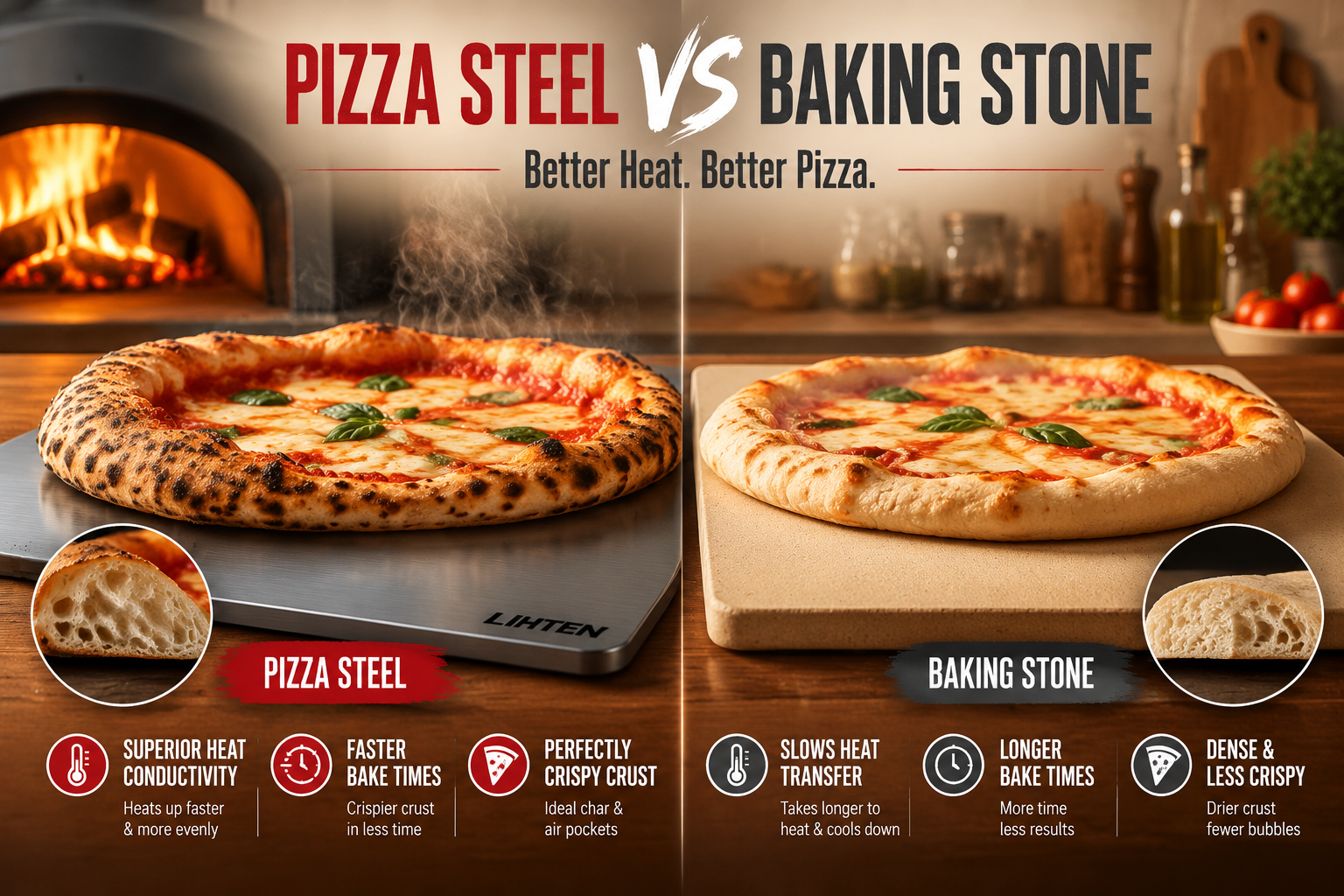
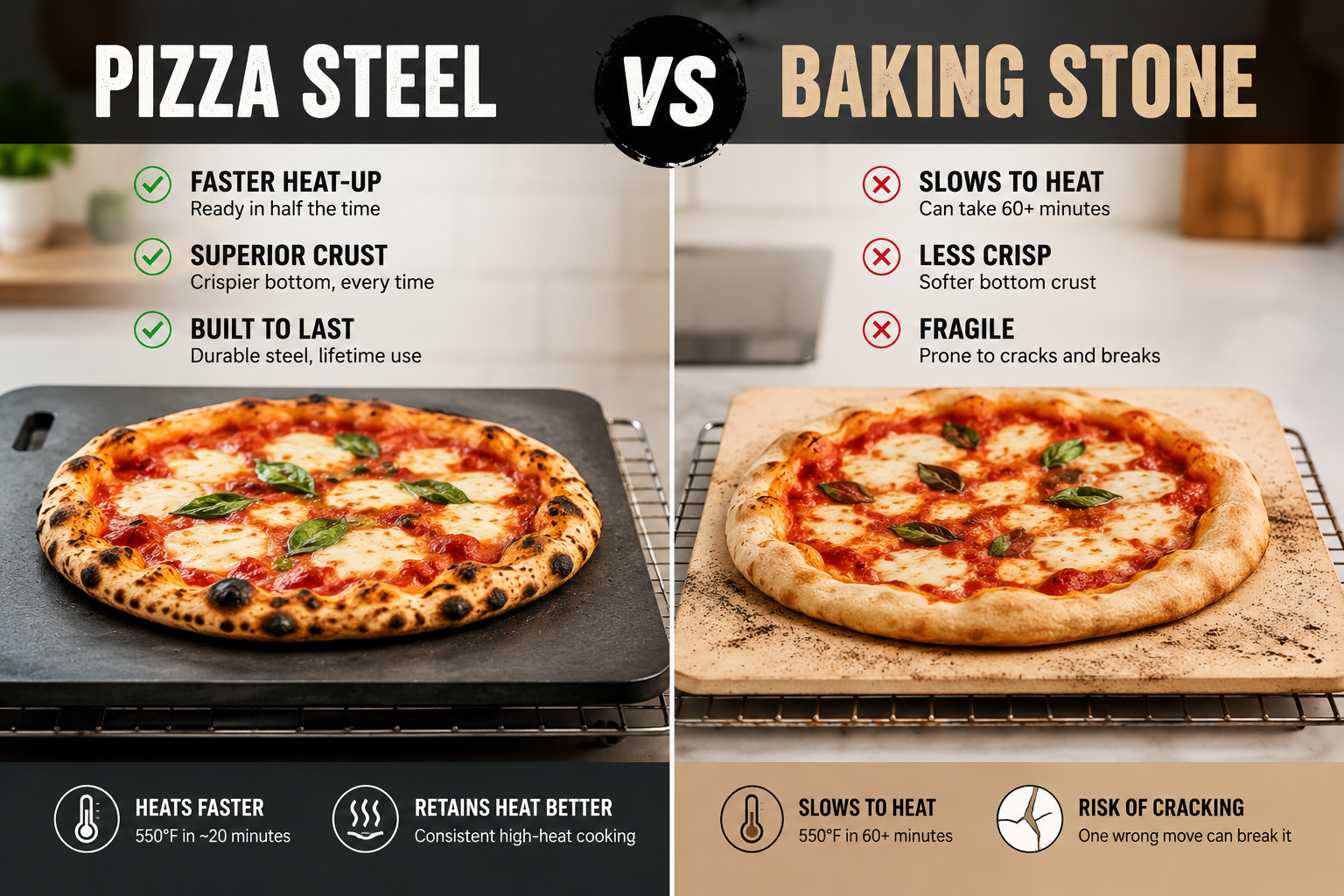
Steel conducts heat significantly faster than ceramic materials. When dough hits a preheated steel surface, the rapid heat transfer creates a fast oven spring and a crisp, charred bottom crust. This makes steels highly effective for baking pizza at standard home oven temperatures (usually capped around 500°F to 550°F).
Stones, however, have a higher specific heat capacity. They take longer to heat up but hold that energy longer, making them less prone to temperature drops when you load multiple loaves of bread or sequential pizzas.
Durability and Maintenance
Steels are virtually indestructible under normal baking conditions and will not crack from thermal shock. However, carbon steels require regular seasoning to prevent rust and maintain a non-stick surface.
If you need guidance on maintaining metal bakeware, our cast iron seasoning guide offers applicable techniques for pizza steels. Stones are porous, which helps draw moisture out of dough, but they can crack if exposed to rapid temperature swings or direct water contact. Stones also require dry scraping for cleaning, as soap will seep into the pores and ruin the flavor of future bakes.
Baking Steel® Original (1/4″ Pizza Steel) Review
The Baking Steel® Original is a high-conductivity carbon steel slab designed to turn a standard home oven or grill into a high-heat deck for New York, or Neapolitan-style pizza, breads, and roasting. Priced at $129, it is widely recommended in independent tests as a top-tier option for home pizza makers seeking professional results.
Key Features:
- High-conductivity carbon steel construction
- 1/4-inch thickness for rapid heat transfer and recovery
- Pre-seasoned and ready for immediate use
- Versatile enough for pizza, bread, searing steaks, and acting as a cold plate
Pros:
- Excellent heat conductivity and recovery for fast bakes and strong bottom browning versus stones.
- Very durable, will not crack like ceramic or cordierite stones when used properly.
- Versatile for pizza, bread, searing steaks, and as a griddle or cold plate.
- Pre-seasoned and ready to use, only light maintenance needed to keep surface seasoned.
- Widely recommended as a top pick in independent tests of steels and stones.
Cons:
- Heavy compared with stones of similar footprint, which can make handling and storage awkward.
- More expensive than many cordierite pizza stones and DIY steel options.
- Can burn bottoms quickly if oven rack placement and preheat time are not dialed in.
Who it’s best for: Home pizza makers who want maximum performance from a standard oven and are willing to pay a premium for a durable, high-conductivity steel.
Check Price and Availability on Amazon <—-
Ooni Pizza Steel Review
The Ooni Pizza Steel is a commercial-grade stainless pizza steel sized for home ovens, designed to deliver fast, even bakes on pizza and flatbreads without the cracking risk associated with ceramic stones. At $149, it is backed by Ooni’s 60-day money-back guarantee and best-price promise.
Key Features:
- Commercial-grade stainless steel construction
- Optimized thickness to balance heat-up time and heat retention
- Designed specifically for standard home oven use
- Backed by a 60-day money-back guarantee
Pros:
- Made from durable stainless or high-grade steel that resists warping and cracking unlike ceramic stones.
- Optimized thickness and size for typical home ovens to balance heat-up time and heat retention.
- Backed by Ooni’s money-back guarantee and support resources for pizza making.
- Suitable for a wide range of pizza styles, including frozen, pan, and thin-crust pies.
Cons:
- Higher price than many generic baking stones and some basic steels.
- Not recommended for use inside Ooni’s own outdoor pizza ovens, where stones are preferred due to extremely high floor temps.
- Still heavy and harder to store and maneuver than a typical stone.
Who it’s best for: Ooni fans and home cooks who want a branded, stainless pizza steel with strong support and an explicit money-back guarantee for oven use.
Check Price and Availability on Amazon <—-
Steelmade Pizza Baking Steel Review
The Steelmade Pizza Baking Steel is a heavy-gauge carbon steel plate made in the USA, intended for pizza, bread, and high-heat baking in standard home ovens and grills. Priced around $119, it offers a slightly more affordable entry point into premium baking steels.
Key Features:
- Heavy-gauge American-made carbon steel
- Sized to fit common oven racks while offering a generous baking surface
- Multi-purpose use as a griddle or roasting surface
- Requires initial seasoning and ongoing rust-prevention care
Pros:
- Very sturdy heavy-gauge steel that conducts heat efficiently, producing crisp pizza bottoms.
- Sized to fit common oven racks while still offering a generous baking surface.
- Can double as a griddle or roasting surface for other foods.
- Made in the USA with a focus on durability and longevity.
Cons:
- Weight makes it cumbersome to move and may require leaving it in the oven most of the time.
- Requires seasoning and rust-prevention care, unlike many stones.
- Less widely reviewed and documented than the Original Baking Steel, so guidance and community recipes are more limited.
Who it’s best for: Home cooks who want a robust American-made baking steel at a slightly lower price than some flagship steels, and who are comfortable maintaining seasoned steel cookware.
FibraMent Home Oven Baking Stone Review
The FibraMent Home Oven Baking Stone is a thick, cordierite-based composite baking stone engineered for even heat distribution and high thermal mass. Priced at $99 for the 17 1/2″ x 13 7/8″ x 3/4″ model, it is designed for serious home bakers who need consistent results for both pizza and artisan bread.
Key Features:
- Cordierite-based composite material
- 3/4-inch thickness for maximum thermal mass and stability
- Excellent heat retention and evenness
- Available in multiple sizes tailored to home ovens and grills
Pros:
- Excellent heat retention and evenness, giving consistently crisp crusts for pizza and artisan bread.
- Very thick (about 3/4″) for stability and thermal mass, which helps maintain temperature when loading multiple loaves or pizzas.
- Cordierite formulation is highly resistant to thermal shock compared with cheap ceramic stones.
- Offered in multiple sizes tailored to home ovens and grills.
Cons:
- Longer preheat time than steels due to thickness and material, often 45 minutes or more.
- Still can crack if mishandled (e.g., subjected to rapid temperature swings) despite good thermal resistance.
- Heavier and more cumbersome than thin budget stones and not as multi-purpose as a steel griddle.
Who it’s best for: Serious home bakers who make both bread and pizza and value gentle, even heat and high thermal mass over fastest possible bake times. If you bake sourdough regularly, this stone pairs well with concepts from our baking stone for sourdough resource.
Check Price and Availability on Amazon <—-
King Arthur Bread and Pizza Stone Review
The King Arthur Bread and Pizza Stone is a cordierite baking stone designed for use in standard home ovens to produce crisp, evenly browned crusts. At approximately $59.95, it is an affordable, versatile option backed by a well-known baking brand.
Key Features:
- Cordierite construction handles high heat
- Rectangular shape maximizes usable baking area
- Backed by King Arthur Baking’s educational resources
- Useful for bread, pizza, and pastries
Pros:
- Cordierite stone handles high heat and is less prone to cracking than many cheap ceramic stones.
- Sized for typical home ovens, with a rectangular shape that maximizes usable baking area.
- Backed by a well-known baking brand with strong educational resources and recipes.
- Useful for bread, pizza, and pastries, not just one style.
Cons:
- Requires substantial preheat time to saturate with heat compared with steels.
- Cannot be used like a griddle or searing surface at very high temperatures the way seasoned steels can.
- Porous material can stain and is harder to clean; soap cannot be used.
Who it’s best for: Home bakers who trust the King Arthur brand and want an affordable, versatile stone to improve both bread and pizza without stepping up to a heavy steel. It is an excellent addition to your bakeware essentials for new bakers.
Check Price and Availability on Amazon <—-
Gi.Metal Pizza Baking Steel Review
The Gi.Metal Pizza Baking Steel is an Italian-made steel plate intended to give professional-style bakes in home ovens in just a few minutes. Priced around $130 to $140 depending on regional VAT and currency, it is designed for pizza enthusiasts who already invest in quality pizza gear.
Key Features:
- Engineered for very fast pizza baking
- Substantial size (about 16″ x 13.5″) fits many home ovens
- Steel construction provides better heat transfer than typical stones
- Part of a full ecosystem of pizza tools from a specialist manufacturer
Pros:
- Engineered for very fast pizza baking with results comparable to a professional deck oven.
- Substantial size (about 16″ x 13.5″) fits many home ovens while providing a generous cooking surface.
- Steel construction provides better heat transfer and durability than typical stones.
- From a specialist pizza-tool manufacturer with a full ecosystem of peels and accessories.
Cons:
- Likely heavy due to steel thickness, which can make handling and storage more challenging.
- Higher price than many cordierite stones and some domestic steels once currency conversion and VAT are included.
- Limited documentation in English compared with mainstream US-focused brands, which may mean fewer community guides.
Who it’s best for: Pizza enthusiasts who want a European-designed pizza steel with professional-oven performance and already invest in quality pizza gear like peels and turning paddles.
How do you choose the right baking surface for your oven?
To choose the right baking surface, match the material to your primary baking goals: select a pizza steel for fast-cooking pizzas and searing, or choose a baking stone for artisan breads, pastries, and gentle heat distribution. You must also consider your oven’s maximum temperature, your available storage space, and your willingness to perform maintenance.
Assess Your Baking Goals
If your main objective is cooking Neapolitan or New York-style pizza in a standard home oven that maxes out at 500°F or 550°F, a pizza steel is the superior choice. The rapid heat transfer compensates for the lower oven temperature, giving you a crisp bottom crust in under six minutes.
If you primarily bake sourdough, artisan bread, or pastries, a baking stone is better. The porous surface draws moisture from the dough, and the high thermal mass prevents the oven temperature from dropping drastically when you load your dough.
Consider Maintenance and Storage
Steels require seasoning to prevent rust, similar to cast iron. You must wipe them with oil periodically and keep them dry. Stones require no seasoning, but you cannot use soap to clean them, and they must be completely dry before heating to prevent steam buildup and cracking. Both steels and thick stones are heavy.
If you have a small kitchen, storing a 16-pound steel slab can be awkward. You might need to leave it in the oven permanently or find a dedicated storage spot. For tips on managing heavy cookware, see our guide on bakeware for small kitchens.
What are the common mistakes when using a pizza steel or stone?
The most common mistakes when using a pizza steel or stone are failing to preheat the surface long enough, placing the surface too close to the broiler, and using water or soap to clean a hot stone. Avoiding these errors ensures consistent crust quality and extends the lifespan of your bakeware.
Insufficient Preheat Time
A common error is putting dough on the steel or stone before it has fully saturated with heat. Steels generally need 30 to 45 minutes to reach optimal baking temperature, while thick cordierite stones often require 45 to 60 minutes. If the surface is not fully heated, the dough will not cook evenly, resulting in a pale or gummy crust.
Improper Rack Placement
Placing the baking surface too high in the oven, especially directly under the broiler, can burn the top of the pizza before the bottom cooks. For steels, placing the rack in the middle or lower-middle section of the oven allows the heat to reflect off the top of the oven, cooking the toppings evenly while the steel crisps the bottom. If the bottom burns too quickly, move the rack down one position.
Cleaning with Water or Soap
Pouring water on a hot stone will cause thermal shock and immediate cracking. Even when cool, stones are porous; using soap will trap the detergent inside the pores and release unpleasant flavors during your next bake.
To clean a stone, let it cool completely, then scrape off burnt food with a dry metal spatula or bench scraper. Steels can be wiped with a damp cloth and dried immediately, then re-oiled lightly to maintain the seasoning.
Check Price and Availability on Amazon <—-
FAQ
Can I leave the pizza steel or stone in the oven all the time?
Yes, you can leave both pizza steels and baking stones in the oven permanently. Leaving them in place actually helps regulate the oven’s temperature by acting as a thermal buffer, reducing temperature fluctuations during regular baking or roasting.
Is a thicker pizza steel better?
Not always. A thicker steel holds more heat, which is useful for back-to-back bakes, but it takes significantly longer to preheat. A 1/4-inch steel offers the best balance of heat conductivity and preheat time for standard home ovens.
Why did my baking stone crack?
Baking stones usually crack due to thermal shock, which occurs when the stone experiences a rapid temperature change. Placing a cold stone in a hot oven, spilling cold water on a hot stone, or placing frozen pizza directly on a hot stone can cause it to fracture.
Do I need to season a stainless steel pizza steel?
Stainless steel does not require seasoning like carbon steel because it does not rust. However, seasoning a stainless steel surface lightly can improve its non-stick properties and make cleaning baked-on cheese or sauce easier.
Can I use a pizza stone on a grill?
Yes, many cordierite stones are designed for grill use. However, you must ensure the stone is rated for direct flame exposure. FibraMent and King Arthur stones handle high heat well, but you should still avoid exposing them to extreme direct flame to prevent cracking.
Which is better for frozen pizza, steel or stone?
A baking stone is generally better for frozen pizza. Frozen dough contains ice crystals that release water as they melt. A stone absorbs this moisture, while a steel’s rapid heat transfer can cause the bottom of a frozen pizza to burn before the top is fully cooked.
Check Price and Availability on Amazon <—-
Final Verdict
Choosing between a Pizza Steel vs Baking Stone comes down to what you bake most often. For home pizza makers who want maximum performance, rapid bake times, and a durable surface that will not crack, the Baking Steel® Original (1/4″ Pizza Steel) is the top choice.
It provides the best heat conductivity for standard home ovens and doubles as a griddle.
If your focus is artisan bread, pastries, or you prefer the traditional moisture-wicking properties of ceramic, the FibraMent Home Oven Baking Stone is the superior option.
Its 3/4-inch thickness provides excellent thermal mass for back-to-back baking without severe temperature drops.
For budget-conscious bakers who still want brand backing and educational resources, the Baking Stone offers excellent value at under $60.