Safest Bakeware Material
Last updated: August 3, 2026
Quick Answer: The Safest Bakeware Material are uncoated stainless steel, borosilicate or tempered glass, fully glazed ceramic or stoneware with verified heavy-metal testing, and cast iron. These materials do not rely on PFAS-based non-stick coatings, remain chemically stable at normal baking temperatures, and do not leach harmful chemicals into food under typical use conditions.
Key Takeaways
- Traditional non-stick bakeware coated with PTFE (Teflon) or other PFAS chemicals is increasingly regulated, with states including Maine and Minnesota banning PFAS-containing cookware and bakeware as of January 1, 2026. [3]
- The safest bakeware materials for everyday baking are uncoated stainless steel, glass, ceramic or stoneware, and cast iron, all of which are inherently free of PFAS coatings. [4]
- PTFE coatings can begin to break down at temperatures above 500 degrees Fahrenheit (260 degrees Celsius), releasing potentially harmful fumes. [8]
- Aluminum bakeware is generally considered low risk for dry baking tasks like cookies and breads, though a parchment barrier is advisable when baking acidic or salty foods. [6]
- Ceramic bakeware is safe when sourced from reputable brands that publish third-party heavy-metal testing results, since low-quality glazes can contain lead or cadmium. [9]
- Cast iron bakeware does leach small amounts of iron into food, which is considered harmless or even beneficial for most people, but may be a concern for those with hemochromatosis. [8]
- Silicone bakeware is generally considered safe when made from food-grade silicone and used within its rated temperature range, though the long-term research is still developing. [6]
- Replacing scratched or flaking non-stick bakeware promptly reduces your exposure to coating particles and degraded chemicals. [4]
View Best Deals on Amazon <—-
Is Bakeware Really Toxic? Understanding the Problem with Traditional Bakeware
Some conventional bakeware materials can release harmful chemicals into food or into the air in your kitchen, particularly when heated to high temperatures or when coatings are scratched and worn.
The concern is not theoretical: regulatory bodies across the United States and Europe have moved decisively in 2026 to restrict or ban PFAS-based non-stick coatings from cookware and bakeware categories. [1][2]
The materials used in the most common everyday bakeware you find in most stores can negatively affect the quality and safety of your family’s food. Most home bakers do not think twice about reaching for a shiny non-stick pan, but the coating on that pan is often made with PTFE, the polymer behind the Teflon brand, and PTFE belongs to a broader class of chemicals called PFAS (per- and polyfluoroalkyl substances). [3]
PFAS chemicals are sometimes called “forever chemicals” because they do not break down easily in the environment or in the human body. Research has linked PFAS exposure to a range of health concerns including thyroid disruption, immune system effects, and certain cancers, according to the U.S. Environmental Protection Agency.
The regulatory response has been swift: as of January 1, 2026, Maine’s PFAS law prohibits the sale of products with intentionally added PFAS, and its Department of Environmental Protection defines “cookware” broadly to include baking sheets, baking molds, trays, bowls, and electric appliances like waffle makers and air fryers. [3] Minnesota has enacted similar restrictions, and Colorado is following a comparable trajectory. [1][5]
In Europe, PFAS restrictions under the EU’s REACH framework are effectively banning PFAS-based non-stick coatings, including PTFE, in cookware when the universal PFAS restriction is fully enforced, accelerating a shift to alternative coatings and bare materials. [2]
What Temperature Does Non-Stick Coating Break Down?
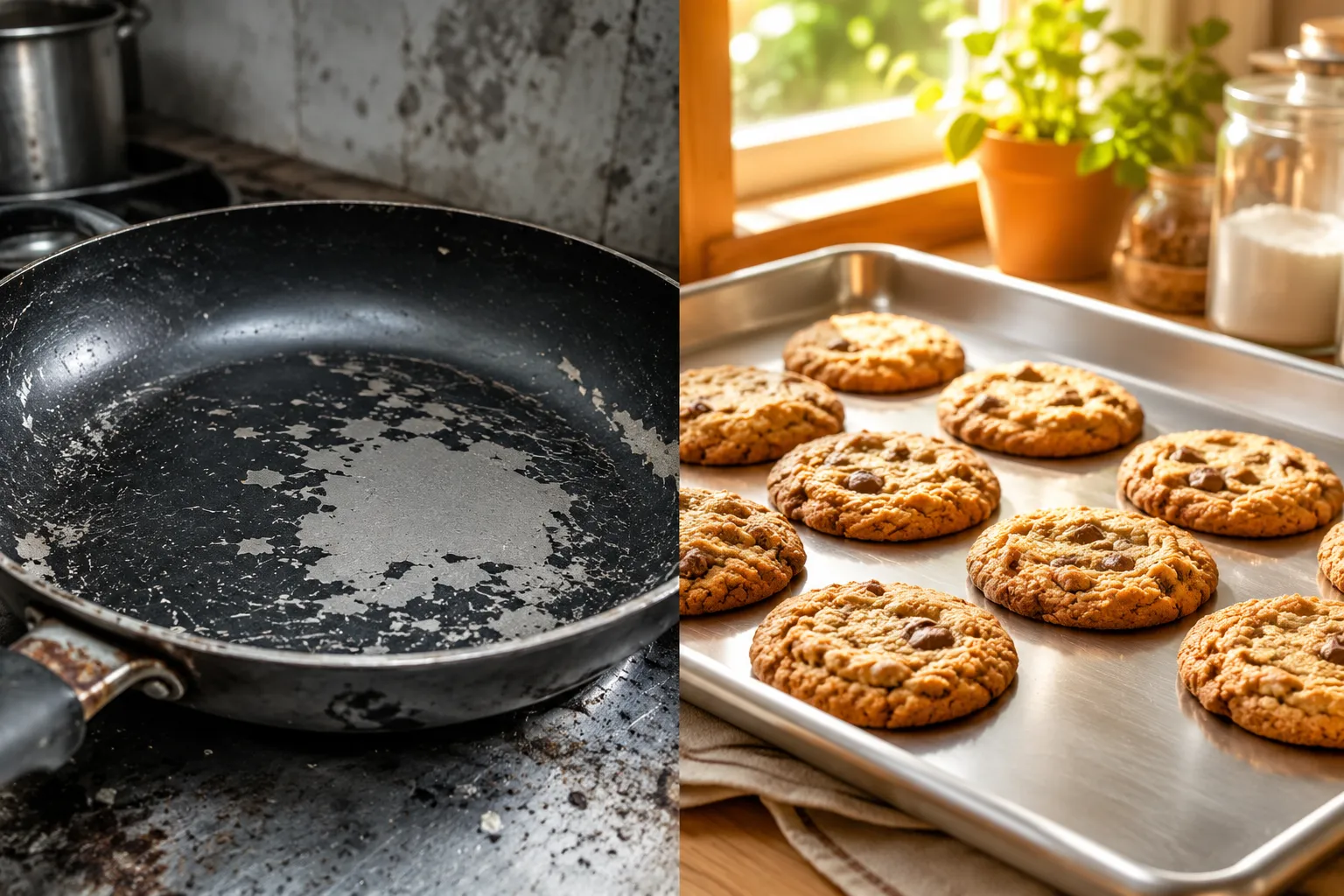
PTFE coatings begin to degrade at approximately 500 degrees Fahrenheit (260 degrees Celsius), releasing fumes that can cause flu-like symptoms in humans and are lethal to pet birds. [8]
Many standard baking tasks, particularly broiling or high-heat roasting, can push pan surfaces past this threshold. Even at lower temperatures, scratched or worn Teflon coatings can shed particles into baked goods. Thankfully, there are now excellent non-toxic bakeware options that perform just as well without these risks.
What Bakeware Should You Avoid Using?
Avoid bakeware coated with PTFE or other PFAS-based non-stick chemicals, particularly if the coating is scratched, flaking, or discolored. Also approach with caution any ceramic bakeware from unknown brands that do not publish lead and cadmium testing results, since low-quality glazes can contain toxic heavy metals. Bare aluminum bakeware used with highly acidic foods over long periods is worth monitoring, though it poses minimal risk for typical dry baking. [6]
How Often Should You Replace Non-Stick Bakeware?
Replace non-stick bakeware as soon as the coating shows visible scratches, peeling, or flaking, which typically occurs within two to five years of regular use depending on care. Even lightly scratched non-stick surfaces can shed coating particles into food and may release chemicals at a faster rate when heated. [4] Switching to inherently non-toxic bakeware materials like stainless steel or cast iron eliminates this replacement cycle entirely.
The Problem with PTFE, PFOA, and PFAS in Bakeware
PTFE is the chemical name for Teflon, the non-stick coating found on a vast range of bakeware and cookware products. PFOA was the processing chemical historically used to manufacture PTFE, and while PFOA has been largely phased out by major manufacturers, it has been replaced by other PFAS chemicals that carry similar concerns. [8]
The U.S. still lacks a single federal PFAS ban, creating a patchwork regulatory landscape where PFAS-based non-stick bakeware can still be sold in many states but faces growing scrutiny and market pressure. [5]
New York legislators have proposed a ban that would remove PFAS-coated non-stick cookware from retail outlets by early 2028, signaling that additional state-level action is expected. [7]
For health-conscious bakers, the practical takeaway is straightforward: choosing non-toxic bakeware materials that are inherently free of these chemicals is the most reliable way to keep them out of your food and your kitchen air.
The Best Non-Toxic Bakeware Materials: A Complete Guide
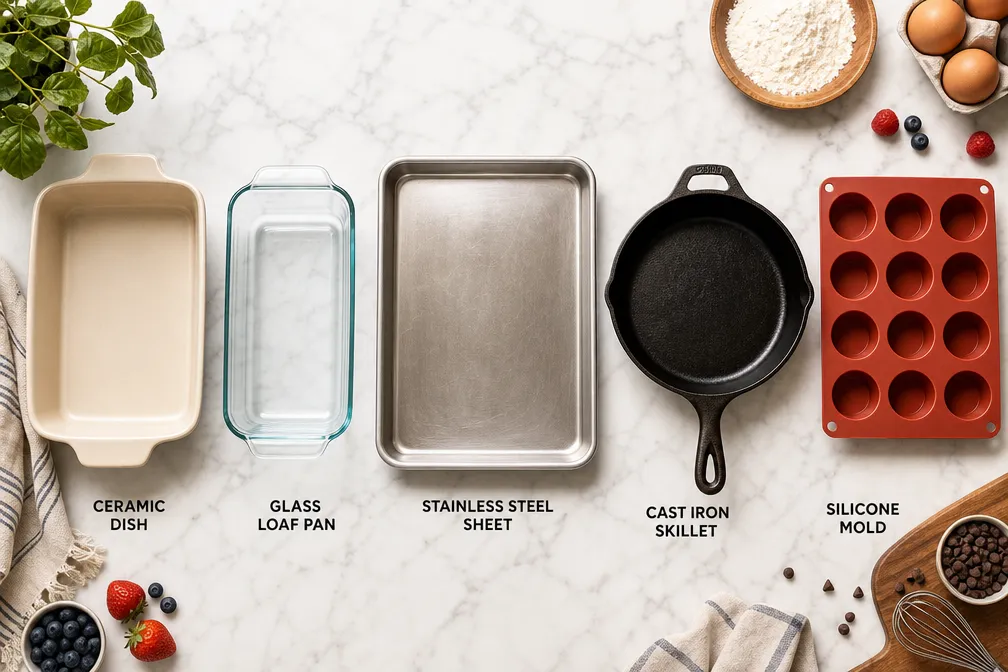
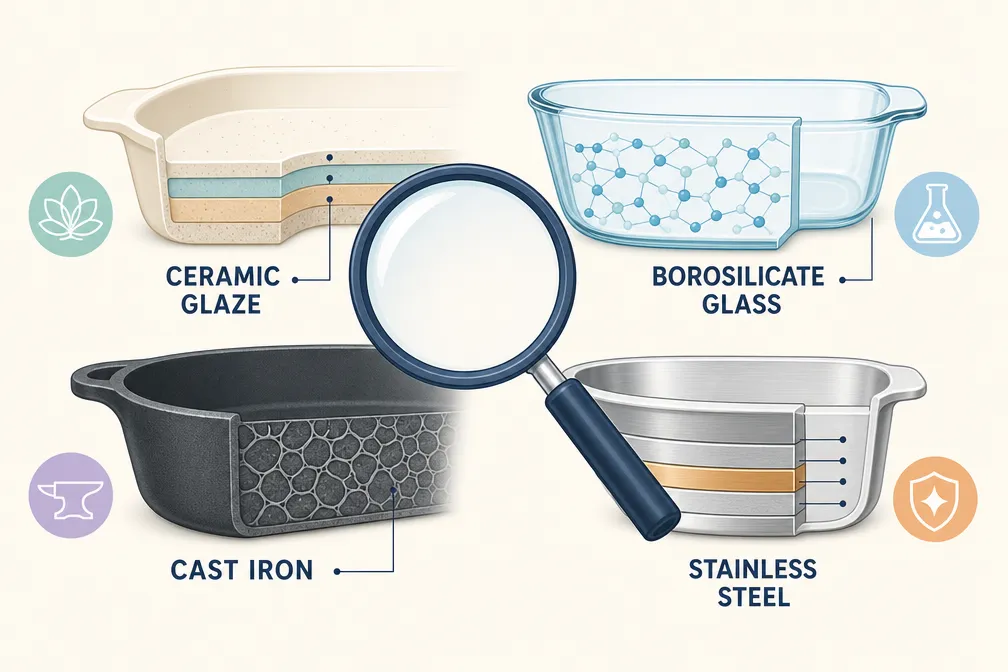
The best non-toxic bakeware materials are those that are chemically stable at baking temperatures, do not rely on synthetic coatings, and have a track record of safe food contact. [4][6] These include uncoated stainless steel, borosilicate glass, fully glazed ceramic and stoneware, cast iron, and food-grade silicone.
For a deeper look at how these options perform in the oven, see our guide to oven-safe bakeware material options.
Is Ceramic Bakeware Safe?
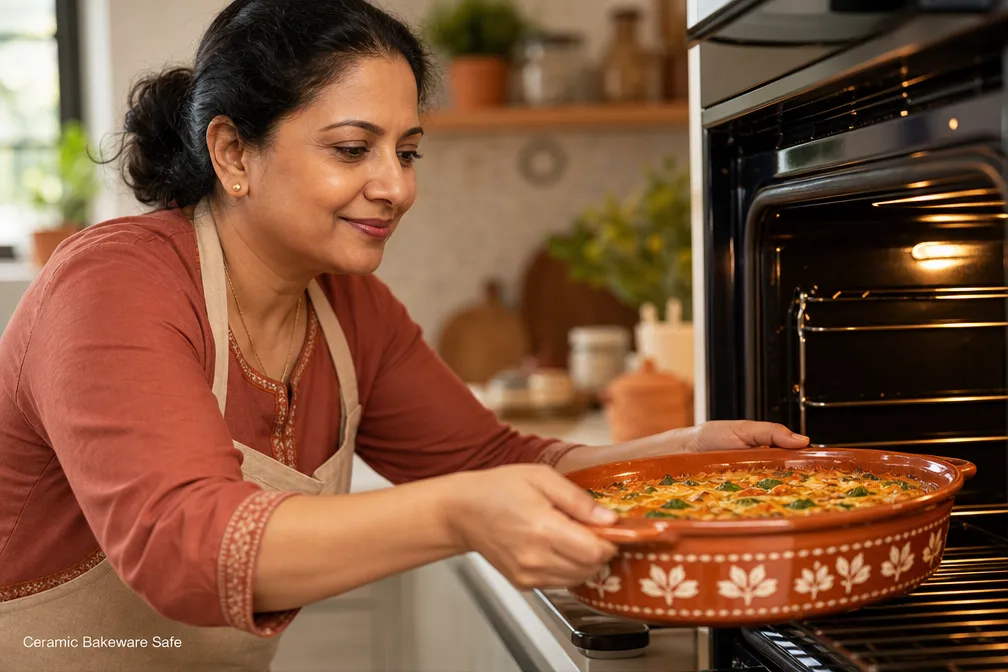
Ceramic bakeware is safe when it comes from a reputable brand that uses lead-free, cadmium-free glazes and publishes third-party testing results. [9] The glaze on ceramic bakeware creates a smooth, non-porous surface that resists food sticking and is easy to clean, making it a popular choice for health-conscious bakers who love both function and aesthetics.
The key distinction is between true ceramic bakeware, which is made from fired clay with a ceramic glaze, and ceramic-coated metal bakeware, where a thin ceramic-like coating is applied over an aluminum or steel base.
True ceramic bakeware from brands like Xtrema is made entirely from inorganic minerals and is free of harmful chemicals. Caraway Cookware uses a mineral-based ceramic coating over an aluminum core and has become one of the most recognized names in the non-toxic bakeware space.
Choose ceramic bakeware if: You want a naturally non-stick surface, you bake casseroles and dishes that go from oven to table, and you prioritize aesthetics alongside safety. For a full review of a well-regarded ceramic option, see our RUYOLIKS ceramic bakeware set review.
The Scoop on Porcelain Bakeware
Porcelain is a type of ceramic fired at very high temperatures, producing an exceptionally dense and durable material. Porcelain bakeware is non-porous, resists staining, and is generally dishwasher safe. Like other ceramic bakeware, its safety depends on the quality of the glaze, so sourcing from established brands with verified testing is essential.
View Best Deals on Amazon <—-
When It Comes to Eco-Friendly Bakeware, Glass Is Great
Glass bakeware, particularly borosilicate glass, is one of the safest bakeware materials available. [8] It is completely inert, meaning it does not leach any chemicals into food under any normal baking conditions. Glass provides even heat distribution, allows you to monitor browning from the outside, and is easy to clean.
The main practical consideration with glass is its sensitivity to sudden temperature changes. Borosilicate glass, used in brands like Pyrex (original formulation), handles thermal shock better than standard soda-lime glass.
Always avoid moving glass bakeware directly from a cold refrigerator into a hot oven, or placing a hot glass dish on a cold or wet surface, to prevent cracking. For more detail, see our guide on glass bakeware safety and benefits.
Stainless Steel Bakeware: Durable and Non-Toxic
Uncoated stainless steel bakeware, particularly grades 304 (also labeled 18/8 or 18/10), is one of the most durable and non-toxic bakeware options available. [4] Stainless steel does not react with food, does not require any coating, and can withstand high oven temperatures without degrading. It is also dishwasher safe and resistant to rust and corrosion.
The main trade-off is that stainless steel does not have the natural non-stick properties of coated pans, so using parchment paper or a light coating of oil is helpful for most baking tasks.
Brands like 360 Bakeware, which manufactures its products in the United States, use high-quality stainless steel and have built a strong reputation in the non-toxic bakeware market. For more on the benefits of this material, see our stainless steel bakeware guide.
Cast Iron Bakeware: Timeless and Safe
Cast iron bakeware is inherently free of harmful chemicals and, when properly seasoned, develops a natural non-stick surface over time. [6] It provides excellent even heat distribution and retention, making it ideal for breads, cornbread, and deep-dish baking. Cast iron bakeware is extremely durable and can last for generations with proper care.
Does cast iron leach iron into food? Yes, small amounts of iron do migrate into food cooked in cast iron, particularly with acidic ingredients. For most people, this is either neutral or mildly beneficial, since iron is an essential mineral.
However, individuals with hemochromatosis (a condition causing iron overload) should consult a doctor before using cast iron bakeware regularly. [8]
Cast iron bakeware is not dishwasher safe and requires hand washing and periodic re-seasoning to maintain its surface. For a complete care guide, see our cast iron seasoning guide.
The Low Down on Silicone Bakeware
Silicone bakeware is generally considered safe when made from food-grade silicone and used within its rated temperature range, typically up to 428 to 500 degrees Fahrenheit (220 to 260 degrees Celsius). [6] It is flexible, lightweight, naturally non-stick, and easy to clean, which is why so many bakers love it for muffin molds and specialty baking shapes.
The concern with silicone is that not all silicone bakeware is created equal. Low-quality or filler-laden silicone can leach chemicals into food, particularly at high temperatures.
A simple test: pinch and twist the silicone, and if white shows through, it likely contains fillers. Stick to reputable brands that certify their products as 100 percent food-grade silicone. For creative ways to use silicone in your kitchen, see our article on creative uses for silicone baking molds.
Is Aluminum Bakeware Safe?
Bare aluminum bakeware is generally considered low risk for typical dry baking tasks like cookies, breads, and roasted vegetables. [4][6] The NSF/ANSI 51 standard recognizes bare aluminum as a permitted food-contact substrate, and the amounts of aluminum that migrate into dry baked goods are minimal.
The concern arises with acidic or salty foods cooked at high temperatures for extended periods, where aluminum migration can increase. Using parchment paper as a barrier is a practical and easy solution for these cases.
Anodized aluminum, which has been electrochemically treated to create a harder, less reactive surface, is considered safer than bare aluminum for a wider range of baking tasks.
A frequently cited concern is a potential link between aluminum exposure and Alzheimer’s disease. Current scientific consensus, as reviewed by the Alzheimer’s Association, does not establish aluminum cookware as a meaningful risk factor for the disease, though research continues.
View Best Deals on Amazon <—-
Is Glass or Stainless Steel Bakeware Better?
Glass and stainless steel are both excellent non-toxic bakeware choices, and the better option depends on what you are baking.
Glass stainless steel comparisons come down to a few practical factors: glass offers complete chemical inertness and lets you monitor browning visually, while stainless steel is more durable, less prone to breakage, and handles sudden temperature changes without risk of shattering.
| Feature | Glass Bakeware | Stainless Steel Bakeware |
|---|---|---|
| Chemical safety | Completely inert | Inert, no coatings needed |
| Heat distribution | Even, slightly slower | Even, heats quickly |
| Durability | Can crack or shatter | Extremely durable |
| Temperature shock | Sensitive (use borosilicate) | Not a concern |
| Non-stick | No | No (use parchment) |
| Dishwasher safe | Usually yes | Yes |
| Best for | Casseroles, pies, lasagna | Sheets, roasting, bread |
Choose glass if: You bake casseroles, pies, or dishes where you want to see the bottom browning, and you handle your bakeware carefully.
Choose stainless steel if: You want maximum durability, you bake a high volume of goods, or you frequently move pans between temperature extremes.
For a thorough comparison of glass bakeware pros and cons, see our glass bakeware guide.
Best Non-Toxic Bakeware Brands Worth Knowing in 2026
The best non-toxic bakeware brands are those that use verified safe materials, publish testing data, and avoid PFAS coatings entirely. [4][9] Here are the standout options across different material categories.
360 Bakeware
360 Bakeware produces its stainless steel bakeware in the United States, using high-quality steel cast construction that requires no non-stick coating.
The brand is a favorite among health-conscious home cooks who love the durability and the peace of mind that comes with knowing exactly what materials are in their kitchen.
360 Bakeware pieces are dishwasher safe, oven safe to very high temperatures, and built to last decades.
Caraway Cookware
Caraway Cookware has become one of the most recognizable names in non-toxic bakeware. Their ceramic-coated bakeware set uses a mineral-based coating over an aluminum core, and the brand is explicit about being free of PTFE, PFOA, lead, and cadmium.
Caraway’s bakeware is visually appealing, comes in a range of colors, and is easy to clean. The brand also offers a bakeware set that includes sheets, pans, and storage solutions.
Xtrema
Xtrema makes pure ceramic cookware and bakeware from 100 percent inorganic minerals, with no metals, no coatings, and no synthetic materials. Every Xtrema piece is tested by third-party laboratories for heavy metals.
Their ceramic bakeware is oven safe to 2500 degrees Fahrenheit, making it one of the most heat-resistant non-toxic bakeware options available. For a detailed look at this brand, see our Xtrema pure ceramic cookware review.
Budget-Friendly Nontoxic Bakeware Options
Not every safe bakeware choice has to come with a premium price tag. Affordable non-toxic bakeware options include:
- Nordic Ware aluminum bakeware (use with parchment for acidic foods), made in the USA
- USA Pan aluminized steel bakeware with a PTFE-free silicone coating, widely available and budget friendly
- Lodge cast iron bakeware, which is among the most affordable cast iron options and is made in the United States
- Basic stainless steel baking sheets from restaurant supply stores, which are often less expensive than branded options and equally safe
For more budget-conscious picks, see our top budget bakeware essentials guide.
View Best Deals on Amazon <—-
What Makes Bakeware Safe to Use in the Oven?
Bakeware is safe to use in the oven when it is made from materials that remain chemically stable at baking temperatures, do not release harmful substances into food or air, and are structurally sound enough to handle the thermal stresses of baking. [4][8]
The key factors are the base material, any coatings applied, and whether the bakeware has been tested and certified for food contact.
How to Tell If Bakeware Is Food Safe
- Look for bakeware labeled as food-grade or food-safe, particularly for silicone and ceramic products.
- Check whether the brand publishes third-party testing results for heavy metals (lead, cadmium) in ceramic glazes.
- Avoid bakeware with unknown coatings or coatings that are not explicitly labeled as PFAS-free.
- For stainless steel, look for grade 304, 18/8, or 18/10 markings, which indicate a high-quality, food-safe alloy.
- Check whether the bakeware complies with FDA food contact regulations or EU food safety standards.
Is Ceramic Bakeware Oven Safe at High Temperatures?
High-quality ceramic bakeware is oven safe at typical baking temperatures, generally up to 450 to 500 degrees Fahrenheit (232 to 260 degrees Celsius) for most brands. [9] Xtrema’s pure ceramic is rated to significantly higher temperatures. The key precaution is avoiding sudden temperature changes, which can cause ceramic to crack. Always preheat the oven with the ceramic dish inside, or at minimum allow the dish to come to room temperature before placing it in a hot oven.
Safest Bakeware for People with Metal Sensitivities
For individuals with nickel allergies or other metal sensitivities, glass bakeware and pure ceramic bakeware are the safest choices, since they contain no metal that can migrate into food. [8]
Stainless steel contains nickel as part of its alloy, and while migration into food is very low under normal conditions, those with confirmed nickel sensitivity may prefer to use glass or ceramic as their primary bakeware materials.
Does Non-Stick Coating Leach Chemicals When Heated?
Yes, PTFE-based non-stick coatings can release chemicals when heated, particularly at temperatures above 500 degrees Fahrenheit (260 degrees Celsius), and even at lower temperatures if the coating is damaged. [8]
The fumes released from overheated Teflon can cause polymer fume fever in humans and are acutely toxic to birds. Additionally, scratched or flaking non-stick coatings shed particles directly into food, meaning the chemicals are ingested rather than just inhaled.
Newer ceramic non-stick coatings, like those used by Caraway, do not contain PTFE or PFAS and do not carry the same risks. However, even ceramic-coated pans can lose their non-stick properties over time and may require replacement, though they do not pose the same chemical hazard when worn.
The practical guidance from multiple 2026 non-toxic bakeware guides is consistent: if you currently use PTFE-coated bakeware, replace it with non-toxic bakeware materials as pieces wear out, and in the meantime, never preheat empty non-stick pans, avoid high-heat settings, and never use metal utensils on coated surfaces. [4][6]
For a comprehensive guide to keeping PFAS out of your kitchen, see our article on cookware free of PFAS risks.
Best Bakeware Materials for Health-Conscious Bakers: Practical Recommendations
Health-conscious bakers should prioritize bakeware made from stainless steel, glass, fully glazed ceramic, or cast iron, all of which are inherently free of PFAS coatings and stable at baking temperatures. [4][6][8] The right choice depends on your specific baking needs, budget, and how much maintenance you are willing to do.
Here is a practical decision guide:
- For baking sheets and roasting pans: Uncoated stainless steel or aluminized steel with parchment paper. Both are non-toxic bakeware options that produce excellent results for cookies, vegetables, and sheet-pan dinners.
- For casseroles and baked pasta dishes: Glass or ceramic bakeware. Both go beautifully from oven to table and are easy to clean.
- For bread baking: Cast iron Dutch ovens or loaf pans produce outstanding crusts and are completely non-toxic. Stainless steel loaf pans are also a solid choice.
- For muffins and specialty shapes: Food-grade silicone molds or stainless steel muffin tins lined with paper liners.
- For high-heat roasting: Cast iron or stainless steel, both of which handle very high oven temperatures without any degradation.
For a full guide to healthy non-toxic bakeware choices, see our healthy non-toxic bakeware guide.
View Best Deals on Amazon <—-
Can Bakeware Cause Health Problems? What the Research Says
Certain types of bakeware can contribute to health problems, primarily through the release of PFAS chemicals from non-stick coatings and the leaching of heavy metals from low-quality ceramic glazes. [3][8]
The risk is not uniform across all bakeware materials: the concern is specific to PTFE-coated non-stick bakeware, poorly glazed ceramics, and, to a lesser extent, bare aluminum used with highly acidic foods.
The regulatory actions taken by multiple U.S. states in 2026 reflect a growing body of evidence that PFAS chemicals accumulate in the body and are associated with adverse health outcomes. [1][3] The shift toward non-toxic bakeware is not just a wellness trend; it is increasingly backed by law.
For most people using quality stainless steel, glass, or ceramic bakeware from reputable brands, the health risk from bakeware materials is negligible. The goal is to identify and phase out the specific materials, primarily PTFE-coated non-stick bakeware, that carry documented risks.
FAQ: Your Questions About the Safest Bakeware Material Answered
What is the safest bakeware that doesn’t release toxins?
The safest bakeware that does not release toxins includes uncoated stainless steel (grade 304/18-10), borosilicate glass, fully glazed ceramic or stoneware from brands with verified heavy-metal testing, and enameled cast iron. These materials are inherently free of PFAS coatings, do not leach harmful chemicals into food at normal baking temperatures, and are stable over years of regular use. [4][8]
What is the least toxic material for cookware?
The least toxic materials for cookware and bakeware are borosilicate glass and uncoated stainless steel, both of which are completely inert and do not require any synthetic coating. Fully glazed ceramic from reputable brands and seasoned cast iron are also among the lowest-risk options. All four are recognized by multiple 2026 non-toxic bakeware guides as the preferred choices for health-conscious kitchens. [6][9]
Is Pyrex bakeware non-toxic?
Pyrex bakeware made from borosilicate glass is non-toxic and one of the safest bakeware options available. Glass is completely inert and does not leach any chemicals into food. However, note that some Pyrex products sold in the United States since the 1990s are made from tempered soda-lime glass rather than borosilicate glass, which is less resistant to sudden temperature changes. Always check the product specification before purchase. [8]
What is the best non-toxic bakeware set?
The best non-toxic bakeware set depends on your priorities. For a complete set with excellent aesthetics and ease of use, Caraway’s ceramic-coated bakeware set is a top choice. For pure material safety with no coatings at all, a 360 Bakeware stainless steel set or a combination of Lodge cast iron and borosilicate glass pieces is hard to beat. Budget-conscious bakers can build a solid non-toxic bakeware collection with Nordic Ware aluminum sheets (used with parchment), Lodge cast iron, and a glass casserole dish for well under $150. [4][6]
View Best Deals on Amazon <—-
Conclusion: Choosing the Safest Bakeware Material for Your Kitchen
The Safest Bakeware Material is not a single answer but a practical framework: choose materials that are inherently free of PFAS coatings, sourced from reputable brands with transparent testing, and matched to your specific baking needs.
Here are the actionable next steps to take right now:
- Audit your current bakeware. Check for scratched, flaking, or worn non-stick coatings and set those pieces aside for replacement.
- Start with one or two key replacements. A stainless steel baking sheet and a glass or ceramic casserole dish cover the majority of everyday baking needs.
- Verify brand claims. When buying ceramic bakeware, look for brands that publish third-party lead and cadmium test results.
- Use parchment paper as a bridge. While you transition to non-toxic bakeware, parchment paper on aluminum or older pans reduces direct food contact with the pan surface.
- Consider cast iron for bread baking. A cast iron Dutch oven produces bakery-quality loaves and will outlast any coated pan by decades.
The shift to non-toxic bakeware does not have to happen all at once. Even replacing one or two high-use pieces with safer materials makes a meaningful difference.
With the growing availability of excellent non-toxic bakeware options at every price point in 2026, there has never been a better time to make the switch.
View Best Deals on Amazon <—-
References
[1] PFAS In Cookware State By State Regulations – https://www.bclplaw.com/en-US/events-insights-news/pfas-in-cookware-state-by-state-regulations.html
[2] How PFAS Regulations Are Changing The Nonstick Cookware Industry – https://www.telamoncookware.com/news/industry-news/how-pfas-regulations-are-changing-the-nonstick-cookware-industry-in.html
[3] State PFAS Cookware Bans 2026 – https://vettedclean.com/cookware/state-pfas-cookware-bans-2026/
[4] Best Non Toxic Bakeware – https://vettedclean.com/cookware/best-non-toxic-bakeware/
[5] PFAS Regulation Cookware Drinkware 2026 – https://www.reselat.com/blog/pfas-regulation-cookware-drinkware-2026
[6] Best Non Toxic Bakeware – https://nontoxiconly.com/blog/best-non-toxic-bakeware/
[7] NY Pols Push For Ban On Nonstick Cookware – https://nypost.com/2026/03/01/us-news/ny-pols-push-for-ban-on-nonstick-cookware-that-even-lefty-calif-gov-gavin-newson-nixed/
[8] Safest Non Toxic Bakeware – https://theroundup.org/safest-non-toxic-bakeware/
[9] Best Non Toxic Bakeware – https://www.zendaguide.com/post/best-non-toxic-bakeware
[10] Best Non Toxic Bakeware – https://gurlgonegreen.com/2022/06/23/best-non-toxic-bakeware/