What Is Carote Cookware Made Of
Last updated: June 24, 2026
Quick Answer: What Is Carote Cookware Made Of ? It is built on a die-cast aluminum body with a granite-style or ceramic nonstick coating applied over the surface. A magnetic stainless steel disc on the base makes it induction compatible. Depending on the product line, the nonstick layer is either a PTFE-based coating (free of PFOA and PFOS) or a fully ceramic coating marketed as PFAS-free. Neither version contains lead or cadmium.
Key Takeaways
- The core of every Carote pan is die-cast aluminum, chosen for its lightweight build and fast, even heat distribution.
- The “granite” finish is a marketing term for a speckled ceramic-style or PTFE-based nonstick coating — not literal crushed stone.
- Some Carote lines use PTFE (the same polymer as Teflon) but without PFOA or PFOS; newer ceramic lines are marketed as fully PFAS-free.
- PTFE-based Carote coatings begin to degrade around 250 degrees C (480 degrees F) — a threshold home cooks rarely hit on medium heat.
- Carote pans are not dishwasher safe for long-term use; hand washing extends coating life significantly.
- With proper care (silicone or wood utensils, medium heat, hand washing), most users report 2-4 years of reliable nonstick performance.
- Carote is manufactured in China and holds PFOA-free certifications; independent third-party testing data beyond manufacturer claims is limited.
- The detachable handle system is a genuine functional advantage for small kitchens and oven-to-table transitions.
- Carote sits in the affordable nonstick segment, typically priced below GreenPan and Our Place but above basic store-brand pans.
- For health-conscious buyers who want zero PTFE, Carote’s newer ceramic lines or alternatives like GreenPan are the better fit.
Ready to see current pricing and available sets? Check Carote cookware on Amazon
What Is Carote Cookware Made Of, Exactly?
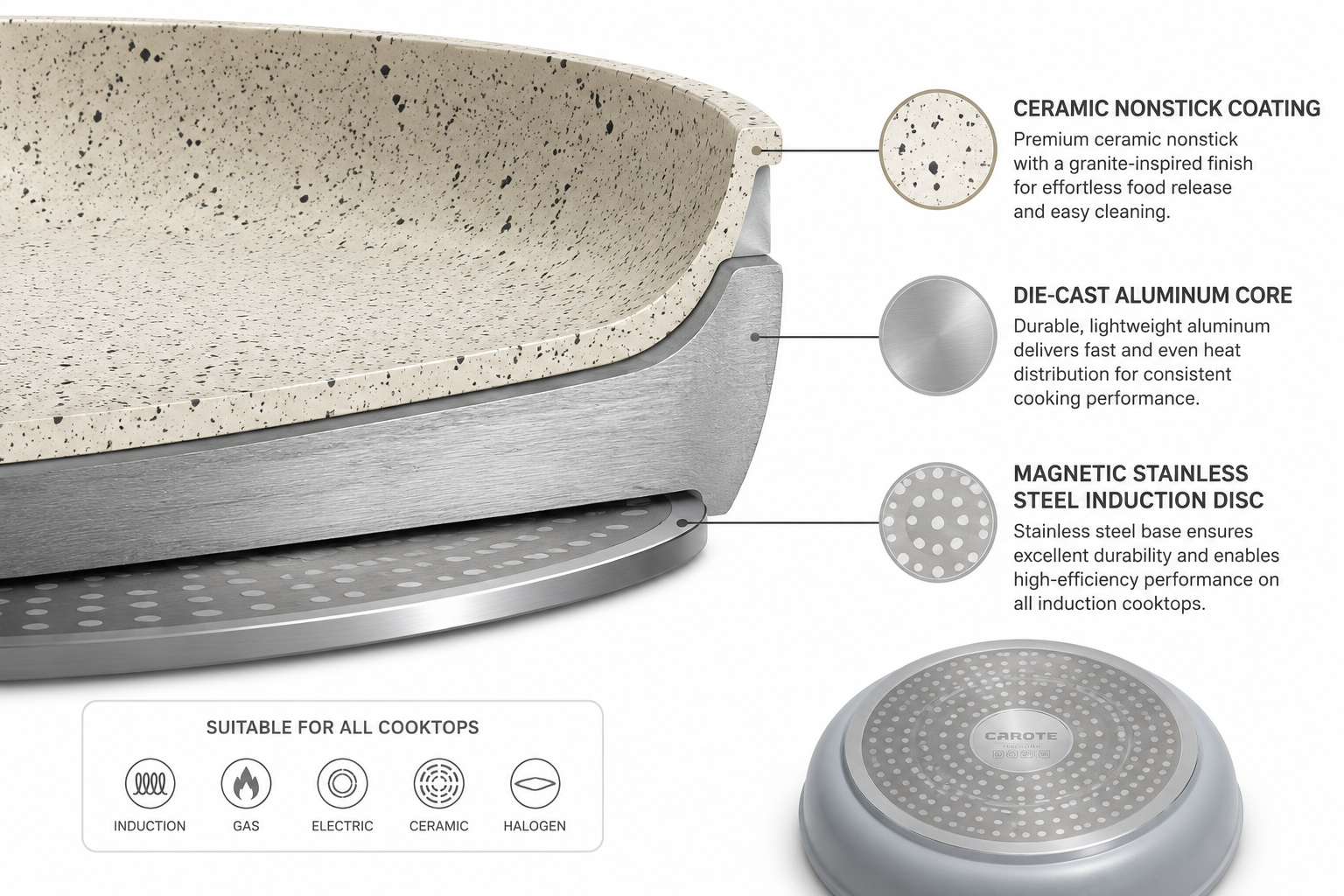
Carote cookware is made of a die-cast aluminum body with a nonstick coating applied over the interior surface and a magnetic stainless steel induction disc bonded to the base. The aluminum core is the structural foundation of every pan in the lineup.
Here is a layer-by-layer breakdown:
| Layer | Material | Purpose |
|---|---|---|
| Exterior shell | Die-cast aluminum | Structural strength, lightweight build |
| Interior coating | Granite-style PTFE or ceramic nonstick | Food release, easy cleaning |
| Base disc | High-magnetic stainless steel | Induction stovetop compatibility |
| Handle system | Detachable bakelite or stainless steel | Heat resistance, space-saving storage |
The term “granite cookware” refers entirely to the coating’s speckled visual appearance — it mimics the look of natural granite stone but contains no actual crushed granite.
As Reddit’s cookware community has noted bluntly: these pans are “NOT granite — it’s porcelain-style coating.” Understanding this distinction matters when evaluating what you are actually buying.
For a broader look at what to prioritize when choosing pans, our guide on what considerations are important when selecting cookware covers the full decision framework.
Does Carote Cookware Have PFOA or PTFE?
This is the most important safety question buyers ask, and the answer depends on which Carote product line you are looking at.
PFOA and PFOS status: All current Carote cookware is PFOA-free and PFOS-free. Both perfluorooctanoic acid (PFOA) and perfluorooctane sulfonate (PFOS) are now banned from cookware manufacturing in most major markets, so this claim is accurate but no longer unique to Carote — it applies to virtually every brand sold in the US and EU today.
PTFE status: This is where Carote’s lineup splits into two distinct categories:
- Granite-line pans: Carote’s own product pages confirm these contain PTFE (polytetrafluoroethylene), the same base polymer used in traditional Teflon. The brand states plainly that the coating is PFOA/PFOS-free PTFE, not a PTFE-free alternative.
- Newer ceramic lines: A 2025-2026 wave of Carote ceramic sets is marketed as fully PFAS-free, using a ceramic-derived nonstick coating with no PTFE at all. These are positioned directly at health-conscious buyers who want to avoid all per- and polyfluoroalkyl substances.
The PFOA-free paradox: PFOA-free marketing can mislead buyers into thinking a pan contains no fluoropolymers at all. It does not mean that. PFOA was a processing chemical used to manufacture PTFE removing PFOA from the process still leaves PTFE in the coating. If avoiding all PTFE is your goal, look specifically for Carote’s ceramic-labeled lines, not just the granite ones.
For a deeper read on this topic, our essential guide to cookware free of PFAS risks explains the full chemical landscape.
Is Carote Cookware Non-Stick Coating Safe?
Yes, Carote cookware is considered safe for normal home cooking use when operated within recommended temperature limits. The coating contains no lead, no cadmium, no PFOA, and no PFOS — the chemicals most associated with health risks in older non-stick cookware.
Temperature safety thresholds matter here. Carote’s own documentation states that PTFE begins to decompose at approximately 250 degrees C (480 degrees F). At that temperature, the coating can release fumes that are irritating to humans and dangerous to pet birds. In practical terms:
- Medium stovetop heat on most residential burners reaches roughly 175-200 degrees C (350-390 degrees F) — well within safe range.
- Preheating an empty pan on high heat is the most common way to exceed safe limits. Never leave a Carote pan unattended on high heat with nothing in it.
- Oven use up to 450 degrees F (232 degrees C) is generally safe for the pan body, though detachable handles must be removed before oven placement.
For the ceramic Carote lines, the temperature concern around PTFE decomposition does not apply, since those coatings use a different chemistry. However, ceramic coatings can still chip or degrade if subjected to thermal shock (moving a hot pan directly into cold water).
Our full Carote cookware safety analysis covers certifications, heavy metal testing, and safe use practices in detail.
Carote Cookware Materials Compared to Other Brands
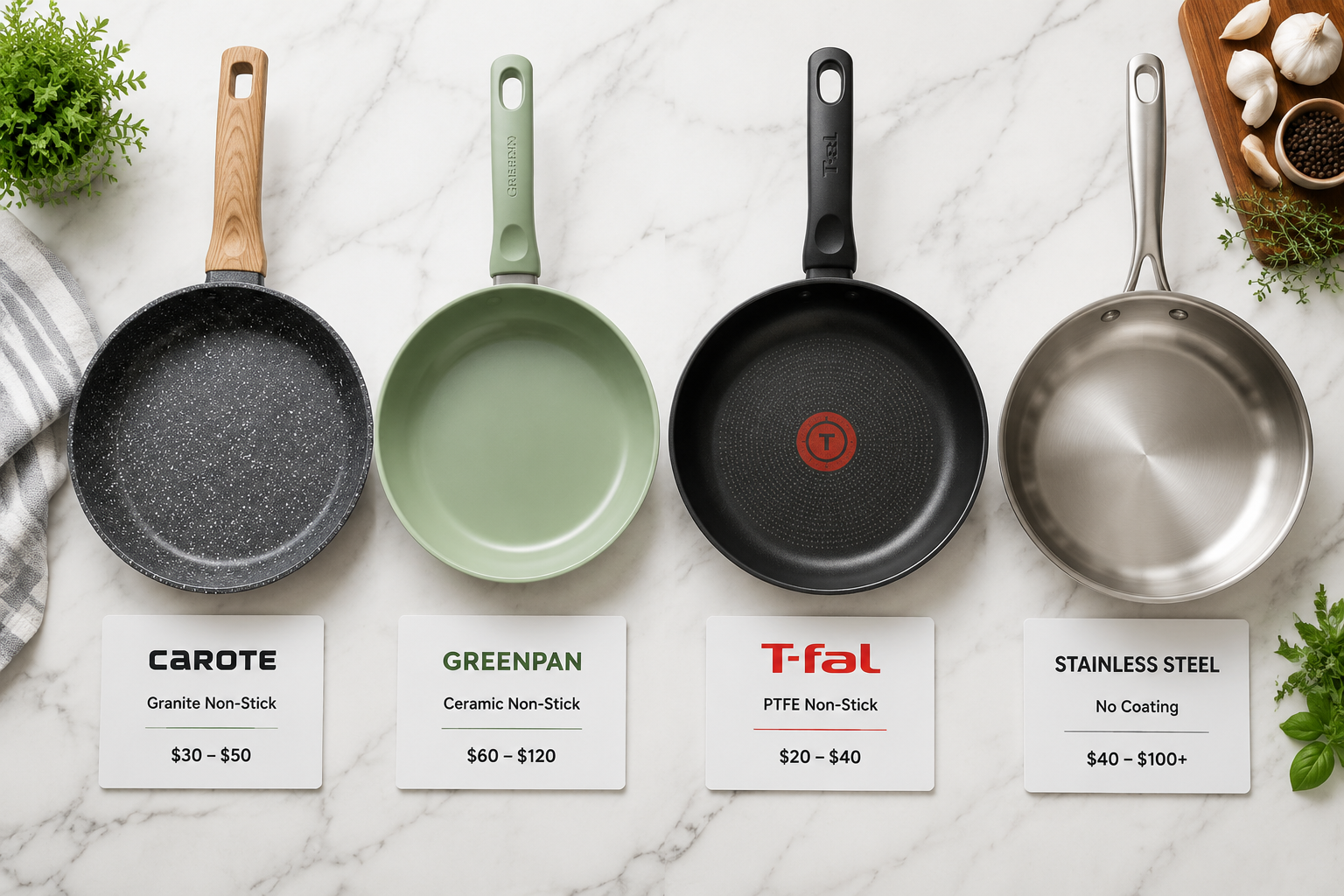
Carote occupies a specific position in the nonstick market: affordable aluminum-base construction with granite or ceramic coating, priced below premium brands but above basic store-brand options.
Ready to see current pricing and available sets? Check Carote cookware on Amazon
| Brand | Base Material | Coating Type | PTFE-Free | Approx. Price (10-pc set) |
|---|---|---|---|---|
| Carote (Granite line) | Die-cast aluminum | PTFE (PFOA/PFOS-free) | No | $50-$80 |
| Carote (Ceramic line) | Die-cast aluminum | Ceramic (PFAS-free) | Yes | $70-$100 |
| GreenPan | Hard-anodized aluminum | Thermolon ceramic | Yes | $150-$250 |
| T-fal | Aluminum | PTFE (PFOA-free) | No | $60-$120 |
| Our Place | Aluminum | Ceramic | Yes | $195+ |
| Tramontina | Aluminum or stainless | PTFE or stainless | Varies | $80-$200 |
Carote vs. T-fal: Both use aluminum bases with PTFE coatings free of PFOA. T-fal has a longer track record in the US market and slightly more third-party review data.
Carote edges ahead on the detachable handle design and aesthetic variety. For a detailed look at T-fal’s stainless alternative, see our T-fal stainless steel cookware set review.
Carote vs. GreenPan: GreenPan uses Thermolon, a proprietary ceramic coating with no PTFE at all, independently positioned as the safer choice for buyers who want complete PFAS avoidance.
Carote’s granite line does not match that standard, though the ceramic Carote line comes closer. GreenPan costs roughly two to three times more.
The China manufacturing question: Carote is manufactured in China. This prompts skepticism from some buyers, but manufacturing origin alone does not determine quality. Many premium Western brands also produce in China.
What matters is quality control, certification compliance, and material sourcing — areas where Carote performs adequately for its price tier, though independent audits beyond manufacturer-reported certifications are limited.
How Long Does Carote Cookware Last?
With proper care, Carote cookware typically lasts 2-4 years before noticeable coating degradation. This lifespan is consistent with most mid-range nonstick cookware and is not a weakness unique to Carote.
Factors that shorten lifespan:
- Using metal utensils (scratches accelerate coating breakdown)
- Running through the dishwasher regularly (harsh detergents degrade the nonstick layer faster than hand washing)
- Cooking on high heat consistently
- Stacking pans without protective padding between them
Factors that extend lifespan:
- Using silicone, wood, or nylon utensils exclusively
- Hand washing with mild soap and a soft sponge
- Storing with pan protectors or hanging on a rack
- Cooking on low to medium heat only
Our beginner’s guide to durable cookware has a full care and maintenance breakdown that applies directly to Carote-style nonstick pans.
Is Carote Cookware Oven Safe, and at What Temperature?
Carote pans with detachable handles are oven safe up to 450 degrees F (232 degrees C) for the pan body alone. The detachable bakelite handles must always be removed before placing the pan in the oven.
Key oven safety rules for Carote:
- Remove the handle before any oven use — the handle is not rated for oven temperatures.
- Do not use the broiler setting; broiler elements can exceed 550 degrees F and will damage the coating.
- Avoid placing a cold pan into a very hot oven quickly, gradual temperature changes preserve the coating longer.
- Glass lids (included with some sets) are typically rated to 350-400 degrees F; check your specific set’s documentation.
For a broader look at which cookware options handle oven use well, our oven safe cookware guide compares materials and temperature ratings across brands.
Does Carote Cookware Coating Peel Off?
Peeling is the most common complaint in negative Carote reviews, and it does happen, but usually under specific conditions rather than randomly.
When peeling is most likely:
- Dishwasher use over several months weakens the coating bond
- Metal utensils create micro-scratches that eventually cause flaking
- Overheating accelerates coating breakdown, especially in PTFE-based granite lines
- Manufacturing defects, which do occur at a low but nonzero rate in any brand’s production run
What aggregated user feedback shows: Based on patterns across Amazon reviews and Reddit discussions, most peeling complaints involve users who either used metal utensils, ran pans through the dishwasher repeatedly, or cooked on high heat regularly. Users who follow care guidelines report significantly longer coating life with minimal peeling.
What to do if your coating peels: Stop using the pan. While ingesting small flakes of PTFE is generally considered non-toxic (PTFE is chemically inert and passes through the body), a degraded coating no longer performs its non-stick function and may indicate the pan has reached end of life.
Can You Use Metal Utensils on Carote Cookware?
No. Metal utensils will scratch and eventually damage any nonstick coating on Carote pans, whether the coating is PTFE-based or ceramic. Carote recommends silicone, wood, or heat-resistant nylon utensils.
This is not a Carote-specific limitation, it applies to all nonstick cookware. The coating on any non-stick pan, regardless of price, is softer than metal and will show wear from metal contact over time.
Practical utensil guide for Carote:
- Best choice: Silicone spatulas, silicone-tipped tongs, wooden spoons
- Acceptable: Nylon utensils rated above 400 degrees F
- Avoid entirely: Stainless steel spatulas, metal whisks, metal forks used to stir
Is Carote Cookware Dishwasher Safe?
Carote markets some products as dishwasher safe, but hand washing is strongly recommended if you want the coating to last. Dishwasher detergents are alkaline and abrasive over repeated cycles, and the high-heat drying cycle stresses the nonstick layer.
In practice, users who dishwash their Carote pans regularly report noticeable performance decline within 12-18 months. Users who hand wash report coatings holding up well past 2 years.
The rule is simple: if you want the pan to last, wash it by hand with warm water, mild dish soap, and a soft cloth or sponge.
Why Is Carote Cookware So Affordable?
Carote keeps prices low through a combination of manufacturing scale, direct-to-consumer online retail, and aluminum construction, aluminum is significantly cheaper to produce than hard-anodized aluminum, stainless steel, or cast iron.
The brand sells primarily through Amazon and major online retailers, cutting out wholesale distribution markups. Its manufacturing base in China allows for lower labor and production costs compared to European or North American manufacturing.
This does not automatically mean lower quality, it means different trade-offs. You get lightweight, functional nonstick cookware at a low entry price. You accept a shorter coating lifespan than premium brands and less rigorous independent third-party testing verification.
For buyers on a tight budget, our roundup of affordable cookware sets under $100 puts Carote in context alongside other value-tier options.
Who Makes Carote Cookware, and Is It a Reputable Brand?
Carote is a Chinese cookware brand that has grown rapidly through Amazon and e-commerce channels. The company markets primarily in North America, Europe, and Australia. It is not a legacy brand with decades of US market history, but it has built a substantial customer base since the mid-2010s.
The brand holds PFOA-free certifications and references SGS testing (a Swiss-based international testing and certification company) in its marketing materials.
However, independent verification from organizations like Consumer Reports, NSF International, or Good Housekeeping is not publicly documented for Carote’s specific product lines as of 2026.
Carote is a reputable budget brand in the sense that it delivers on its core promises — lightweight, functional nonstick cookware at a low price, for a reasonable period of time. It is not positioned as a premium or heirloom-quality brand, and buyers should calibrate expectations accordingly.
Ready to see current pricing and available sets? Check Carote cookware on Amazon
Carote Cookware: Best for What Type of Cooking?
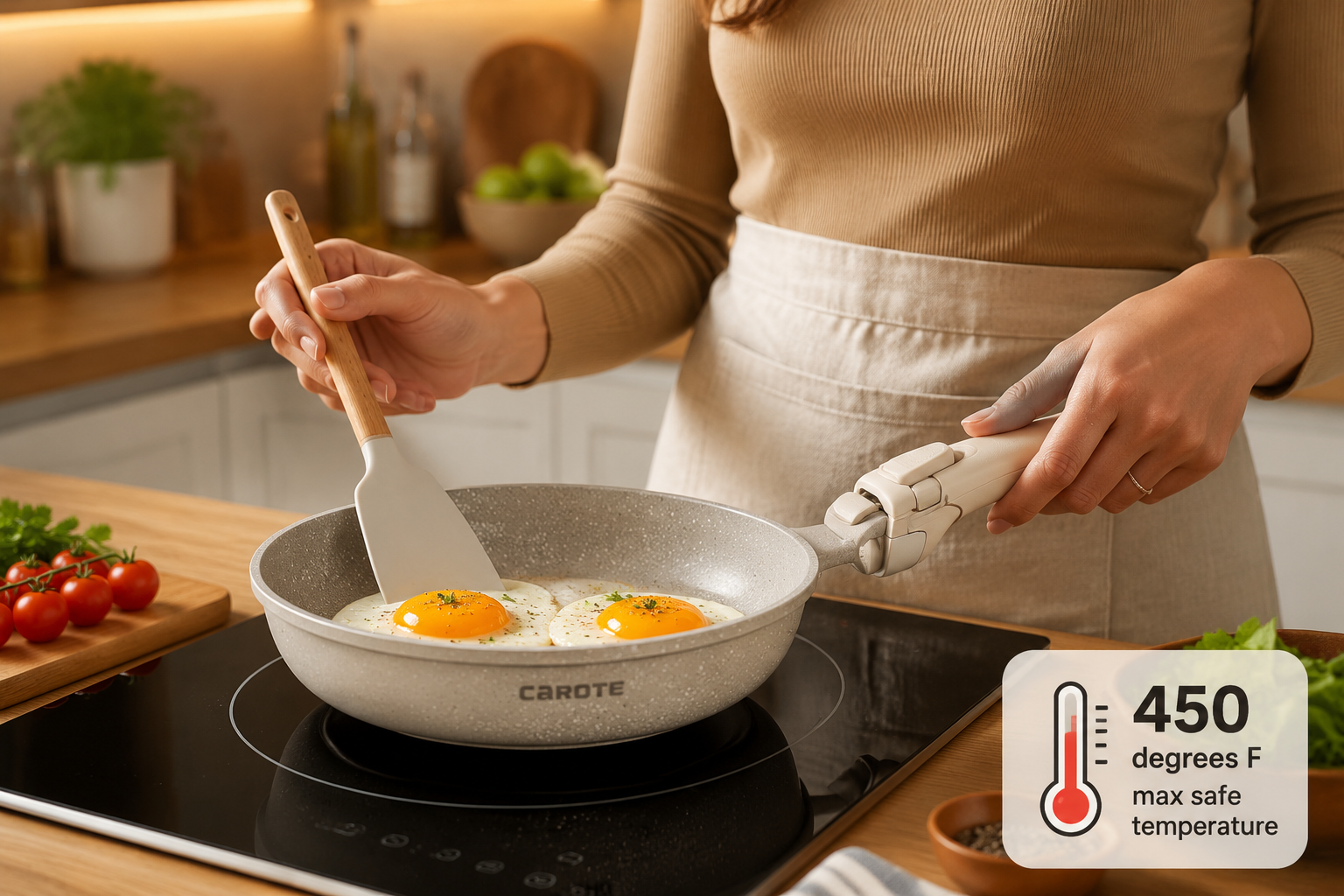
Carote cookware performs best for everyday low-to-medium heat cooking tasks where non-stick release is the priority. It is particularly well suited to:
- Eggs (scrambled, fried, omelets) — the non-stick surface handles delicate proteins well
- Pancakes, crepes, and other batter-based foods
- Sauteed vegetables and light stir-fries
- Reheating leftovers
- Fish fillets that tend to stick on stainless steel
Where Carote is less ideal:
- High-heat searing of steaks or thick proteins (use stainless or cast iron for that)
- Oven roasting at temperatures above 450 degrees F
- Cooking with acidic ingredients over long periods, which can stress the coating
Who it is best for: Carote suits apartment dwellers, small-kitchen households, light home cooks, and anyone transitioning away from older non-stick pans who wants an affordable, space-saving upgrade.
The detachable handle system is a genuine practical advantage — customers consistently highlight how much easier it makes storage in compact kitchens.
For buyers who cook on induction stovetops, Carote’s magnetic stainless steel base makes it compatible — our essential guide to induction cookware explains what to look for when shopping for induction-ready options.
Are There Complaints About Carote Cookware Quality?
Yes, and they follow a predictable pattern. The most common complaints in verified reviews and Reddit discussions center on three issues:
- Coating degradation faster than expected — typically in users who dishwash regularly or use metal utensils
- Handle wobble over time — the detachable handle mechanism can loosen with heavy use, though this is usually fixable
- Uneven heat distribution in larger pans — some users report hot spots in 12-inch and larger skillets
Less common but documented complaints include:
- Coating discoloration after high-heat use
- Lids not fitting perfectly after thermal cycling
- Inconsistent quality between individual units in the same set
The counterbalance: The majority of verified purchasers rate Carote positively, citing the non-stick performance in the first 1-2 years, the visual appeal of the granite finish, and the value relative to price. Complaints are real but concentrated among users who did not follow care guidelines.
Ready to see current pricing and available sets? Check Carote cookware on Amazon
Frequently Asked Questions
Q: Is Carote cookware toxic?
No, Carote cookware is not toxic under normal use. It contains no lead, cadmium, PFOA, or PFOS. PTFE-based Carote lines are safe at cooking temperatures below 480 degrees F. The ceramic lines contain no PTFE at all.
Q: What is the granite coating on Carote pans made of?
The granite coating is a nonstick polymer layer — either PTFE-based or ceramic-derived — applied over aluminum. The speckled granite appearance is purely aesthetic. No actual granite stone is used in the coating.
Q: Does Carote cookware contain PFAS chemicals?
Carote’s granite lines contain PTFE, which is technically a fluoropolymer and part of the broader PFAS chemical family, though it is considered far less harmful than PFOA or PFOS. Carote’s ceramic lines are marketed as fully PFAS-free with no PTFE.
Q: Can Carote pans go in the oven?
Yes, up to 450 degrees F (232 degrees C) with the handle removed. Never use the broiler or exceed this temperature.
Q: How do I know if my Carote pan is PTFE-based or ceramic?
Check the product listing. Carote’s “granite” or “stone” labeled pans typically use PTFE. Products explicitly labeled “ceramic” or “PFAS-free” use ceramic nonstick. When in doubt, contact the seller or check Carote’s product page directly.
What Is Carote Cookware Made Of: FAQs
Q: Is Carote cookware induction compatible?
Yes. All current Carote sets include a magnetic stainless steel disc bonded to the base, making them compatible with induction stovetops.
Q: How do I make my Carote pan last longer?
Use silicone or wood utensils, cook on low to medium heat, hand wash with mild soap, and store with pan protectors between stacked pans.
Q: Is Carote FDA certified?
Carote claims compliance with FDA food contact surface standards and references SGS certification. Independent verification from third-party organizations like NSF International is not publicly documented as of 2026.
Q: What happens when the Carote coating wears out?
The pan loses its non-stick properties and food begins to stick. If the coating is visibly peeling or flaking, replace the pan. Ingesting small PTFE flakes is generally considered non-toxic, but a degraded pan no longer functions as intended.
Q: Is Carote good for beginners?
Yes. The lightweight construction, non-stick surface, and affordable price make Carote a practical starting point for new home cooks who are not yet ready to invest in premium cookware.
Conclusion
Understanding What Is Carote Cookware Made Of cuts through a lot of marketing noise. The core is die-cast aluminum, lightweight, fast-heating, and cost-effective.
The nonstick coating is either a PTFE-based granite-style layer (PFOA and PFOS-free) or a fully ceramic coating depending on the product line. A magnetic stainless steel base handles induction compatibility.
For most everyday home cooks, Carote delivers real value: functional non-stick performance, appealing aesthetics, and a genuinely useful detachable handle system, all at a price that does not require significant financial commitment.
The trade-off is a coating lifespan of roughly 2-4 years under proper care, and less independent third-party safety verification than premium brands offer.
Actionable next steps:
- If you want zero PTFE, choose Carote’s ceramic-labeled lines specifically, not the granite ones.
- Commit to hand washing and silicone utensils from day one, this single habit extends coating life more than any other factor.
- Avoid preheating empty pans on high heat; this is the fastest way to degrade any nonstick coating.
- If you are comparing Carote to a higher-end brand, calculate the cost per year of use rather than just the sticker price, Carote’s lower upfront cost often makes it competitive even accounting for a shorter lifespan.
Ready to see current pricing and available sets? Check Carote cookware on Amazon to compare today’s options and read verified customer reviews.
For more context on how Carote fits into the broader non-toxic cookware landscape, our complete Carote cookware set guide and non-toxic cookware sets overview are useful next reads.